C-5.1 Describe Documentation Encountered in the Pipe Trades
Manufacturers’ Instructions
To perform piping work, it is essential to have the right tools. Piping contractors fully appreciate the complexity of these tools and the importance of manufacturers’ documentation for completing a job correctly.
Most appliances and plumbing components are supplied with manufacturers’ instructions. These provide information on installation, service, and maintenance requirements. Once equipment is installed, these instructions should be left with the customer for future reference. Depending on the type of equipment or component, user instructions may also be included.
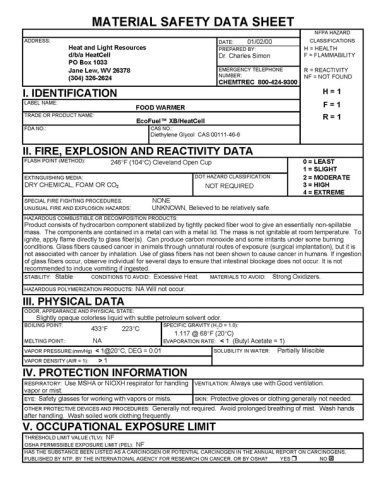
Safety Data Sheets
A Safety Data Sheet (SDS) is a technical bulletin that provides specific hazard information, safe handling information, and emergency procedures for a controlled product. Since the SDS contains detailed health and safety information specific to each controlled product, it should be used as a key source of information for developing training programs and safe work procedures.
Documentation of Hazards in Piping
A number of hazards are present when working with piping. The SDS may provide cautions and specific information about responding to a range of hazards such as:
- Exposure to asbestos during installation, removal, or repair of pipes in buildings contaminated with asbestos.
- Exposure to lead during installation or removal of lead pipes and while working with lead-based solder.
- Exposure to welding fumes, ultraviolet light, heavy metals, and chlorinated compounds during welding or torch cutting.
- Contact with solvents, adhesives, and epoxies during repair or installation of PVC/ABS pipes.
- Exposure to materials and liquids in old pipes during repair or removal.
- Exposure to exhaust fumes from gas- or diesel-powered equipment.
- Awkward postures, vibration, and hazardous noise while using power tools, grinders, saws, and mobile equipment.
- Dust exposure on construction sites and from grinding activities.
- Contact with biological materials in pipes and drains.
- Exposure to hazardous materials from industrial work sites.
It is the employer’s responsibility to ensure workers are adequately educated and trained. If the employer cannot provide the required education, training consultants can be employed to provide it. Education covers information about the product, while training must include how to safely use the product.
System Component Documentation
Technical documentation is the generic term for documentation related to a product. People mainly associate the term with documents and information that are provided to the public by the manufacturer, which typically include:
- User instructions
- Operating instructions
- Servicing instructions
- Installation manuals
Proprietary Component Documentation
A proprietary technology or product is one for which the technology or the product’s inner workings are owned and carefully guarded by a company. Some proprietary products can only function properly, if at all, when used with other products made by the same company.
A primary motivation behind the development of products using proprietary technology is straightforward: buyers are compelled to use other products marketed by the same company. For example, some building automation system (BAS) manufacturers use proprietary communication protocols that will communicate only with their own control equipment. These protocols don’t allow easy intercommunication with other brands of BAS. That is one reason why this type of system is rapidly disappearing from the marketplace. Because a proprietary system does not communicate with other systems, the user’s options for expanding the BAS are limited. Choices are also reduced for the purchase of new equipment, which limits the user’s bargaining power. However, proprietary systems do offer the advantage of a single source of responsibility when problems occur.
Plumbing Product Certification
The Canadian Institute of Plumbing and Heating (CIPH), in conjunction with provincial/territorial plumbing inspectors, recently found it necessary to provide an industry bulletin on the distribution and installation of uncertified plumbing products.
Uncertified products are being inappropriately sold and installed in all jurisdictions of Canada. In many instances, this is creating health and safety issues. There is a myth that all plumbing products sold through the wholesale chain are suitable for sale and installation. There is no jurisdiction in Canada that allows uncertified products to knowingly be installed. In fact, Alberta and Quebec both have legislation against the sale of such products.
All certified plumbing products are required to bear a certification mark. Figure 2 shows some examples.
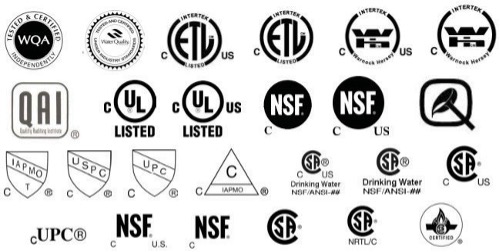
Some fixture manufacturers acknowledge that customers want an aesthetic that is mark-free and choose to mark their product with an adhesive label that is designed to be removed after inspection and to self-destruct so that it cannot be placed on another product. If the permanent adhesive label is accidentally removed prior to inspection, the inspector has no choice but to assume the product is uncertified and request its removal.
Therefore, wholesalers need to educate contractors to keep proof of the product’s certification compliance on the product (in addition to the carton, installation instructions, warranty, homeowner’s manual, and specification sheet) until AFTER inspection.
Certified products offer several advantages:
- They are more reliable and have been produced using a demonstrated quality program.
- They have been evaluated to ensure they will perform properly (e.g., ensuring threads are the correct type for proper connection).
- They are regularly checked for compliance by accredited certification organizations to ensure they continue to be manufactured in accordance with national standards.
- Where required, they have been evaluated for toxicological concerns.

Self-Test C-5.1: Describe Documentation Encountered in the Pipe Trades
Complete Self-Test C-5.1 and check your answers.
If you are using a printed copy, please find Self-Test C-5.1 and Answer Key at the end of this section. If you prefer, you can scan the QR code with your digital device to go directly to the interactive Self-Test.
References
BC Industry Training Authority. (2019). Piping trades apprenticeship program: Use Tools and Equipment—Level 1 harmonized [Binder]. Crown Publications, Queen’s Printer for British Columbia. https://www.crownpub.bc.ca/Product/Details/7960000261_S
- Plumber: Level 2 Competency C-4 Use Manufacturer and Supplier Documentation
- Steamfitter: Level 2 Competency C-4 Use Manufacturer and Supplier Documentation
- Sprinkler Fitter: Level 1 Competency C-4 Use Manufacturer and Supplier Documentation
Camosun College. (2019). Line D: Organizational Skills —Competency D-5: Use Manufacturer and Supplier Documentation (Rev. ed.) [Learning guide]. BCcampus. https://collection.bccampus.ca/textbook/9MgG7bwy/
Camosun College. (2015). Trades Access Common Core Competency D-5: Use Manufacturer and Supplier Documentation. Victoria, B.C.: Crown Publications. Download for free from the B.C. Open Textbook Collection (https://open.bccampus.ca/browse-ourcollection/find-open-textbooks/).
Canadian Institute of Plumbing and Heating. (n.d.). Canadian Institute of Plumbing and Heating. https://www.ciph.com/
Media Attributions
All figures are sourced from Industry Training Authority (2019) and/or Camosun College (2019) and are used under the Creative Commons Attribution 4.0 (CC BY 4.0) licence unless otherwise noted. Images copyrighted by the BC Industry Training Authority are licensed under a Creative Commons Attribution-NonCommercial-ShareAlike 4.0 (CC BY-NC-SA 4.0) licence.
- Figure 1 MSDS Sheet, by sid on Flickr is used under a CC BY-NC-ND license.
A company that makes products or equipment. (Section C-5.1)
Taking care of equipment to keep it working properly. (Section C-5.1)
A document that explains how to safely use a product and what dangers it may have. (Section C-5.1)
Something that can cause harm or danger. (Section C-5.1)
A product that may be dangerous and needs safety information. (Section C-5.1)
Learning how to do a job safely and correctly. (Section C-5.1)
Written information that explains how to install, use, or fix a product. (Section C-5.1)
Something owned by a company that others cannot use freely. (Section C-5.1)
Products that have not been tested or approved by an official organization to show they are safe and meet required standards. (Section C-5.1)
A symbol on a product that shows it has been tested and approved. (Section C-5.1)
Proof that something meets certain rules or standards. (Section C-4.1; Section C-5.1)