C-1.12 Use Pascal’s Theory of Pressure and Force
Blaise Pascal and Pascal’s Law
Blaise Pascal was a noted French mathematician who discovered that a closed container of fluid could be used to transfer force from one place to another, or to multiply force by its transmission through a fluid. This seemingly innocuous principle led to the development of the hydraulic press and the science of modern hydraulics, which studies the mechanical properties and uses of liquids. In honour of his discovery, the unit of pressure in the metric system is called the pascal (Pa), and hydraulics is described using Pascal’s law.
According to Pascal’s law, any force applied to a confined fluid is transmitted in all directions throughout the fluid, regardless of the shape of the container. To understand how Pascal’s law applies to hydraulics, imagine an enclosed fluid as shown in Figure 1.
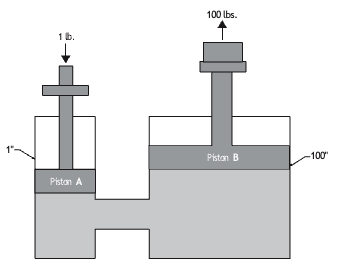
The enclosure has two movable pistons. Now imagine that piston A has a cross-sectional area of 1 in² and piston B has a cross-sectional area of 100 in². If a 1 lb force pushes piston A into the fluid, this produces a pressure of 1 [latex]\frac{\text{lb}}{\text{in}^2}[/latex], or 1 psi. This pressure is transmitted through the enclosure to piston B. This 1 psi pressure acts on piston B, which has an area of 100 in². As a result, a force of 100 lb is produced, which can support a 100 lb load at the same height.
As stated earlier, Pascal’s law is independent of the shape of the container. The connecting tube does not need to match the size of the pistons. A connection of any size, shape, or length will work, as long as there is an unobstructed passage for the fluid.
This principle allows large forces to be generated with relatively little effort. Large pieces of earth-moving equipment, for example, use hydraulics to exert large forces on soil or boulders. Hydraulic devices all depend on Pascal’s law and the relationship among pressure, force, and area.
Pressure, Force, and Area
There is a mathematical relationship between pressure, force, and area. To understand this relationship, study the formulas below:
[latex]\quad F = P \times A\ \quad P = \frac{F}{A}\ \quad A = \frac{F}{P}[/latex]
[latex]\quad\text{F(force)} = \text{P(pressure)} \times \text{A(area)}\\ \quad\text{P(pressure)} = \frac{\text{F(force)}}{\text{A(area)}}\\ \quad\text{A(area)} = \frac{\text{F(force)}}{\text{P(pressure)}}[/latex]
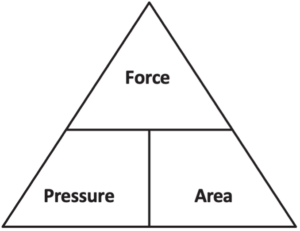
The triangle shown in Figure 2 is a convenient memory device for these formulas. Because force is above the line, it reminds you that in division formulas, force is divided by one of the other two factors.
Force is measured using the standard metric unit, newton (N). The term newton is abbreviated as the letter N in most formulas; “10.0 N” would represent 10.0 newtons of force. One newton is the amount of force required to give a 1 kg mass an acceleration of [latex]1 \frac{\text{metre}}{\text{second}^2}[/latex].
In the imperial system, the term pound (lb) is used as a unit of force.
The Units of Pressure
Pressure is defined as force divided by the area over which the force is evenly distributed. Since liquids and gases are fluids, they exert pressure on their containers evenly.
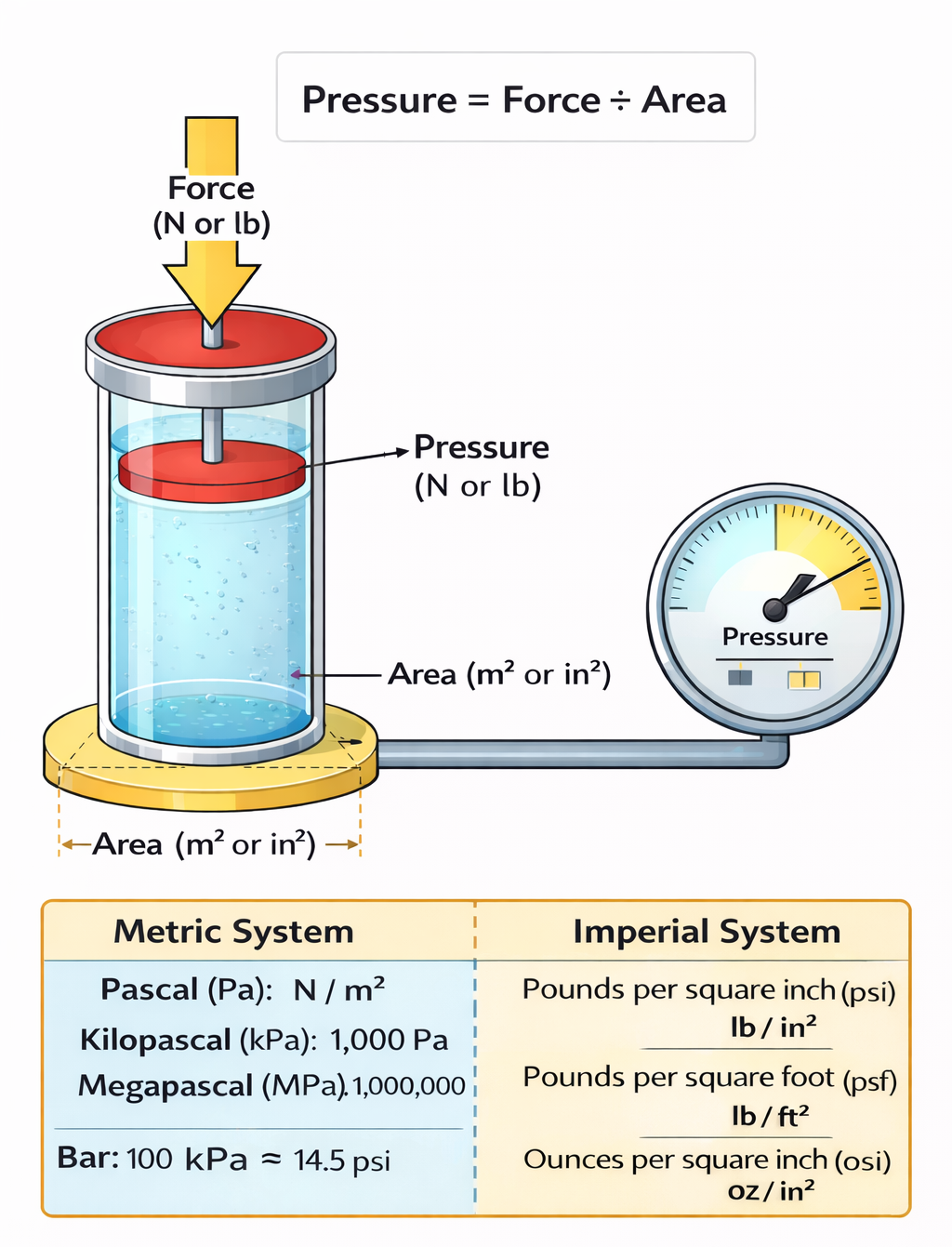
The metric system measures pressure in newtons (force) per square metre (area); these pressure units are called pascals (Pa). Pascals are such small units of pressure that it is more common to actually use units like kilopascals or megapascals (kPa or MPa), which are 1,000 and 1,000,000 pascals, respectively.
Also found in the metric system is the bar. This unit is not approved by the International System of Units (SI) but is recognized in the European Union, and is equal to 100 kPa, or approximately 14.5 psig.
In the imperial system, pressure is commonly measured in units of pounds per square inch (psi), or pounds per square foot (psf) pounds per square inch (psi), pounds per square foot (psf), or ounces per square inch (osi).
Remember that there are three distinct types of pressure, each described by specific units, as follows:
- Absolute pressure is the actual pressure of a fluid with respect to a perfect vacuum. Absolute pressure is gauge pressure plus atmospheric pressure.
- Gauge pressure is the fluid pressure with respect to the atmospheric pressure outside its container. Gauge pressure does not include atmospheric pressure.
- Differential pressure is the difference between any two pressures. Notice that gauge pressure is actually a differential pressure between absolute pressure and atmospheric pressure.
The metric system does not distinguish between absolute and gauge pressure; therefore, it is always necessary to spell it out as kPa abs, kPa gauge and perhaps kPa diff. In the imperial system, the abbreviations psig, psia, and psid clearly describe the pressure type intended.
The Units of Area
Depending on what system you are working in, area is measured in units of:
- square inch (in2)
- square foot (ft2)
- square centimetre (cm2)
- square metre (m2)
Example 1:
A box weighs 170 N, and its base has an area of 2.2 m2. What pressure does it exert on the floor?
Solution:
[latex]\quad\text{Pressure} = \frac{\text{Force}}{\text{Area}}\\ \quad\text{Pressure} = \frac{170\text{ N}}{2.2\text{ m}^2} = \frac{77.27\text{ N}}{1\text{ m}^2}\\ \quad\text{Pressure} = 77.27\text{ Pa}[/latex]
Answer:
[latex]\quad77.27\text{ Pa}[/latex]
Example 2:
What is the area of a surface when the pressure is 15 Pa and the force applied on it is 300 N?
Solution:
[latex]\quad\text{Area} = \frac{\text{Force}}{\text{Pressure}}\\ \quad\text{Area} = \frac{300\text{ N}}{15\text{ Pa}}\\ \quad\text{Area} = 20\text{ m}^2[/latex]
Answer:
[latex]\quad20\text{ m}^2[/latex]
Example 3:
What is the force when 82 kPa of pressure is applied to a surface area of 1.3 m2?
Solution:
[latex]\quad\text{Force} = \text{Pressure} \times \text{Area}\\ \quad\text{Force} = 82,000\text{ Pa} \times 1.3\text{ m}^2[/latex]
Answer:
[latex]\quad106,600\text{ N force}[/latex]
Example 4:
A boiler weighs 850 lb, and its base has an area of 420 in2 What pressure does it exert on the floor?
Solution:
[latex]\quad\text{Pressure} = \frac{\text{Force}}{\text{Area}}\\ \quad\text{Pressure} = \frac{850\text{ lb}}{420\text{ in}^2}\\ \quad\text{Pressure} = 2.02 \frac{\text{ lb}}{\text{ in}^2}[/latex]
Answer:
[latex]\quad2.02\text{ psi}[/latex]
Example 5:
What is the area of the bottom of a tank when the pressure at the bottom is 17 psi and the weight of the fluid is 9,450 lb?
Solution:
[latex]\quad\text{Area} = \frac{\text{Force}}{\text{Pressure}}\\ \quad\text{Area} = \frac{9,450\text{ lb}}{17\text{ psi}}\\ \quad\text{Area} = 555.88\text{ in}^2[/latex]
Answer:
[latex]\quad555.88\text{ in}^2[/latex]
Example 6:
What is the force exerted on an expansion tank diaphragm with an area of 1.25 ft2 when 15 psi of system pressure is applied to it? (Note: 1 ft2 = 144 in2)
Solution:
[latex]\quad\text{Force} = \text{Pressure} \times \text{Area}\\ \quad\text{Force} = 15\frac{\text{lb}}{\text{ in}^2} \times 1.25\text{ ft.}^2\\ \quad\text{Force} = 15\frac{\text{lb}}{\text{ in}^2} \times 180\text{ in}^2\\ \quad\text{Force} = 2,700\text{ lb}[/latex]
Answer:
[latex]\quad2,700\text{ lb force}[/latex]
Elements of Hydrostatics
Pressure in a Liquid
As the name suggests, hydrostatics is that branch of physics concerned with the properties of water at rest. It is particularly concerned with how pressure is transmitted through fluids in closed and open containers.
The key principles of hydrostatics are as follows:
- Fluid pressure is exerted in all directions.
- The shape of the container does not affect fluid pressure.
- Fluid pressure is proportional to the depth below the surface; pressure increases with depth
- Fluid pressure is proportional to density; pressure depends on density
- Horizontal runs do not increase pressure.
- The volume of fluid does not affect pressure.
Let us examine each of these principles in more detail.
Fluid Pressure is Exerted in all Directions
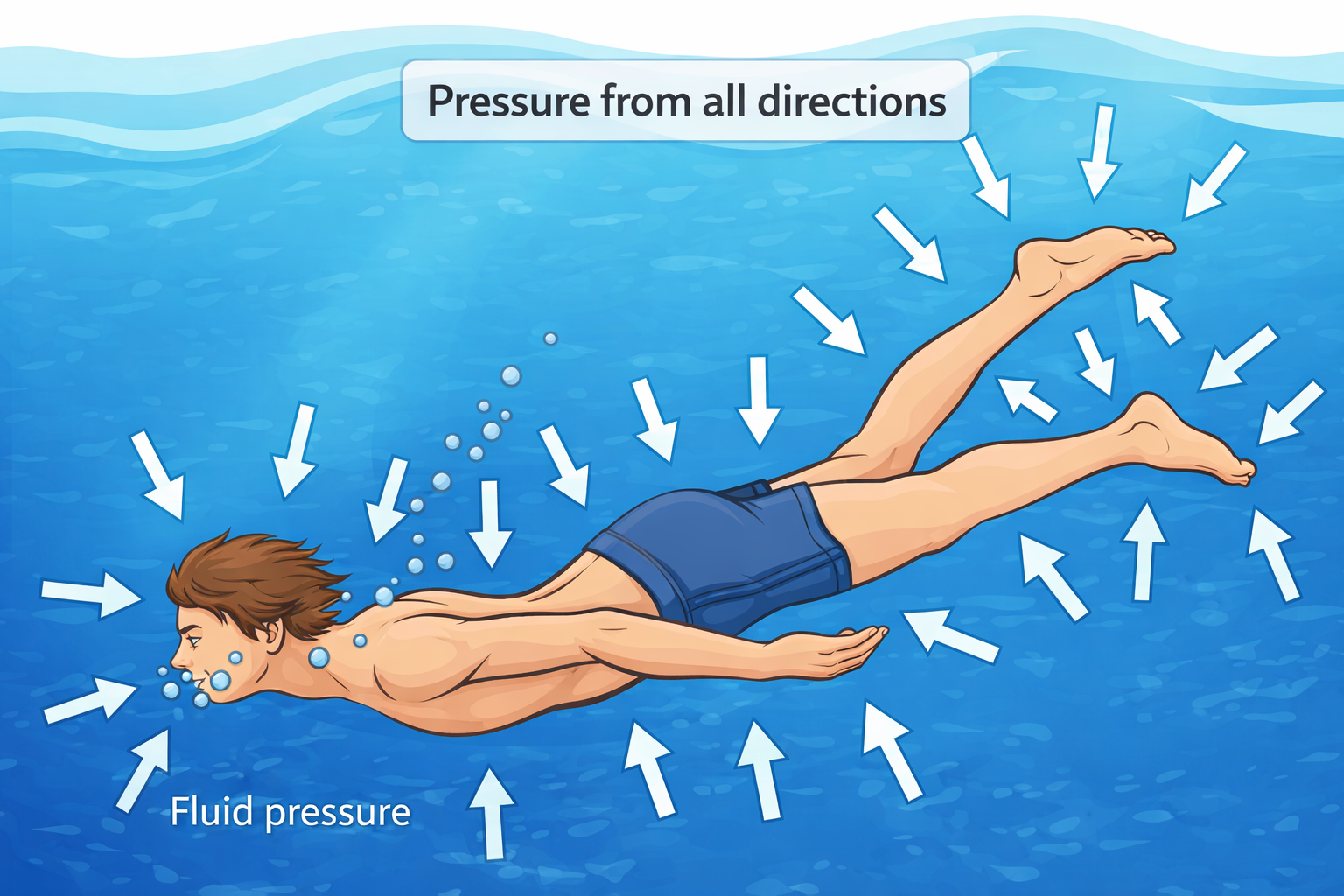
The pressure a fluid exerts on an object is applied in all directions. That is because the particles that make up the fluid can move in any direction. These particles exert forces as they bump into objects in the fluid. Figure 4 shows how water exerts pressure on a swimmer who is underwater. Notice that the arrows point in different directions. That is because the water is pressing all around the swimmer, not just from above.
The Shape of the Vessel Does Not Affect Fluid Pressure
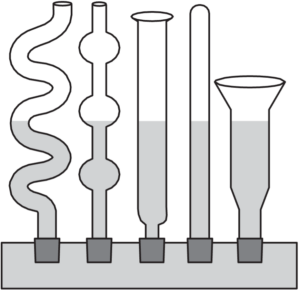
Fluids will conform to the shape of the container that they are placed into, and because of that, they will exert pressure outward against the container (Figure 5). The pressure increases as more fluid is added and is greater toward the bottom of the container, where the weight of the liquid has the most effect. In terms of fluid dynamics, gases can also be considered fluids in terms of their effects on containers, since they also conform to the container and exert pressure in the same way as liquids.
Fluid Pressure is Proportional to Depth Below the Surface
The force of gravity pulls fluids downward. Because any given volume has a certain weight, this weight pushes downward on whatever is below it. Fluid pressure is the result of the weight of all the fluid above pushing down on the fluid below. As you go deeper, there is a greater weight pushing down (Figure 6). This is the reason water pressure increases with depth. The pressure depends only upon the depth and is the same anywhere at a given depth and in every direction.
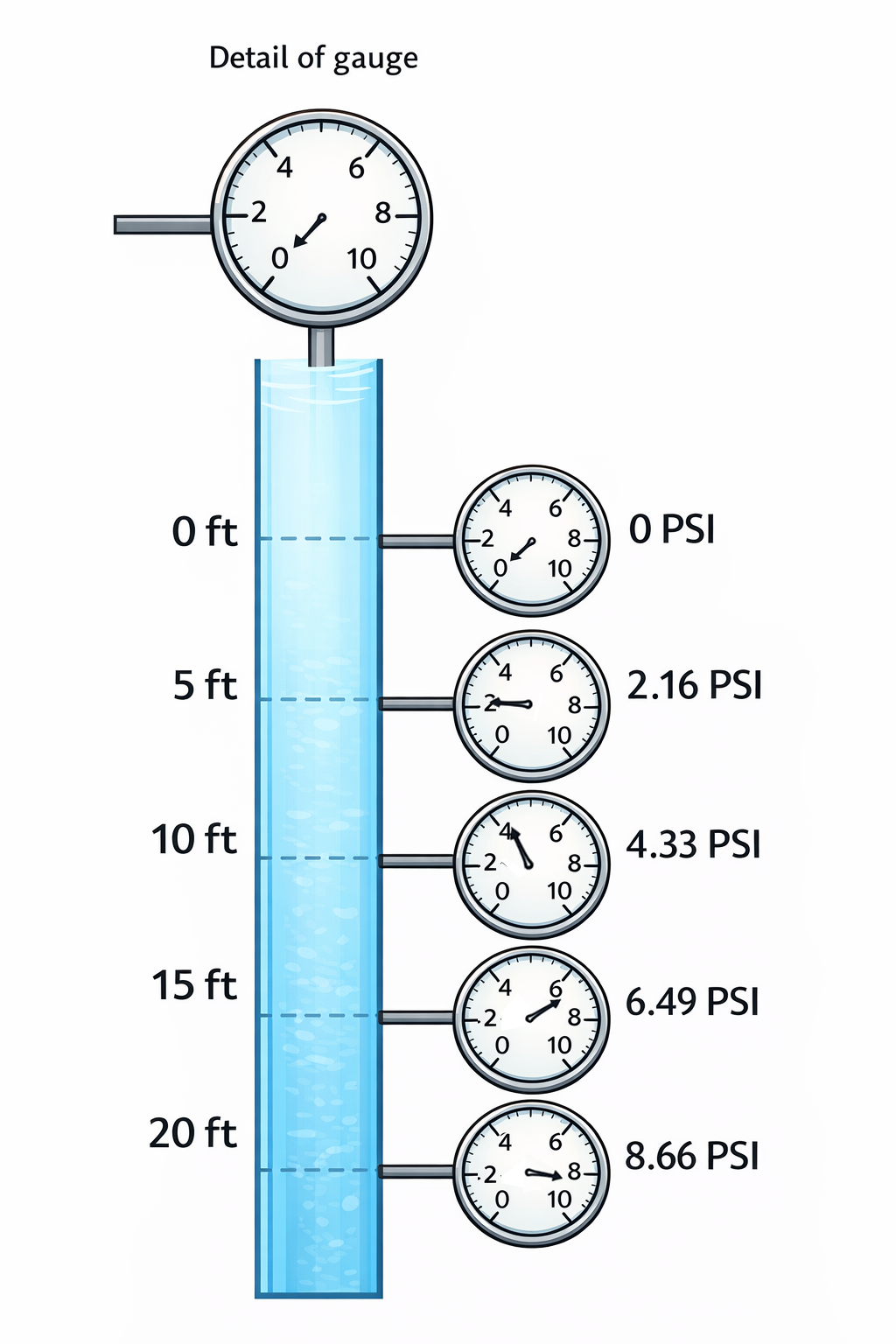
Water has a density of [latex]62.4 \frac{\text{lb}}{\text{ ft}^3}[/latex] As the depth increases, the pressure exerted on the sides of the vessel increases by approximately 0.433 psi per foot of depth.
Fluid Pressure is Proportional to Density
Another factor that changes pressure is the density of the liquid. This can be expressed as follows:
[latex]\quad\text{Pressure} = \text{Height (in feet)} \times \text{density (per foot depth)}[/latex]
Example:
Two vessels are filled to the same height with different fluids. One contains a liquid having a density of [latex]124.8 \frac{\text{lb}}{\text{ ft.}^3}[/latex] and the other contains water, which has a density of [latex]62.4 \frac{\text{lb}}{\text{ ft.}^3}[/latex].
The pressure at the bottom of the vessel containing the more dense fluid would be double the pressure at the bottom of the one containing water. This is because, due to its density, the fluid in the one column weighs twice as much as the water. Therefore the pressure is also double.
Because the heavier fluid has a density exactly twice that of water, it would be described as having a specific gravity (SG) of 2. (Remember: the SG of a liquid or solid is compared to an equal volume of water.)
You can calculate the pressure exerted by any fluid if you know its specific gravity. Then multiply the SG by the pressure that water would exert for any specific depth.
Example:
Find the pressure exerted by a column of mercury 10 ft in depth.
Solution:
Because the specific gravity of mercury is 13.6, mercury exerts a pressure 13.6 times greater than that exerted by a column of water 10 ft in depth.
Water 10 ft in depth would exert:
[latex]\quad0.433 \frac{\text{psi}}{\text{ ft.}} \times 10 \text{ ft.} = 4.33 \text{ psi}[/latex]
Therefore mercury 10 ft in depth would exert:
[latex]\quad4.33 \text{ psi} \times 13.6 = 58.88 \text{ psi}[/latex]
Horizontal Runs Do Not Increase Pressure
As pressure is exerted equally in all directions, horizontal runs cannot affect pressure. Only a change in the vertical component will change the pressure at the base of a liquid-filled piping arrangement.
The Volume of Fluid Does Not Affect Pressure
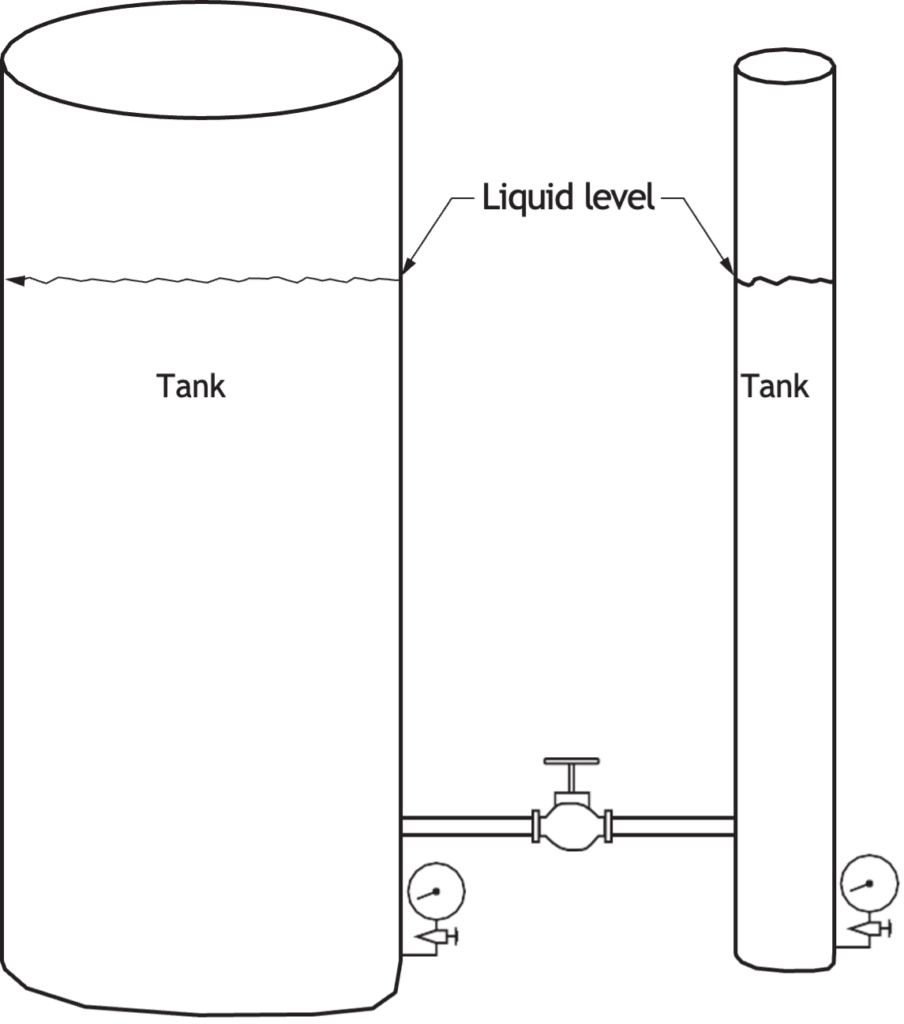
So far, we have discussed that the only two factors that affect pressure are the height and density of the fluid. Therefore, the total volume of the fluid does not affect pressure, as pressure always references a specific area. In Figure 7, storage tank No. 1 contains a greater volume of fluid than tank No. 2, but the pressure at the base is identical in both tanks (both gauges read pressure in pounds over 1 square inch). If the valve that joins the two tanks at the bottom was opened, the fluid from tank No. 1 would not enter into tank No. 2. Because fluids always seek their own level, the level in tank No. 1 cannot be different from the level in tank No. 2.
Hydrostatic Pressure Test
Hydrostatics is the study of fluids under pressure and at rest. When a hydrostatic pressure test is applied on a piping system, the piping is filled with water or other compatible liquid and then pressurized with a pump. To be proficient at this procedure, you must be able to calculate a pressure or to calculate the height of a water column needed to produce a certain pressure (known as feet of head).
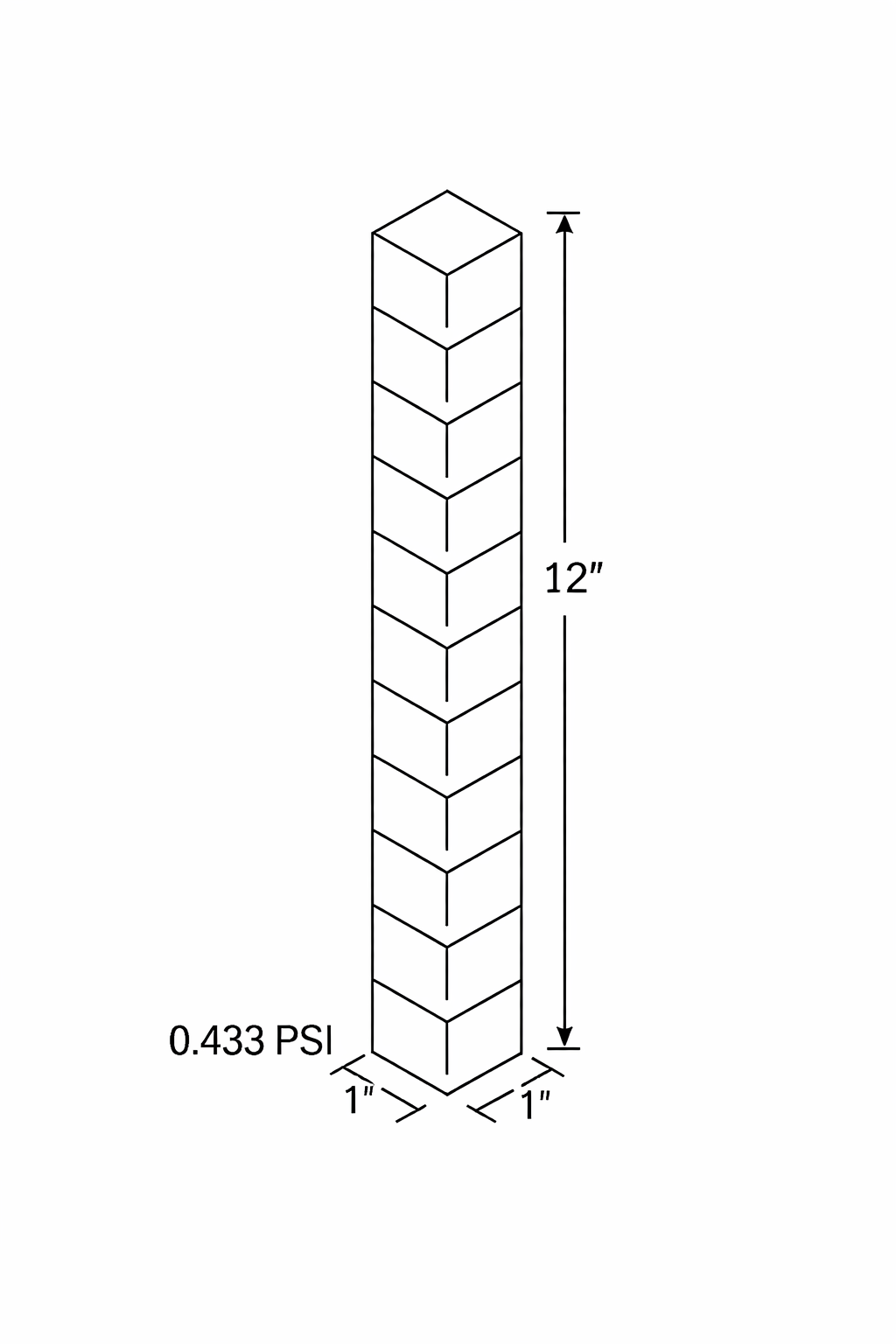
As stated previously, water has a density of [latex]62.4 \frac{\text{lb}}{\text{ ft.}^3}[/latex] This means that 1 cubic foot of water exerts a force of 62.4 lb on its 1 ft² base. Because each side of a cubic foot is equal to 144 in2, the force of the water is spread equally over all 144 square inches. The result would be 0.433 pounds of water exerting a force on each square inch of bottom surface:
[latex]\quad\frac{62.4 \text{ lb}}{144 \text{ in}^2} = 0.433 \frac{\text{lb}}{\text{ in}^2} \text{ (psi)}[/latex]
Or:
[latex]\quad0.0361\frac{\text{lb}}{\text{ in}^3} \times 12\text{ in} = 0.433 \frac{\text{lb}}{\text{ in}^2} \text{ (psi)}[/latex]
The base area of the 1-foot-high column of water in Figure 8 is exactly 1 square inch. Thus, the pressure on the base of the column would be 0.433 psi. This is referred to as 1 foot of head pressure.
[latex]\quad\text{Water pressure (psi)} = 0.433 \frac{\text{psi}}{\text{ ft.}} \times \text{height in feet}[/latex]
Example 1:
What is the pressure in psi exerted by a column of water 15 ft high?
Solution:
If each foot of water column (foot of head) exerts a pressure of 0.433 psi, then 15 ft of head would exert a pressure of:
[latex]\quad15 \text{ ft.} \times 0.433 \frac{\text{psi}}{\text{ft.}} = 6.495 \text{ psi}[/latex]
Example 2:
What is the pressure in psi exerted by a column of mercury 4 ft high?
Solution:
We know that mercury weighs 13.6 times as much as water, so it would produce a pressure 13.6 times greater than an equal column of water. If each foot of head of water exerts a pressure of 0.433 psi, then 4 ft of water head would be:
[latex]\quad4 \text{ ft.} \times 0.433 \frac{\text{psi}}{\text{ft.}} = 1.735 \text{ psi}[/latex]
However, a 4-ft.-high column of mercury would exert a pressure of:
[latex]\quad1.735 \text{ psi} \times 13.6 = 23.555 \text{ psi}[/latex]
|
Commonly Used Values |
Number to Remember |
Origin |
|
One inch water column |
0.0361 psi |
[latex]0.433\frac{\text{psi}}{\text{ft.}} \div 12\text{ in} = 0.0361 \frac{\text{psi}}{\text{in}}[/latex] |
|
One foot head (water) |
0.433 psi |
[latex]62.4\frac{\text{lb}}{\text{ft.}^3} \div 144\frac{\text{in}^2}{\text{ft.}^2} = 0.433\text{ psi}[/latex] |
|
One metre head (water) |
9.81 kPa |
Piping trades workers often use a close approximation of 10[latex]\frac{\text{kPa}}{\text{m}}[/latex] |
|
One inch mercury column |
0.491 psi |
[latex]0.0361\text{ lb} \times 13.6[/latex] |
Calculating Total Force
Force is defined as any interaction that tends to change or influence the motion of an object. Previously, we were calculating the pressure on a single unit of area: in2, ft2, or cm2. This was the force pushing down on a defined unit’s area. The total force the liquid is exerting is equal to the pressure times the total area:
[latex]\quad\text{Force} = \text{Pressure} \times \text{Area}[/latex]
Example 1:
Calculate the total force on a surface when the pressure exerted is 40 psi and the surface has an area of 50 in2
Solution:
[latex]\quad\text{Force} = \text{Pressure} \times \text{Area}\\ \quad\text{Force} = 40\frac{\text{lb}}{\text{ in}^2} \times 50 \text{ in}^2\\ \quad\text{Force} = 2,000\text{ lb}[/latex]
Example 2:
Calculate the total force on the bottom of a storage tank when the depth of water is 20 ft and the diameter of the tank is 8 ft.
Solution:
In this example, we were not given the value for pressure or the area, but we were given enough information to calculate both of them. Once we establish the unknown values, we will use the following formula to calculate force:
[latex]\quad\text{Force} = \text{Pressure} \times \text{Area}[/latex]
First, calculate the pressure at the bottom of the storage tank due to 20 ft of head:
[latex]\quad\text{Pressure} = 0.433\frac{\text{psi}}{\text{ ft.}} \times 20 \text{ ft.}\\ \quad\text{Pressure} = 8.66\text{ psi}[/latex]
Next, calculate the area of the bottom of the storage tank in square inches:
[latex]\quad\text{Area} = \text{D}^2 \times 0.7854\\ \quad\text{Area} = 8^2 \times 0.7854\\ \quad\text{Area} = 50.27 \text{ ft.}^2\\ \quad\text{Area} = 50.27 \text{ ft.}^2 \times 144\frac{\text{ in.}^2}{\text{ ft.}^2} = 7,238.88 \text{ in.}^2[/latex]
Notice that in this example, the area is required to be stated in square inches to match the pressure’s expression in pounds per square inch.
Now calculate the force at the bottom of the storage tank:
[latex]\quad\text{Force} = \text{Pressure} \times \text{Area}\\ \quad\text{Force} = 8.66\frac{\text{lb}}{\text{ in.}^2} \times 7,238.88 \text{ in.}^2\\ \quad\text{Force} = 62,688.7 \text{ lb}[/latex]
Additional Resources
These open resources support essential math skills used in the plumbing trades (Overgaard & Flinn, 2022).
- Math for Trades: Volume 1 (Overgaard & Flinn, 2022)
- Math for Trades: Volume 2 (Overgaard & Flinn, 2022)
- Math for Trades: Volume 3 (Overgaard & Flinn, 2022)
- OER for Trades: Math for Trades (Video collection) (Flinn, 2022)

Self-Test C-1.12: Use Pascal’s Theory of Pressure and Force
Complete Self-Test C-1.12 and check your answers.
If you are using a printed copy, please find Self-Test C-1.12 and Answer Key at the end of this section. If you prefer, you can scan the QR code with your digital device to go directly to the interactive Self-Test.
References
BCcampus. (n.d.). Playlist: Tools and equipment videos. BCcampus MediaSpace. https://media.bccampus.ca/playlist/details/0_3g8xp22x/categoryId/175673 Playlist Details – Trades Access Common Core Line C: Tools and Equipment Videos – BCcampus
BC Industry Training Authority. (2019). Piping trades apprenticeship program: Use Tools and Equipment—Level 1 harmonized [Binder]. Crown Publications, Queen’s Printer for British Columbia. https://www.crownpub.bc.ca/Product/Details/7960000261_S
- Plumber: Competency C-1 Use Mathematics and Science
- Steamfitter: Competency C-1 Use Mathematics and Science
- Sprinkler Fitter: Competency C-1 Use Mathematics and Science
Camosun College. (2019). Line C: Tools and Equipment—Competency D-2 Apply Science Concepts to Trades Applications (Rev. ed.) [Learning guide]. BCcampus. https://collection.bccampus.ca/textbook/fkXxtNTn/
Camosun College. (2015). Trades Access Common Core Competency D-2 Apply Science Concepts to Trades Applications. Victoria, B.C.: Crown Publications. Download for free from the B.C. Open Textbook Collection (https://open.bccampus.ca/browse-ourcollection/find-open-textbooks/).
Camosun Innovates. (2022). Tools and Equipment Videos [Video playlist]. Camosun College/BCcampus. https://camosuninnovates.opened.ca/
Overgaard, M., & Flinn, C. (2022). Math for Trades: Volume 1. BCcampus. https://opentextbc.ca/mathfortrades1/
Overgaard, M., & Flinn, C. (2022). Math for Trades: Volume 2. BCcampus. https://opentextbc.ca/mathfortrades2/
Overgaard, M., & Flinn, C. (2022). Math for Trades: Volume 3. BCcampus. https://opentextbc.ca/mathfortrades3/
Overgaard, M. and Flinn, C. (2022). OER for Trades: Math for Trades [Video collection]. BCcampus MediaSpace. https://media.bccampus.ca/channel/OER%2Bfor%2BTrades%3A%2BMath%2Bfor%2BTrades/175670
Note: these videos align with the open textbooks Math for Trades: Volume 1 and Math for Trades: Volume 2. All videos are by Chad Flinn and available under a Creative Commons Attribution 4.0 Licence.
Media Attributions
All figures are sourced from Industry Training Authority (2019) and/or Camosun College (2019) and are used under the Creative Commons Attribution 4.0 (CC BY 4.0) licence unless otherwise noted. Images copyrighted by the BC Industry Training Authority are licensed under a Creative Commons Attribution-NonCommercial-ShareAlike 4.0 (CC BY-NC-SA 4.0) licence.
- Figure 3 Pressure and measurement systems comparison was created by TRU Open Press using OpenAI (2026), subject to the CC BY-NC-SA license.
- Figure 4 Swimmer subject to pressure from all directions was created by TRU Open Press using OpenAI (2026), adapted from BC Industry Training Authority, 2019; subject to the CC BY-NC-SA license.
- Figure 6 Fluid pressure increases in proportion to depth was created by TRU Open Press using OpenAI (2026), adapted from BC Industry Training Authority, 2019; subject to the CC BY-NC-SA license.
A machine that uses liquid pressure to push or press objects with great force. (Section C-1.14)
The use of liquids under pressure to move things or do work, like lifting heavy objects or powering machines. (Section C-1.12; Section C-1.14)
A rule that says pressure applied to a liquid in a closed space is spread evenly in all directions. (Section C-1.14)
A liquid that is trapped inside a container or system. (Section C-1.4)
A unit used to measure force (or weight) in the imperial system. It tells how heavy something is or how much force is being applied. (Section C-1.12)
A unit used to measure pressure; it is larger than a pascal. (Section C-1.14)
A unit used to measure pressure that equals one million pascals. It is used when pressures are very large. (Section C-1.12)
A unit of pressure in the metric system; 1 bar is equal to 100 kilopascals (kPa) and is close to normal atmospheric pressure. (Section C-1.6, Section C-1.12)
The total pressure, including air pressure from the atmosphere. (Section C-1.16)
(sometimes referred to as overpressure); the pressure measured above atmospheric pressure. (Section C-1.6)
The pressure exerted by the weight of the air surrounding the Earth. (Section C-1.19
(often stated as delta P, or ΔP.); the difference between two pressure measurements. (Section C-1.6)
The study of fluids that are not moving. (Section C-1.13)
How much mass is packed into a certain space; mass per unit volume of a substance; affects whether a fluid rises or sinks during convection. (Section C-1.13; Section C-1.18)
The horizontal length of a pipe. (Section C-1.7)
A test where a system (like pipes or tanks) is filled with water and pressurized to check for leaks and make sure it is strong and safe. (Section C-1.12)
A way to measure pressure based on the height of a column of water. The taller the column of water, the greater the pressure it creates. (Section C-1.12)
The overall push or pull acting on an object. It is found by multiplying the pressure by the area the pressure is acting on. (Section C-1.12)