C-1.20 Describe Characteristics of Hydrocarbon Gases
Hydrocarbon gases are widely used in the gasfitting and piping industries for heating, cooking, and industrial processes. These gases are made up of hydrogen and carbon atoms and behave differently depending on their composition and how they are stored. Understanding the basic characteristics of hydrocarbon gases—such as where they come from, how they are processed, and how they are made safe for use in real applications—is essential for anyone working with natural gas and liquefied petroleum gases.
The three fuel gases most commonly used in the gas industry are natural gas (NG) and two liquefied petroleum (LP) gases—propane and butane. They are part of the group of gases known as hydrocarbons, which are mixtures of hydrogen (H) and carbon (C).
Natural gas occurs in nature as a mixture of methane and other gases. Propane is a byproduct of natural gas processing. Natural gas must be cleaned of impurities before being distributed, and byproducts of this process include hydrocarbons like propane in addition to butane, ethane and pentane. The difference between propane and natural gas in domestic use is mostly their difference in cost, storage considerations and risk factors. There is very little difference, however, in how they perform in appliances for heating, cooking, or drying.
Natural gas, propane and butane are colourless, odourless gases. As a safety measure, a foul-smelling odourant called mercaptan is added to the fuel gas mixture by the gas purveyor so that hazardous gas leaks are detectable.
Gas Chemistry of Natural Gas
Natural gas has two major components:
- Methane = 87.4%
- Ethane = 6.8%
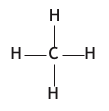
Since most of its content is methane, for convenience, natural gas is usually represented by the chemical formula for methane (CH4). Figure 1 shows the molecular diagram for methane.
Note: In figure 1, the letter C refers to carbon and the letter H refers to hydrogen.
Gas Chemistry of Propane
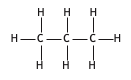
Propane is also a hydrocarbon and is classified as an LP (liquefied petroleum) gas. LP gases are refined, stored and transported as a liquid under moderate temperature and pressure. They are then vaporized prior to use within a gas-burning appliance. Figure 2 shows the chemical structure of a propane molecule (C₃H₈).
Gas Chemistry of Butane
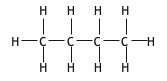
Butane is also a hydrocarbon and, like propane, is classified as an LP gas. Figure 3 shows the chemical structure of a butane molecule (C₄H₁₀).
Heat Content (Calorific Value [CV])
Different fuel gases release different amounts of heat energy when they burn. This energy output is known as the calorific value or heat content of the fuel. Understanding calorific value is important because it affects appliance performance, gas sizing, efficiency, and overall system design.
The table below compares the heat content of natural gas, propane, and butane in several common units. These values show how much heat each fuel produces per unit volume.
|
Fuel Gas |
Calorific Value [latex]\frac{\text{BTU}}{\text{ft.}^3}[/latex] |
Calorific Value [latex]\frac{\text{kW}}{\text{m}^3}[/latex] |
Calorific Value [latex]\frac{\text{kW}}{\text{ft.}^3}[/latex] |
Calorific Value [latex]\frac{\text{BTU}}{\text{m}^3}[/latex] |
|
Natural gas |
1,000 |
10.35 |
0.293 |
35,310 |
|
Propane |
2,500 |
25.86 |
0.732 |
88,275 |
|
Butane |
3,200 |
33.1 |
0.937 |
112,992 |
Specific Gravity
As mentioned earlier in this competency, specific gravity (SG), often termed relative density, is the comparison of the weight of a gas to the weight of an equal volume of air (or water for liquids). All three of the gases covered in this section are used in the combustion process while in the vapour state. It is essential to understand the SG of each gas. Table 2 gives the specific gravity of natural gas, propane, and butane as vapours.
|
Fuel Gas |
Specific Gravity as a Vapour |
|
Natural gas |
0.6 |
|
Propane |
1.5 |
|
Butane |
2.0 |
As the molecular weight of a fuel gas increases, its specific gravity (SG) also increases compared to air. Natural gas has a specific gravity of about 0.6, which means it is lighter than air and will rise toward the ceiling if it leaks. Propane and butane, however, are heavier than air. If an LP-gas leak occurs, the gas can settle and collect in low areas, creating a significant safety hazard.
When these gases are in their liquid state, their specific gravity is compared to water instead of air. Table 3 shows the specific gravity of common fuel gases in liquid form.
|
Fuel Gas |
Specific Gravity as a Liquid |
|
Propane |
0.51 |
|
Butane |
0.58 |
|
Natural gas (LNG) |
0.42–0.50 (approx.) |
Note: Liquefied natural gas (LNG) has a lower specific gravity than water and will float if released in liquid form. However, as it vaporizes, it becomes lighter than air and will rise.
Flame Speed
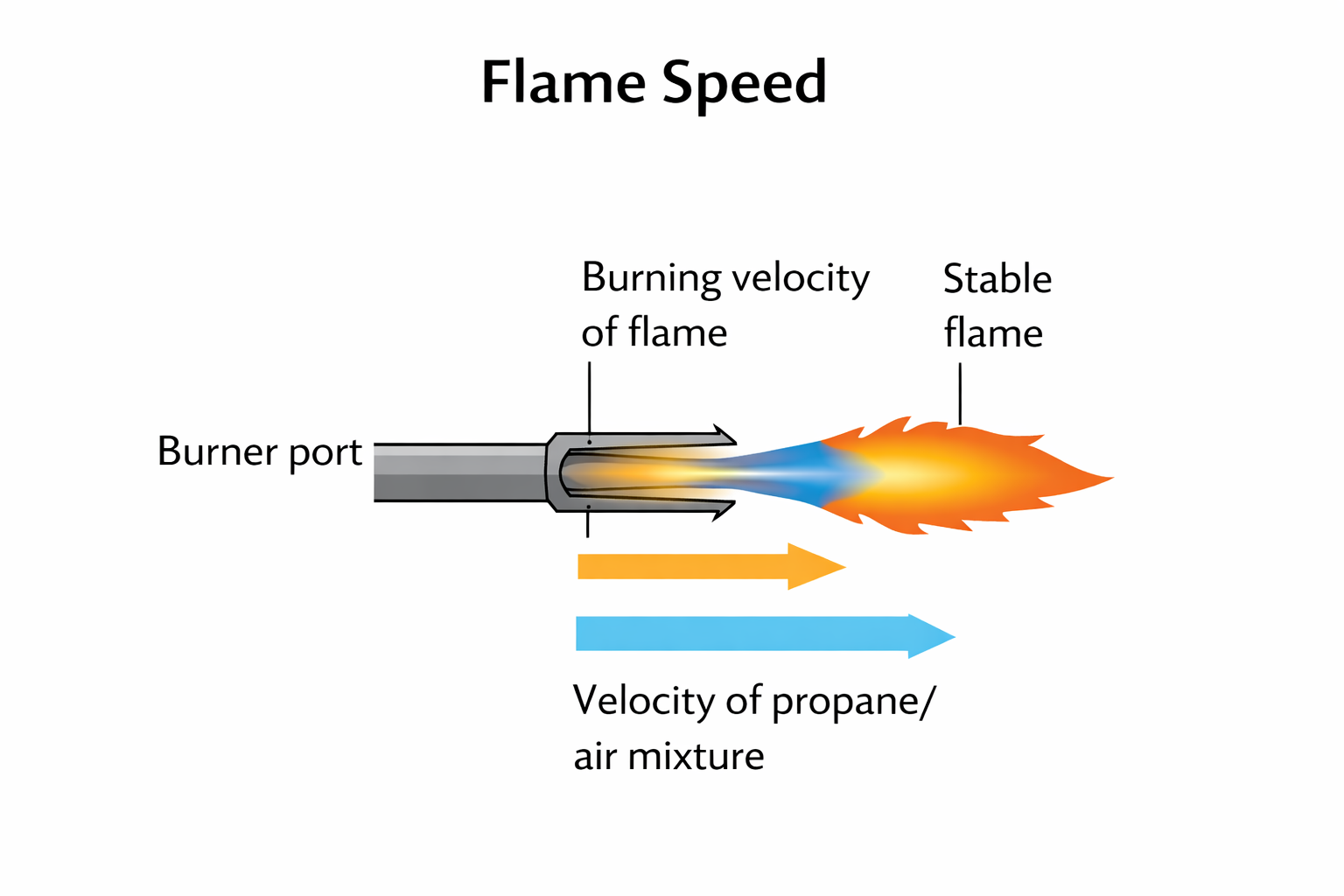
Flame speed is the rate at which a flame moves through a gas–air mixture as it burns.
It is important to understand that flame speed is not the same as gas flow speed. Two things are happening at the burner:
- The gas–air mixture velocity (how fast the gas is leaving the burner)
- The flame speed (how fast the flame travels through the mixture)
A stable flame occurs when these two speeds are equal. When the gas–air mixture velocity matches the flame speed, the flame remains steady at the burner port.
Understanding Flame Stability
- If the gas velocity is too high, the flame may lift off or blow out
- If the flame speed is too high, the flame may travel back into the burner (flashback)
For safe operation, these two must remain balanced.
 Safety Note: Flashback can damage equipment and create a serious hazard. Proper burner adjustment is critical.
Typical Flame Speeds of Common Fuel Gases
Different gases burn at different speeds. This affects burner design, safety, and performance.
| Fuel Gas | Approximate Flame Speed (ft/s) |
| Natural gas (methane) | 1.0 |
| Propane | 1.5 |
| Butane | 1.3 |
Note: Flame speeds are approximate and can vary depending on mixture conditions and temperature.
Limits of Flammability
A correct gas–air mixture is necessary for combustion. If the mixture is not within the proper range, it will not burn.
- If there is too little gas, the mixture is too lean and will not burn
- If there is too much gas, the mixture is too rich and will not burn
The limits of flammability (also called explosive limits) define the range of gas–air mixtures that will ignite when an ignition source is present.
This range is defined by two values:
- Lower Flammable Limit (LFL): the minimum concentration of gas in air that can ignite.
- Upper Flammable Limit (UFL): the maximum concentration of gas in air that can ignite.
- Below the LFL⇒the mixture is too lean to burn (not enough fuel).
- Above the UFL⇒the mixture is too rich to burn (too much fuel, not enough oxygen).
Different gases have different ranges of flammability. Compare these four common fuel gases:
|
Fuel Gas |
Lower Limit of Flammability |
Upper Limit of Flammability |
|
Methane |
4% |
15% |
|
Propane |
2% |
10% |
|
Butane |
2% |
8% |
|
Acetylene |
2.5% |
81% |
Ignition Temperatures
Ignition temperature is defined as the lowest temperature at which combustion begins and continues in a substance when it is heated in air. Table 6 lists the ignition temperatures of the three major fuel gases.
|
Fuel Gas |
Ignition Temperature °F |
Ignition Temperature °C |
|
Natural gas |
1,100 to 1,200 |
593 to 650 |
|
Propane |
920 to 1,020 |
493 to 548 |
|
Butane |
900 to 1,000 |
482 to 540 |
Flow Characteristics in Fuel Gas Piping
Six major factors affect the flow rate of fuel through a supply line connected to a heating appliance. To ensure that any appliance served by the piping system has enough fuel at the correct pressure to operate at its rated input, the pipe must be sized by taking all of the following flow characteristics into account.
Type of Gas
Since lighter (lower-density) gases flow through a pipe more easily than heavier gases, larger volumes of natural gas can flow through a pipe than propane or butane for a given pipe diameter and supply pressure. In addition, pressure losses due to friction are reduced with lower-viscosity fuels.
Type of Pipe
When a gas flows through a pipe, the internal roughness of the pipe walls can create localized eddy currents within the fluid, adding resistance to the flow of the fluid. Pipes with smooth interior walls, like copper, have less resistance than materials with rough interior walls like black iron (carbon steel) pipe.
Length of Pipe
When gas flows through a pipe, friction along the interior walls limits the velocity of the fuel. The average velocity decreases as pipe length increases, which reduces the flow rate at the appliance. When sizing a gas distribution network, it is important to consider that the longer the pipe, the greater the resistance to flow. In order to limit this resistance, the pipe size may need to be increased during design to provide less friction and maintain the required flow rate.
Diameter of Pipe
If the system pressure behind the gas flow in a pipe is constant, the diameter of the pipe will directly affect the flow rate. If the diameter of the pipe is increased, the flow rate will also increase. Flow rate is directly proportional to the pipe’s internal area and increases significantly with the pipe’s inside diameter.
Number of Fittings
Fittings such as elbows, tees, and valves represent a significant component of the pressure loss in most gas piping networks. Each fitting on a piping system adds resistance to gas flow. It is important to design a system with as few fittings as possible.
Pressure Drop
Pressure drop is the pressure difference between the gas supply (either the gas meter or a system pressure regulator) and a gas appliance. The Gas Code and design guidelines limit the amount of pressure drop allowed in these systems. The code limits this loss to ensure that sufficient pressure remains to provide the required flow rate. Good design of any piping system should limit the maximum pressure drop to maintain adequate flow pressure to fixtures and appliances.

Self-Test C-1.20: Describe Characteristics of Hydrocarbon Gases
Complete Self-Test C-1.20 and check your answers.
If you are using a printed copy, please find Self-Test C-1.20 and Answer Key at the end of this section. If you prefer, you can scan the QR code with your digital device to go directly to the interactive Self-Test.
References
BCcampus. (n.d.). Playlist: Tools and equipment videos. BCcampus MediaSpace. https://media.bccampus.ca/playlist/details/0_3g8xp22x/categoryId/175673 Playlist Details – Trades Access Common Core Line C: Tools and Equipment Videos – BCcampus
BC Industry Training Authority. (2019). Piping trades apprenticeship program: Use Tools and Equipment—Level 1 harmonized [Binder]. Crown Publications, Queen’s Printer for British Columbia. https://www.crownpub.bc.ca/Product/Details/7960000261_S
- Plumber: Competency C-1 Use Mathematics and Science
- Steamfitter: Competency C-1 Use Mathematics and Science
- Sprinkler Fitter: Competency C-1 Use Mathematics and Science
Camosun College. (2019). Line C: Tools and Equipment—Competency D-2 Apply Science Concepts to Trades Applications (Rev. ed.) [Learning guide]. BCcampus. https://collection.bccampus.ca/textbook/fkXxtNTn/
Camosun College. (2015). Trades Access Common Core Competency D-2 Apply Science Concepts to Trades Applications. Victoria, B.C.: Crown Publications. Download for free from the B.C. Open Textbook Collection (https://open.bccampus.ca/browse-ourcollection/find-open-textbooks/).
Camosun Innovates. (2022). Tools and Equipment Videos [Video playlist]. Camosun College/BCcampus. https://camosuninnovates.opened.ca/
Flinn, C. (n.d.). OER for Trades: Math for Trades [Video collection]. BCcampus MediaSpace. https://media.bccampus.ca/channel/OER%2Bfor%2BTrades%3A%2BMath%2Bfor%2BTrades/175670
Note: these videos align with the open textbooks Math for Trades: Volume 1 and Math for Trades: Volume 2. All videos are by Chad Flinn and available under a Creative Commons Attribution 4.0 Licence.:
Media Attributions
All figures are sourced from Industry Training Authority (2019) and/or Camosun College (2019) and are used under the Creative Commons Attribution 4.0 (CC BY 4.0) licence unless otherwise noted. Images copyrighted by the BC Industry Training Authority are licensed under a Creative Commons Attribution-NonCommercial-ShareAlike 4.0 (CC BY-NC-SA 4.0) licence.
- Figure 4 Flame speed and gas-air mixture of propane velocity at a burner was created by TRU Open Press with assistance from OpenAI, 2026, and is subject t the CC BY-NC-SA 4.0license of this resource.
A gas made up of hydrogen and carbon atoms, commonly used as a fuel. (Section C-1.20)
A fuel gas found in nature, made mostly of methane, and used for heating, cooking, and energy. (Section C-1.20)
A fuel gas (such as propane or butane) that is stored as a liquid under pressure and turns into a gas when released. (Section C-1.20)
A common LP gas used as a fuel, stored as a liquid and used in heating and cooking. (Section C-1.20)
A hydrocarbon gas similar to propane, used as a fuel and stored under pressure as a liquid. (Section C-1.20)
The main component of natural gas, made of one carbon atom and four hydrogen atoms. (Section C-1.20)
A substance that is made as a result of a process but is not the main product being produced. (Section C-1.20)
A colourless, odourless hydrocarbon gas made of two carbon atoms and six hydrogen atoms (C₂H₆). It is commonly found in natural gas and is often removed during processing to produce other fuels or chemicals. (Section C-1-20)
A strong-smelling chemical added to fuel gases so leaks can be easily detected. (Section C-1.20)
The amount of heat energy a fuel produces when it burns. (Section C-1.20)
(relative density); A number that compares how heavy a gas is compared to air (or a liquid compared to water). (Section C-1.20)
The form of a substance when it is a gas, meaning it can spread out and fill the space around it. (Section C-1.20)
The total weight of all the atoms in a molecule which helps determine how heavy a gas is compared to others and affects how it behaves, such as how easily it flows or rises in air. (Section C-1.20)
The speed at which a flame travels through a gas–air mixture. (Section C-1.20)
A flame that remains steady at the burner because the speed of the gas–air mixture leaving the burner is equal to the flame speed. (Section C-1-20)
A dangerous condition where a flame travels backward into the burner or piping because the flame speed is faster than the gas–air mixture leaving the burner. (Section C-1.20)
The range of gas–air mixtures that can ignite or explode. (Section C-1.20)
The lowest temperature at which a gas will ignite and continue to burn. (Section C-1.20)
A measure of how easily a fluid flows. Fluids with low viscosity (like natural gas) flow easily, while fluids with high viscosity (like oil) flow more slowly and resist movement. (Section C-1.20)