C-1.9 Calculate Offsets Using the Applicable Trigonometric Function
Both the Pythagorean theorem and trigonometry work with right-angle triangles. It is important to remember the following:
- All right-angle triangles have three sides: hypotenuse, opposite and adjacent. In the trades, the sides are often called travel, rise, and run.
- One angle in a right-angle triangle is always 90°.
- The sum of the three angles in a triangle is always equal to 180°.
- The travel (hypotenuse) is always the longest side and is opposite the right angle (90°).
| Trade Term | Math Term | Meaning |
|---|---|---|
| Travel | Hypotenuse | The longest side of the triangle (diagonal) |
| Run | Adjacent side | The horizontal distance (beside the angle) |
| Rise | Opposite side | The vertical distance (across from the angle) |
Tip:
- Opposite = across from the angle
- Adjacent = next to the angle
- Hypotenuse = longest side (always across from 90°)
Using trigonometry to solve for the length of the sides of a right-angle triangle, we label the sides with names that we use to set up our calculations. Before we begin solving for the lengths of the sides, we must determine what they are going to be called.
Right Triangle Side Names
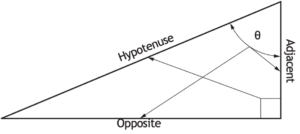
θ is the Greek letter theta. It is used to represent an unknown angle in any problem using trigonometry.
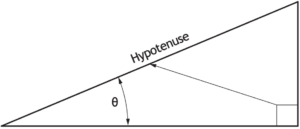
The longest side of a right triangle is called the hypotenuse. It will always be the side that is opposite the largest angle in the triangle, the right angle. The two shorter sides are named depending on which of the two smaller angles you choose to use as your reference angle. The reference angle can be either of the two smaller angles, and we use it as our anchor to label the sides of the triangle.
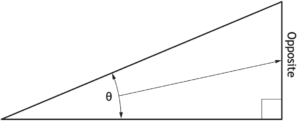
In Figure 1, the angle theta (θ) is the reference angle. In Figure 2, the side across the triangle from the reference angle (θ) is called the opposite side because it is located on the opposite side of the triangle from the reference angle.
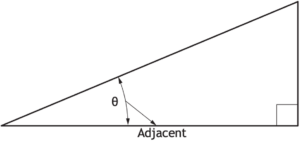
The side of the triangle beside the reference angle is called the adjacent side (Figure 3). In our case this is the side adjacent to, or beside, the reference angle (θ).
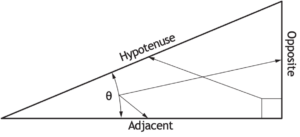
If the reference angle (θ) is switched to the other angle at the top right, then the adjacent and the opposite side also change positions (Figure 5). The hypotenuse remains the same, as it is always across from the right angle.
Self-Test C-1.9.1: Calculate Offsets Using the Applicable Trigonometric Function
Complete Self-Test C-1.9.1 and check your answers.
Identify the opposite and adjacent sides of the following right-angle triangles using the identified angle θ as the reference angle. Place the letter associated with the side in the space provided.
If you are using a printed copy, please find Self-Test C-1.9.1 and Answer Key at the end of this section. If you prefer, you can scan the QR code with your digital device to go directly to the interactive Self-Test.
Trigonometry (Trig) Functions
Trigonometry is the branch of mathematics that deals with the relationships between the angles and sides of triangles. In the piping trades, trigonometry is essential for calculating lengths, offsets, slopes, and angles when laying out pipe runs or determining measurements that cannot be reached directly. By understanding how sine, cosine, and tangent relationships work, students can turn real-world piping problems into simple geometric calculations, making layout work faster, more accurate, and easier to visualize.
Although right-angle triangles contain two smaller (acute) angles, trigonometry only considers one angle at a time. For any particular size of a right-angle triangle, the ratio of the lengths of the same two designated sides will always be the same constant number. This statement is true no matter how large the triangle becomes.
The term ratio describes the proportional relationship between two values. The three sides of a right-angle triangle—hypotenuse, opposite and adjacent—have a fixed relationship with each other. This means that as one of the three sides increases or decreases in length, the other two sides increase or decrease proportionally. The ratios of the lengths of the sides of triangles are the trigonometric functions of the acute angles used to form the triangles.
In trigonometry, you must know at least two values in order to solve for the lengths of the sides of a triangle. You can solve a right-angle triangle if you know one of the acute angles and the length of one of the three sides. Remember: the hypotenuse (travel) is always the longest side and is always opposite the right angle.
As discussed earlier, the opposite and adjacent sides of a right triangle change depending on which angle is considered the reference angle. It is important to learn how to identify the sides in a right triangle because it will make trigonometry easier to understand.
Note: Trigonometric values for all possible right-angle triangles can be found in a single table. See the IPT Pipe Trades Manual Table #73A. pages 287–292.
There are three basic trigonometric functions (ratios):
- Sine
- Cosine
- Tangent
The sine of an angle is the ratio of the length of the opposite side to the length of the hypotenuse. The abbreviation of sine is sin.
[latex]\quad\text{sin} = \frac{\text{opposite side}}{\text{hypotenuse}}\\[/latex]
The cosine of an angle is the ratio of the length of the adjacent side to the length of the hypotenuse. The abbreviation of cosine is cos.
[latex]\quad\text{cos} = \frac{\text{adjacent side}}{\text{hypotenuse}}[/latex]
The tangent of an angle is the ratio of the length of the opposite side to the length of the adjacent side. The abbreviation of tangent is tan.
[latex]\quad\text{tan} = \frac{\text{opposite side}}{\text{adjacent side}}[/latex]
One way to remember these three trigonometric functions is using the term SOH-CAH-TOA, which is derived from the relationships shown below:
[latex]\quad\text{SOH} \\ \quad\text{sin} = \frac{\text{opp}}{\text{hyp}}\\ \quad\text{CAH} \\ \quad\text{cos} = \frac{\text{adj}}{\text{hyp}}\\ \quad\text{TOA} \\ \quad\text{tan} = \frac{\text{opp}}{\text{adj}}\\[/latex]
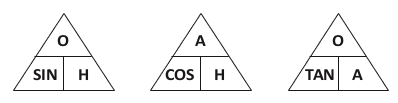
When solving trig problems, using a memory device called compartment triangles (Figure 6) makes it easier to determine when to multiply or divide when solving for an unknown side or angle.
Example 1:
To use the compartment triangles, cover the unknown value with your thumb. If the two values that remain are beside each other, multiply them.
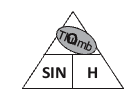
To use the compartment triangles, cover the unknown value (in Figure 7 the length of the opposite side) with your thumb. If the two remaining values are beside each other, multiply them. If the unknown value is in the bottom corner of the compartment triangle, divide the top value by the trig ratio.
Solution:
[latex]\quad\text{Length of the opposite side} = \text{sin of known angle} \times \text{length of the hypotenuse}[/latex]
Example 2:
If the unknown value is in the bottom corner of the compartment triangle (in this case the length of the hypotenuse), divide the top value by the trig ratio of your reference angle located in the other bottom corner.
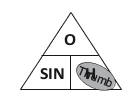
Solution:
[latex]\quad\text{Hypotenuse} = \frac{\text{opposite}}{\text{sin}(\theta)}[/latex]
Important Reminder
To use any trigonometric ratio, you must know:
- One of the acute angles, and
- The length of one of the three sides
The trig function that you choose to solve your problem must contain the length of the side of the triangle that you know, and the length of the side of the triangle that you are looking for (the unknown side).
Example 3:
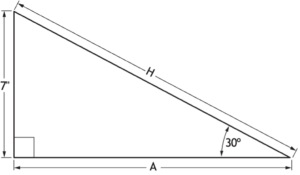
In Figure 9, the reference angle used is 30°, as it is the only angle given. The known dimension is 7′, which is the opposite side of the triangle when we use the 30° angle as our reference angle. To solve the length of side A (side adjacent), we must find a trig ratio that contains both the adjacent and the opposite side.
From the three triangles available, the tan triangle is the appropriate one to use. To solve for the length of the adjacent side, put your thumb over the A (Figure 10).
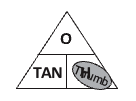
Note: When entering the calculation string into your calculator, you must ensure that the angular unit for input is in degrees. You should see a “deg” symbol on the display.
Also, after you choose which trig function to use you must input the value of your reference angle. In this example it is 30 degrees.
Enter the following into your calculator:
[latex]\quad\frac{7}{\text{tan}(30)} = 12.124[/latex]
A triangle that has an opposite side measuring 7′, with a reference angle equal to 30°, has an adjacent side equal to 12.12′. Because this is a ratio of the length of the opposite compared to the length of the adjacent, if the opposite side length were doubled to measure 14′, the adjacent side length would also double to 24.248′.
Using the same triangle but now solving for the length of the hypotenuse (Figure 9) means that you would require a trig ratio that includes the value you know (length of the opposite side) and the value you are looking for (length of hypotenuse).
From the available trig ratio triangles, the sin ratio is what is needed to solve this problem. To solve for the length of the hypotenuse, put your thumb over the H.
[latex]\quad\frac{\text{opposite}}{\text{sin}(30)} = \frac{7}{\text{sin}(30)} = 14[/latex]
This example proves that by knowing one acute angle and the length of one side, we can solve for the other two sides of the triangle.
Calculating Piping Offsets
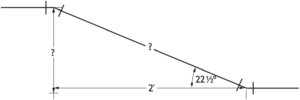
When using trigonometry to solve piping offsets, the procedure is the same as for any other right-angle triangle calculation. The key skill is visualizing where the triangle exists within the offset and identifying the reference angle. In Figure 11, a piping offset is made with two [latex]22\frac{1}{2}[/latex]° fittings. In Figure 11, a piping offset is made with two 22½° fittings. The dimension lines create a right-angle triangle, with the pipe’s travel acting as the hypotenuse. The easiest reference angle to use would be the pipe’s fitting angle, which would make the known dimension (2′) the adjacent side. Another acceptable method would be to use the other acute angle as the reference. In this example, this would be [latex]67\frac{1}{2}[/latex]°, as we know that the two acute angles must add up to 90°:
[latex]\quad90° − 22\frac{1}{2}° = 67\frac{1}{2}°[/latex]
If you use the larger [latex]67\frac{1}{2}[/latex]° as the reference angle, the known dimension (2′) now becomes the opposite side and the unknown rise is the adjacent side.
Example 1:
Using the 45° offset shown in Figure 12, calculate the centre-to-centre length of the pipe’s rise and its travel.
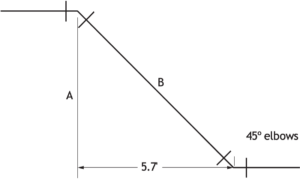
Step 1: Start with the side represented by letter A (rise).
Solution:
Using the 45° fitting as our angle of reference, the side of the triangle we are solving for is the opposite side. The known dimension is the adjacent side.
The given dimension is in feet and decimal parts of a foot, and can be converted to inches (67″), if preferred. We will use 67″ in our example.
As before, find a trig function that has both the adjacent and the opposite located in ratio. The tangent triangle has both of these values, so we cover over the O to get the following equation:
[latex]\quad\text{tan}(45) \times 67 = 67\text{"}[/latex]
The calculation shows that the opposite side of the triangle is the same length as the adjacent side. This is true for all 45° triangles. Because the acute angles are equal, so are the lengths of the short sides (rise and run).
Step 2: Now calculate the amount of pipe travel represented by letter B.
Solution:
Once again using the 45° fitting as our angle of reference, the side of the triangle we are solving for is the hypotenuse. The known dimension we will use is still the adjacent side.
We find a trig function that has both the adjacent and the hypotenuse located in ratio. The cosine triangle has both of these values, so we cover over the H and see that:
[latex]\quad\frac{67}{\text{cos}(45)} = 94.75\text{"}[/latex]
The following calculation shows that the hypotenuse of the triangle is longer than either of the two equal shorter sides by a factor of 1.414:
[latex]\quad\frac{94.75}{67} = 1.414[/latex]
This is true for all 45° triangles and can be summarized as:
- A 45° triangle will have short sides of equal length.
- A 45° triangle will have a hypotenuse that is longer than either of the shorter sides by a factor of 1.414.
These are very important facts to remember as a pipe trades worker because of the frequency that 45° ells are used in industry.
Example 2:
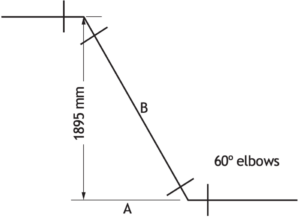
Using the 60° offset shown in Figure 13, calculate the amount of pipe run and travel.
Solution:
Step 1: Solve for the A (run or adjacent). The known dimension is side opposite, so tangent would be the correct ratio triangle to use (Figure 14).
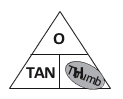
The triangle shows that the length of side [latex]\frac{\text{opposite}}{\text{tan}(60)}[/latex] would equal the adjacent side’s length:
[latex]\quad\frac{1,895}{\text{tan}(60)} = 1,094.08\text{ mm}[/latex]
Step 2: Solve for B (travel or hypotenuse). The known dimension used is still side opposite, so sine would be the correct ratio triangle to use (Figure 15).
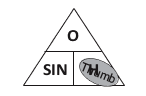
The triangle shows that the length of side [latex]\frac{\text{opposite}}{\text{sin}(60)}[/latex] would equal the length of the hypotenuse:
[latex]\quad\frac{1,895}{\text{sin}(60)} = 2,188.16\text{ mm}[/latex]
Self-Test C-1.9.2: Calculate Offsets Using the Applicable Trigonometric Function
Complete Self-Test C-1.9.2 and check your answers.
Using trigonometry, solve for the unknown lengths for the following 45° (questions 1-10), 60° (questions 11-20), and [latex]22\frac{1}{2}[/latex]° (questions 21-30) piping offsets. Express your answers to the nearest [latex]\frac{1}{8}\text{"}[/latex] or 0.1 mm, as required.
If you are using a printed copy, please find Self-Test C-1.9.2 and Answer Key at the end of this section. If you prefer, you can scan the QR code with your digital device to go directly to the interactive Self-Test.
References
BCcampus. (n.d.). Playlist: Tools and equipment videos. BCcampus MediaSpace. https://media.bccampus.ca/playlist/details/0_3g8xp22x/categoryId/175673 Playlist Details – Trades Access Common Core Line C: Tools and Equipment Videos – BCcampus
BC Industry Training Authority. (2019). Piping trades apprenticeship program: Use Tools and Equipment—Level 1 harmonized [Binder]. Crown Publications, Queen’s Printer for British Columbia. https://www.crownpub.bc.ca/Product/Details/7960000261_S
- Plumber: Competency C-1 Use Mathematics and Science
- Steamfitter: Competency C-1 Use Mathematics and Science
- Sprinkler Fitter: Competency C-1 Use Mathematics and Science
Camosun College. (2019). Line C: Tools and Equipment—Competency D-1: Solve Trades Mathematical Problems (Rev. ed.) [Learning guide]. BCcampus. https://collection.bccampus.ca/textbook/qFKGAJ78/
Camosun College. (2015). Trades Access Common Core Competency D-1: Solve Trades Mathematical Problems. Victoria, B.C.: Crown Publications. Download for free from the B.C. Open Textbook Collection (https://open.bccampus.ca/browse-ourcollection/find-open-textbooks/).
Camosun Innovates. (2022). Tools and Equipment Videos [Video playlist]. Camosun College/BCcampus. https://camosuninnovates.opened.ca/
Flinn, C. (n.d.). OER for Trades: Math for Trades [Video collection]. BCcampus MediaSpace. https://media.bccampus.ca/channel/OER%2Bfor%2BTrades%3A%2BMath%2Bfor%2BTrades/175670
Note: these videos align with the open textbooks Math for Trades: Volume 1 and Math for Trades: Volume 2. All videos are by Chad Flinn and available under a Creative Commons Attribution 4.0 Licence.:
Media Attributions
All figures are sourced from Industry Training Authority (2019) and/or Camosun College (2019) and are used under the Creative Commons Attribution 4.0 (CC BY 4.0) licence unless otherwise noted. Images copyrighted by the BC Industry Training Authority are licensed under a Creative Commons Attribution-NonCommercial-ShareAlike 4.0 (CC BY-NC-SA 4.0) licence.
A formula used to find the longest side of a triangle using the other two sides. (Section C-1.10)
A type of math used to find angles and side lengths in triangles. (Section C-1.10)
A triangle that has one 90° angle. (Section C-1.9)
The longest side of a right triangle, opposite the right angle. (Section C-1.9; Section C-1.10)
The side of a triangle directly across from the angle you are using. (Section C-1.10)
The side of a triangle that is next to the angle you are using. (Section C-1.11)
(hypotenuse); the diagonal distance in a piping offset. (Section C-1.9)
The vertical distance a pipe moves up or down in an offset. (Section C-1.10)
The horizontal length of a pipe. (Section C-1.7)
A symbol used to represent an unknown angle. (Section C-1.9)
An angle that is less than 90°. In a triangle, the two angles that are not the right angle are called acute angles. (Section C-1.9)
A way of comparing two quantities by showing how much of one there is compared to the other, often written as a fraction (e.g., 2:1 or 2/1); relating to angles, describes the proportional relationship between two values (Section C-1.9).
A math relationship between angles and sides of a triangle. (Section C-1.9)