C-1.13 Use Archimedes’ Principles of Displacement and Floatation
Archimedes’ Principle of Displacement
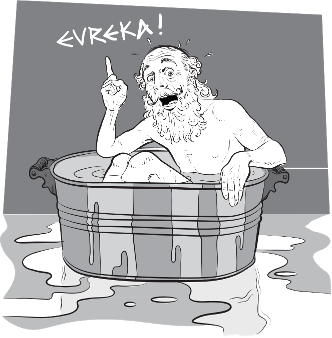
Archimedes is best known for his work in hydrostatics. One of his most important discoveries was that a submerged, irregular shaped object displaces a volume of water equal to the volume of the object.
Archimedes used this discovery to prove that the goldsmith of the king of Syracuse had adulterated a gold crown with silver. Archimedes realized that he could check the density of the crown because he could measure its volume accurately. The story goes that the crown was proven to be impure, and the unfortunate goldsmith was executed.
Applications of Displacement
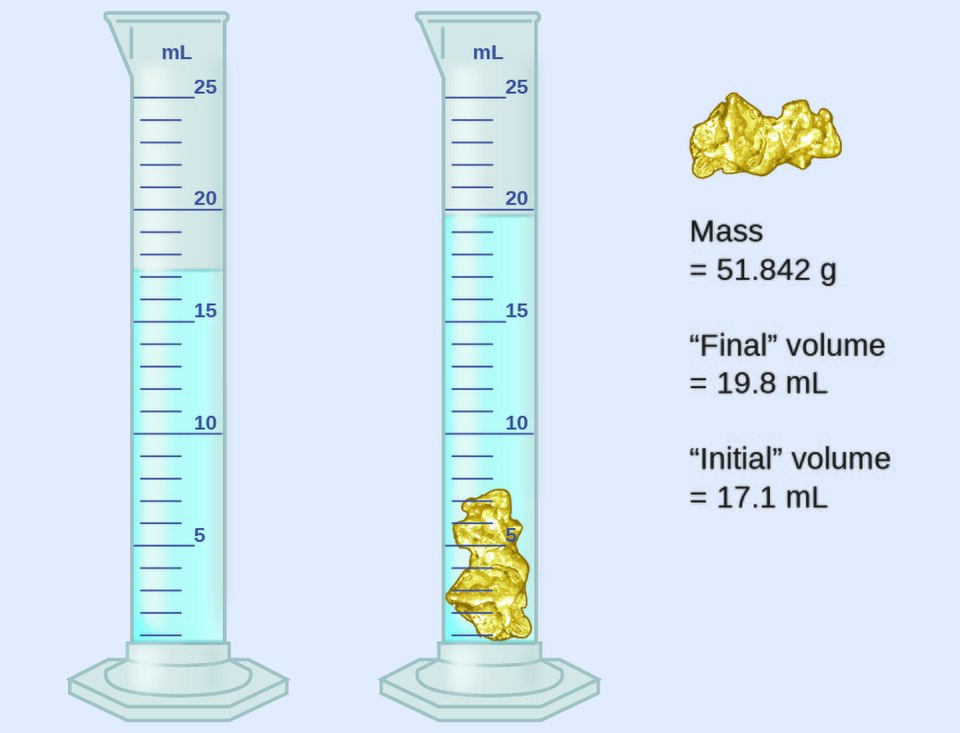
Commonly called water displacement, the volume of displaced fluid is equal to the volume of an object fully immersed in a fluid. If an object is only partially submerged, the displaced volume is equal to only the portion of the object below the surface. Several methods exist for measuring displacement. In one method, the increase in water level is recorded as the object is placed into the water. In another method, the object is placed into a container filled to the top with water, causing it to overflow. The overflow is collected and measured.
Archimedes’ Principle of Flotation (Buoyancy)
“Any object, wholly or partly immersed in a fluid, is buoyed up by a force equal to the weight of the fluid displaced by the object.”
Archimedes’ principle of flotation may also be stated as:
“A body immersed in a fluid loses as much weight as the weight of the fluid it displaces.”
Objects denser than water will sink, but they still lose part of their weight when submerged. For example, a person can lift a heavier stone underwater than in air because the buoyant force of the water supports part of the weight. The upward force that a liquid exerts on an object is called buoyancy. The force exerted by liquids on submerged objects—and the apparent loss of weight—was studied extensively by Archimedes.
Archimedes’ principle works for any fluid. For our purposes, we will focus on fresh water, which has a density of:
[latex]\quad 62.4 \frac{\text{lb}}{\text{ft}^3} = 1000 \frac{\text{kg}}{\text{m}^3}[/latex]
Example 1:
If you place a 1-cubic-foot object that weighs 63.0 lb into water, the object displaces 62.4 lb of water. Because it weighs more than the displaced water, it will sink. It is, however, being buoyed up with a force of 62.4 lb, so if we weighed it in the water, it would only weigh 0.6 lb. This means its apparent weight in water is:
63.0 lb − 62.4 lb = 0.6 lb
In other words, the object appears much lighter in water because most of its weight is supported by buoyancy.
If we went to the ocean and put the same object into salt water, it would still weigh 63.0 lb, but would be buoyed up by a force of 64.3 lb, and it would float.
An object sinks in a fluid if the weight of the fluid it displaces is less than the weight of the object. A submerged object remains in equilibrium, neither rising nor sinking, if the weight of the fluid it displaces exactly equals its own weight. If an object, when submerged, displaces a weight of fluid greater than its own weight, it will float.
Summary:
- An object sinks if it displaces less weight of fluid than its own weight.
- An object floats if it displaces more weight of fluid than its own weight.
- An object remains suspended if the two weights are equal (equilibrium).
Example 2:
A 1 m³ object weighs 500 kg and is placed in fresh water. Will it float or sink?
Solution:
The object will float because fresh water has a density of 1000 kg/m³. The object only needs to displace 0.5 m³ of water to balance its weight.
Example 3:
Given copper weighs [latex]558 \frac{\text{lb}}{\text{ft}^3}[/latex], how much would 100 lb of copper weigh when submerged in sea water?
Solution:
Volume of copper:
[latex]\quad \frac{100}{558} = 0.179 \text{ ft}^3[/latex]
Density of sea water:
[latex]\quad 64.3 \frac{\text{lb}}{\text{ft}^3}[/latex]
Buoyant force:
[latex]\quad 0.179 \times 64.3 = 11.52 \text{ lb}[/latex]
New weight in water:
100 lb − 11.52 lb = 88.48 lb
The copper loses 11.52 lb (11.52%) of its weight when submerged.
Summary formula:
Percentage loss of weight =
[latex]\quad \frac{\text{Density of fluid}}{\text{Density of object}}[/latex]
Finding Specific Gravity of Liquids
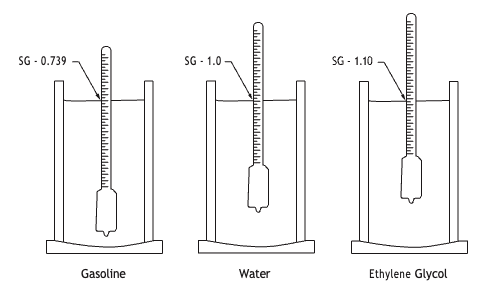
A hydrometer is an instrument used to measure the specific gravity (SG) (or relative density) of liquids. This is the ratio of the density of a liquid to the density of water. Operation of the hydrometer is based on Archimedes’ principle that a solid suspended in a fluid will be buoyed up by a force equal to the weight of the fluid displaced by the submerged part of the suspended solid. Thus, it floats higher in denser liquids and lower in less dense liquids.
A hydrometer is usually made of glass and consists of a cylindrical stem and a bulb weighted with mercury or lead shot to make it float upright. The liquid to be tested is poured into a tall container, often a graduated cylinder, and the hydrometer is gently lowered into the liquid of unknown specific gravity until it floats freely. The hydrometer sinks until the weight of unknown liquid displaced equals the weight of the hydrometer (Figure 3). The hydrometer must sink deeper in liquids of lesser density; therefore, the larger numbers are at the bottom and smaller numbers are at the top of the scale. The point at which the surface of the liquid touches the stem of the hydrometer is noted.
Hydrometers usually contain a scale inside the stem, so that the specific gravity can be read directly. A variety of scales are available depending on the application. Hydrometers may be calibrated for different uses, such as a lactometer for measuring the density of milk, a saccharometer for measuring the density of sugar in a liquid, or an alcohol meter for measuring higher levels of alcohol in spirits.

Self-Test C-1.13: Use Archimedes’ Principles of Displacement and Floatation
Complete Self-Test C-1.13 and check your answers.
If you are using a printed copy, please find Self-Test C-1.13 and Answer Key at the end of this section. If you prefer, you can scan the QR code with your digital device to go directly to the interactive Self-Test.
References
BCcampus. (n.d.). Playlist: Tools and equipment videos. BCcampus MediaSpace. https://media.bccampus.ca/playlist/details/0_3g8xp22x/categoryId/175673 Playlist Details – Trades Access Common Core Line C: Tools and Equipment Videos – BCcampus
BC Industry Training Authority. (2019). Piping trades apprenticeship program: Use Tools and Equipment—Level 1 harmonized [Binder]. Crown Publications, Queen’s Printer for British Columbia. https://www.crownpub.bc.ca/Product/Details/7960000261_S
- Plumber: Competency C-1 Use Mathematics and Science
- Steamfitter: Competency C-1 Use Mathematics and Science
- Sprinkler Fitter: Competency C-1 Use Mathematics and Science
Camosun College. (2019). Line C: Tools and Equipment—Competency D-2 Apply Science Concepts to Trades Applications (Rev. ed.) [Learning guide]. BCcampus. https://collection.bccampus.ca/textbook/fkXxtNTn/
Camosun College. (2015). Trades Access Common Core Competency D-2 Apply Science Concepts to Trades Applications. Victoria, B.C.: Crown Publications. Download for free from the B.C. Open Textbook Collection (https://open.bccampus.ca/browse-ourcollection/find-open-textbooks/).
Camosun Innovates. (2022). Tools and Equipment Videos [Video playlist]. Camosun College/BCcampus. https://camosuninnovates.opened.ca/
Flinn, C. (n.d.). OER for Trades: Math for Trades [Video collection]. BCcampus MediaSpace. https://media.bccampus.ca/channel/OER%2Bfor%2BTrades%3A%2BMath%2Bfor%2BTrades/175670
Note: these videos align with the open textbooks Math for Trades: Volume 1 and Math for Trades: Volume 2. All videos are by Chad Flinn and available under a Creative Commons Attribution 4.0 Licence.:
Media Attributions
All figures are sourced from Industry Training Authority (2019) and/or Camosun College (2019) and are used under the Creative Commons Attribution 4.0 (CC BY 4.0) licence unless otherwise noted. Images copyrighted by the BC Industry Training Authority are licensed under a Creative Commons Attribution-NonCommercial-ShareAlike 4.0 (CC BY-NC-SA 4.0) licence.
- Figure 2 [Measuring the volume of an irregular shape…] CNX Chem 01 04 CylGold is by OpenStax [In Chemistry], retrieved from Wikimedia Commons, used under a CC BY 4.0 license.
The study of fluids that are not moving. (Section C-1.13)
Completely under a fluid. (Section C-1.13)
A shape that does not have even or simple sides. (Section C-1.13)
This is a method used to measure volume by placing an object in water and seeing how much the water level rises. (Section C-1.13)
When an object pushes fluid out of the way. (Section C-1.13)
The force from a fluid that pushes an object upward. (Section C-1.13)
The upward force a liquid pushes on an object. (Section C-1.13)
How much mass is packed into a certain space; mass per unit volume of a substance; affects whether a fluid rises or sinks during convection. (Section C-1.13; Section C-1.18)
How heavy something seems when it is in a fluid, like water. (Section C-1.13)
A balanced state where forces are equal. (Section C-1.13)
A tool used to measure how dense a liquid is. (Section C-1.13)
(relative density); A number that compares how heavy a gas is compared to air (or a liquid compared to water). (Section C-1.20)