C-4.1 Identify Organizations, Code and Standards Affecting the Pipe Trades
Building codes are legally adopted regulations, while standards are technical documents referenced by codes to define acceptable materials, methods, and performance.
A standards organization’s primary activities are developing technical codes and standards that address industry needs. The main purpose of building codes is to protect public health, safety, and general welfare, as they relate to the construction and occupancy of buildings and structures. A standard is a document that provides requirements, specifications, guidelines, or characteristics that ensure materials, products, processes, and services are fit for their intended purpose. Standards in the construction industry cover a range of topics, but they are usually in one of the following categories:
- Test or measurement standards, which provide information on the acceptability (pass/fail) in a performance category, usually under some standard condition (fire separation ratings), or provide data that can be used to determine acceptability or performance.
- Procedural standards, which describe how products or systems are to be installed, used, maintained, tested, or operated to be safe, reliable, and fit for the intended use.
As tradespeople, we come into contact with code requirements and standards every day. Due to their importance, a construction industry without them is almost unimaginable.
Organizations
The following are some of the organizations that issue codes and standards for our industry and the areas they oversee.
American National Standards Institute
The American National Standards Institute (ANSI) has served as coordinator of the voluntary standardization system for the US private sector for more than 90 years.
ANSI establishes the procedures that are the basis for the development of American national standards. They then accredit standards-developing organizations that operate in accordance with these procedures and approve their draft standards, provided they are developed via this process.
A recent example of this accreditation process occurred when ANSI-accredited the American Society of Safety Engineers (ASSE). The ANSI/ASSE A10 Construction Package is a comprehensive compilation of the ANSI/ASSE A10 series of construction safety standards, which includes more than 30 construction and demolition standards.
American Society of Heating, Refrigeration and Air-Conditioning Engineers (ASHRAE)
The American Society of Heating, Refrigeration and Air-Conditioning Engineers (ASHRAE) publishes a well-recognized series of standards and guidelines relating to HVAC systems and issues. These standards are often referenced in building codes and are considered useful standards for use by consulting engineers, mechanical contractors, architects and government agencies. These are legally unenforceable, except when referenced as mandatory provisions in building codes, but they are commonly accepted standards for architects and engineers.
American Society of Plumbing Engineers
The American Society of Plumbing Engineers (ASPE) is a non-profit association dedicated to the advancement of the science of plumbing engineering, to the professional growth and advancement of its members and to the health, welfare and safety of the public.
ASPE is a member of and approved by ANSI as an ANSI-accredited standards developer. As such, ASPE may submit standards for approval by ANSI’s Board of Standards Review as meeting certain criteria regarding due process in development to be designated American National Standards.
ASPE provides plumbing engineers and designers with ways to enhance their skills and knowledge through research and education.
American Society for Testing and Materials
The American Society for Testing and Materials (ASTM) is a group of voluntary members who test and certify standards of materials and procedures. It is now international in range and is currently known as ASTM International. ASTM standards apply to a large area of products and technology in over 130 industries. ASTM standards have made product selection easier for a wide variety of products and techniques, such as steel classifications.
The standards produced by ASTM International fall into six categories:
- The Standard Specification, which defines the requirements to be satisfied by the subject of the standard.
- The Standard Test Method, which defines the way a test is performed and the precision of the result. The result of the test may be used to assess compliance with a Standard Specification.
- The Standard Practice, which defines a sequence of operations that, unlike a Standard Test Method, does not produce a result.
- The Standard Guide, which provides an organized collection of information or series of options that does not recommend a specific course of action.
- The Standard Classification, which provides an arrangement or division of materials, products, systems or services into groups based on similar characteristics such as origin, composition, properties or use.
- The Terminology Standard, which provides agreed definitions of terms used in the other standards.
ASTM has a dominant role among standards developers in the USA and claims to be the world’s largest developer of standards. The quality of the standard test methods is such that they are frequently used worldwide, even in places where ASTM specifications are not required.
American Water Works Association
The American Water Works Association (AWWA) is the largest non-profit scientific and educational association dedicated to managing and treating water. AWWA is the only organization dedicated strictly to the interest of people in the waterworks field. Its publications, committee studies, reports and standard specifications are all of great value, as is the opportunity to interact and exchange ideas with others in the profession.
Currently, there are over 150 AWWA standards covering filtration materials, treatment chemicals, disinfection practices, meters, valves, utility management practices, storage tanks, pumps, ductile iron, steel, concrete, asbestos-cement, and plastic pipe and fittings. Standing committees periodically review and update the standards as required.
The International Organization for Standardization (ISO)
The International Organization for Standardization (ISO) is a worldwide federation of national standards bodies from more than 145 countries. ISO is a non-governmental organization established in 1947 and based in Geneva, Switzerland. Its mission is to promote the development of standardization and related activities in the world with a view to facilitating the international exchange of goods and services, and to developing cooperation in the spheres of intellectual, scientific, technological and economic activity. ISO’s work results in international agreements that are published as International Standards and other types of ISO documents.
Out of 19,400 standards from almost all sectors of business and technology, more than a hundred come from ISO technical committee ISO/TC 59, Buildings and Civil Engineering Works. In addition, many other ISO technical committees have developed standards and related technical documents on construction products.
Standards Council of Canada
The Standards Council of Canada (SCC) is a federal Crown corporation. Its mandate is to promote efficient and effective standardization in Canada. Standardization is the development and application of standards publications that establish accepted practices, technical requirements and terminologies for products, services and systems. Standards help to ensure better, safer and more efficient methods and products, and are an essential element of technology, innovation and trade. SCC carries out a variety of functions intended to ensure the effective and coordinated operation of standardization in Canada. It also represents Canada’s interests on standards-related matters in foreign and international forums.
The designation National Standard of Canada indicates that a standard is recognized as the official
Canadian standard in a particular subject area or topic. Before a standard can become a national standard, it must be approved by the SCC. Inclusion of the abbreviation CAN in the prefix of the standard’s reference number indicates that a particular standard has been designated a National Standard of Canada.
Canadian Construction Code Development
Canada’s model construction and fire codes are developed through a national process supported by the National Research Council (NRC). Historically, the Canadian Commission on Building and Fire Codes (CCBFC) oversaw code development, working with technical committees and receiving policy input from provinces and territories.
In 2022, the Canadian Board for Harmonized Construction Codes (CBHCC) was established to replace the CCBFC. The CBHCC works with federal, provincial, and territorial governments to improve coordination and harmonize construction codes across Canada, while continuing to support stakeholder input from industry and the public.
| Aspect | Previous Model (CCBFC) | Current Model (CBHCC) |
|---|---|---|
| Governance | Canadian Commission on Building and Fire Codes (CCBFC) | Canadian Board for Harmonized Construction Codes (CBHCC) |
| Policy Input | Provincial/Territorial Policy Advisory Committee on Codes (PTPACC) | Integrated federal–provincial–territorial governance |
| Technical Development | Standing committees and task groups | Committees and working groups under CBHCC |
| Focus | National model codes with provincial input | Harmonization across jurisdictions |
| Role of NRC | Supported development and published codes | Continues to support development and publication |
| Stakeholder Participation | Industry and public input through committees and public review | Continued stakeholder input through consultations and review processes |
Canadian Gas Association
Founded in 1907, the Canadian Gas Association (CGA) is the voice of Canada’s natural gas distribution industry. Members include distribution companies, transmission companies, equipment manufacturers and other service providers.
CGA produces and maintains a range of publications, background information, presentations and statistics on natural gas and the natural gas distribution industry. As well, CGA develops educational information and organizes training schools, workshops, seminars and conferences.
They sponsor and participate in a number of forums, partnerships and coalitions to foster dialogue on energy policy and achieve a better understanding of natural gas.
Canadian General Standards Board (CGSB)
The Canadian General Standards Board (CGSB) has historically been one of Canada’s largest standards development and conformity assessment organizations. It provided services such as standards development, product and service certification, and the registration of quality and environmental management systems. These activities supported economic, regulatory, procurement, health, safety, and environmental interests across government, industry, and the public.
CGSB developed and maintained more than 900 standards through committees of volunteer experts, covering a wide range of areas, including building construction and the transportation of dangerous goods.
Recent Update (2026)
As of April 1, 2026, CGSB has ceased offering standards development and conformity assessment services. However, its existing standards remain available and can be accessed free of charge through the CGSB catalogue. While CGSB no longer develops new standards, its existing standards continue to be used as reference documents in industry and regulatory contexts.
Canadian Standards Association

The Canadian Standards Association (CSA) is the largest standards development organization (SDO) in Canada, with the widest subject area recognition. They have published more than 3000 standards and codes addressing subjects that affect the interests of industry, consumers, regulators and the public at large.
The Canadian Standards Association is a not-for-profit standards organization that develops standards in over 50 areas, including:
- Safety and performance standards for electrical and electronic equipment
- Industrial equipment
- Boilers and pressure vessels
- Compressed gas handling appliances
- Environmental protection
- Construction materials
- Selection and installation of backflow preventers
Most standards are voluntary, meaning there are no laws requiring their application. Despite that, adherence to standards is beneficial to companies because it shows products have been independently tested to meet certain standards. Some standards are referenced in codes and regulations, which then makes them law. The CSA mark (Figure 1), like many certification marks, is a registered certification logo and can only be applied by someone who is licensed or otherwise authorized to do so by the CSA.
Laws and regulations in most municipalities, provinces and states in North America require certain products to be tested to a specific standard or group of standards by a Nationally Recognized Testing Laboratory. Currently 40 percent of all the standards issued by CSA are referenced in Canadian legislation. CSA’s sister company, CSA International, is a Nationally Recognized Testing Laboratory (NRTL) that manufacturers can choose, usually because the law of the jurisdiction requires it or the customer specifies it.
National Fire Protection Association
The National Fire Protection Association (NFPA) is an international non-profit organization with the mission of reducing the worldwide burden of fire and other hazards on the quality of life by providing and advocating consensus codes and standards, research, training and education.
The world’s leading advocate of fire prevention and an authoritative source on public safety, NFPA develops, publishes and circulates more than 300 consensus codes and standards intended to minimize the possibility and effects of fire and other risks. As part of its commitment to eliminate fire deaths and injuries through effective public education programs and information, NFPA strives to be the definitive source for fire and life safety information.
UL Solutions (formerly Underwriters Laboratories of Canada – ULC)
UL Solutions is an independent product safety testing, inspection, and certification organization operating in Canada and globally. In Canada, this work was historically carried out by Underwriters Laboratories of Canada (ULC), which has been testing products for public safety for over 100 years. UL Solutions in Canada is accredited by the Standards Council of Canada (SCC) and plays a key role in the Canadian National Safety System. It evaluates a wide range of products, components, materials, and systems to ensure they meet established safety and performance requirements.
Standards development is now carried out through UL Standards & Engagement (ULSE Inc.), an independent, not-for-profit organization that develops consensus-based safety and performance standards using input from industry, government, and the public. Today, UL Solutions supports manufacturers in bringing safer products to Canadian and global markets through testing, certification, and standards development. Its certification marks (such as the ULC mark) are widely recognized as indicators of product safety and compliance.
Municipal Bylaws
Depending on the scope of work, you may need a building permit, a development permit, or both.
Building Permits
You need a building permit if you plan to:
- Construct a new building
- Make additions or structural changes to an existing building
- Renovate, repair, or demolish a building
- Change a building’s use
- Build a garage, balcony, or deck
- Excavate a basement or construct a foundation
Plumbing and Gas Permits
Plumbing and gas permits are required for the construction of all associated systems and must be obtained before construction begins.
A plumbing permit is required if you:
- Install, change, or upgrade any part of a plumbing system
- Open walls
- Change other plumbing or move pipes
- perform major repairs
If your company is a licensed gas contractor, you require a gas permit to install or replace a gas-fired appliance like a fireplace, hot water tank, boiler, furnace or kitchen stove. A permit is also required if you are installing or altering the associated gas pipes and appliance vents.
If you are constructing a new dwelling, a building permit will be required prior to a gas or plumbing permit being issued. A plumbing permit is NOT required for clearing of stoppages or the repairing of leaks in pipes, valves or fixtures.
Plumbing permits are issued by your local municipal building department. Gas permits are typically issued by Technical Safety BC (previously known as the British Columbia Safety Authority [BCSA]). In some instances, gas installation permits might also be offered by municipal departments.
The permit process is generally the same for all types of projects, but more specific requirements may be required for some commercial construction and industrial projects.
Permit Process
Permit Application
A completed permit application must be submitted before work begins. Permit applications are available through the authority having jurisdiction (AHJ). Typical information required includes who will perform the work, and what, where, and how the work will be completed. Drawings, plans, or other documentation of the proposed work may be required. Permit fees are usually due at the time of application.
Review Process
During the review process, staff officials will determine if the project is in compliance with the applicable codes and other local ordinances and statutes. The length of the review process will depend on the type and complexity of the project. Many small residential applications can be processed in one day.
Permit Approval
If the project meets all requirements, the permit application is approved. Once all final permit fees are paid, the permit is issued.
However, if the permit application is not approved or a review has determined that a project fails to meet the requirements, the permit application, as submitted, will be denied. When a permit application is denied, corrections to the application shall be made and the application is resubmitted for final approval.
Permit Execution
Construction
During the entire construction phase, the permits must be placed in a prominent place at the project site. A copy of the approved building plan and other related documents must also be maintained at the site.
Inspections
Each major phase of construction must typically be inspected by an inspector or similar authority to make certain the work conforms to the code, the permit and the approved plans. Inspection requests may be made via internet, by phone or in person. Normally, the response is one business day after the request is made.
If an inspector finds that work does not conform to the approved plans, the inspector will fail the inspection and provide comments. Another inspection will be necessary before work is resumed. Reinspections can cause project delays and unnecessary expense.
Field Changes
Most changes will require a review and approval in the same manner as the original application. Proposed revisions or alterations must be brought to the attention of the permit staff before making changes in the field.
Project Completion
When the project is completed and code compliance is determined, the inspector issues a final inspection. The final inspection marks the completion of the project and grants permission to occupy a building with the knowledge that it has met the minimum safety standards as required by code.
Codes, Standards, Acts, and Regulations
National Building Code of Canada
The National Building Code (NBC) is the model building code that forms the basis for all of the provincial building codes. Some jurisdictions create their own code based on the NBC, while other jurisdictions have adopted the NBC, often adding supplementary laws or regulations.
The intent of the NBC is to detail the minimum provisions acceptable to maintain the safety of buildings, with specific regard to public health, fire protection, accessibility and structural sufficiency. It is not a textbook for building design. The building code concerns construction, renovation and demolition. It also covers change-of-use projects where the change would result in increased hazard and/or maintenance and operation in the existing building. The code sets out technical requirements for the aforementioned project types and does not pertain to existing buildings.
British Columbia Public Health Act (Ministry of Health)
The Ministry of Health is a provincial organization that provides guidance to health authorities and develops legislation, policy and guidelines in all areas that concern public health. In the piping trades we follow the guidelines from the Public Health Act when installing and servicing onsite sewage and private drinking water systems, for example.
BC Sewerage System Regulation
- The Sewerage System Regulation replaces the old Sewage Disposal Regulation (2005). This regulation, along with the companion document, the Sewerage System Standard Practice Manual (SPM), Version 3(PDF, 7.6MB), shifts the focus of managing onsite sewerage systems by using an outcome-based approach to wastewater management. This is intended to allow for greater flexibility in how the systems are regulated.
- An onsite sewerage system is usually located on the land from which sewage originates. This type of system locally treats effluent that is not serviced by a larger municipal or regional sewerage system.
- The Sewerage System Regulation, under the Public Health Act, covers holding tanks for sewage effluent or onsite sewerage systems that:
- process a sewage flow of less than 22,700 litres per day
- serve single-family systems or duplexes
- serve different buildings on a single parcel of land
- serve one or more parcels on strata lots or on a shared interest of land
- The regional health authorities are responsible for accepting applications and fees for onsite sewerage systems submitted by homeowners or, on their behalf, by industry professionals. Onsite sewerage systems are installed, repaired and maintained by authorized persons.
- Site investigations of sewerage systems may be initiated in cases where systems are suspected to be negatively affecting a drinking water supply (e.g., as a result of system failure) or causing a health hazard, as per the Public Health Act.
Safety Standards Act
The Safety Standards Act sets out the general requirements for regulated work performed by contractors involved in the operation and installation of technical systems and equipment. It also includes information on the legal requirements for permits and qualifications. The Safety Standards Act authorizes the British Columbia Safety Authority to take enforcement actions if they discover a non-compliance with the act or regulations.
Products and work regulated under the act include:
- Boilers and boiler systems
- Electrical systems and equipment
- Elevating devices and passenger conveyors
- Gas systems and equipment
- Pressure vessels, pressure piping, refrigeration systems and equipment
- Amusement rides
- Ski lifts
Gas Safety Regulation—Technical Safety BC
The Gas Safety Regulation applies to everyone who installs, alters, maintains, or operates gas technologies.
Technical Safety BC administers and enforces the Gas Safety Regulation in British Columbia. This includes issuing permits, licensing contractors and gas fitters, conducting inspections, and ensuring that gas systems and equipment are installed and operated safely in accordance with applicable codes and regulations.
All licensed contractors and gas fitters are required to keep up to date with changes in the act and regulations. Contractors and gas fitters must have access to a current edition of the Canadian CSA Gas Code and BC Variations to the National Code.
Power Engineers, Boiler, Pressure Vessel and Refrigeration Safety Regulation
The Power Engineers, Boilers, Pressure Vessel and Refrigeration Safety Regulation applies in respect of every boiler and boiler plant, every pressure plant, every pressure vessel, every pressure piping system, every fitting, every plant and all refrigeration equipment and refrigeration plants. This regulation has many other agency-adopted national codes and standards listed below:
American Society of Mechanical Engineers (ASME)
- ASME B31.1 Power Piping
- ASME B31.3 Process Piping
- ASME B31.5 Refrigeration Piping and Heat Transfer Component
- ASME B31.9 Building Services Piping
- ASME B31.11 Slurry Transportation Piping Systems
- ASME PTC 25 Pressure Relief Devices
American National Standards Institute and National Board of Boiler and Pressure Vessel Inspectors (ANSI/NB)
- ANSI/NB-23 National Board Inspection Code
- ANSI K61.1-1999/CGA G-2.1-1999 Safety Requirements for the Storage and Handling of Anhydrous Ammonia
American Petroleum Institute (API)
The following are adopted:
- API STD 530 Calculation of Heater-Tube Thickness in Petroleum Refineries
- API 510 Pressure Vessel Inspection Code: In-Service Inspection, Rating, Repair and Alteration
- API 570 Piping Inspection Code: Inspection, Repair, Alteration and Rerating of In-Service Piping Systems.
American Society of Mechanical Engineers and American National Standards Institute (ASME/ ANSI)
- ASME Section I—Rules for Construction of Power Boilers
- ASME Section IV—Rules for Construction of Heating Boilers
- ASME Section VIII—Rules for Construction of Pressure Vessels
- ASME Section X—Fibre-Reinforced Plastic Pressure Vessels 2013 Edition
- ASME Section XII—Rules for Construction and Continued Service of Transport Tanks
- ASME CSD-l- Controls and Safety Devices for Automatically Fired Boilers
- ASME/ANSI PVHO-1 Safety Standard for Pressure Vessels for Human Occupancy
- ASME QAI-1-2010 Qualifications for Authorized Inspection
Canadian Standards Association (CSA)
- CSA B51-09 Boiler, Pressure Vessel, and Pressure Piping Code
- CSA B52-05 (R2009) Mechanical Refrigeration Code
- CSA N285.0-08/N285.6 Series-08
General Requirements for Pressure-Retaining Systems and Components in CANDU Nuclear Power Plants and Material Standards for Reactor Components for CANDU Nuclear Power Plants.
CANDU (Canada Deuterium Uranium) reactors are a type of nuclear power system used to generate electricity by producing steam to drive turbines. Like other large-scale industrial systems, they rely on complex networks of pipes, valves, and pressure-retaining components to safely transport water and steam under high pressure and temperature.
To ensure safety and performance, these systems must comply with strict codes and standards.
The following codes and standards are adopted:
- NFPA 85, Boiler and Combustion Systems Hazards Code
- Tubular Exchanger Manufacturers Association (TEMA) standards
Safety Orders, Directives and Information Bulletins
- Safety orders are instruments that are issued to prevent or reduce the risk of personal injury or damage to property. Compliance is mandatory and enforceable by the Safety Authority.
- Directives are instruments that clarify or provide new interpretation of a regulation or code. Compliance is mandatory.
- Information bulletins provide helpful information and clarification on existing regulations or code that affect your particular technology.
Non-Compliance Enforcement Process
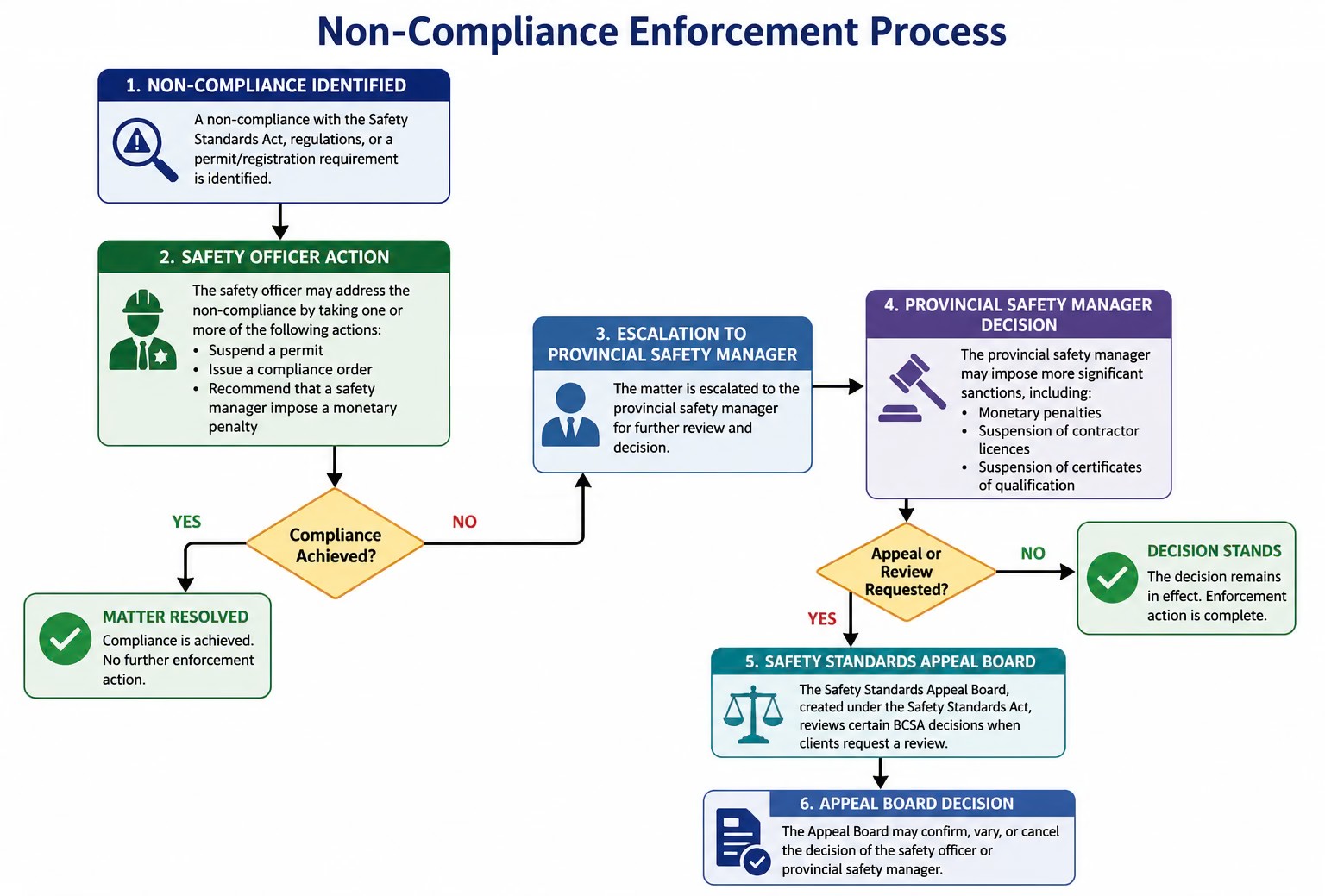
- An enforcement action typically begins with the safety officer. The safety officer is an employee/ inspector working for TSBC in British Columbia, who may address a non-compliance by suspending a permit, issuing a compliance order, or recommending that a safety manager impose a monetary penalty.
- The next step involves the provincial safety manager, also within Technical Safety BC, who may impose more significant sanctions such as monetary penalties or suspending contractors’ licences or certificates of qualification. Enforcement decisions by safety officers and safety managers are generally subject to review or appeal.
- The Safety Standards Appeal Board is created under the Safety Standards Act. It is this appeal board that can review certain TSBC decisions when clients request a review.
Leadership in Energy and Environmental Design
- Leadership in Energy and Environmental Design (LEED) is a program developed by the US Green Building Council to certify environmentally responsible and sustainable buildings. It comprises a suite of rating systems for recognizing best-in-class sustainable design, construction, and operation of high-performance green buildings, homes, and neighbourhoods.
- It provides third-party verification of green building projects that satisfy prerequisites and earn points to achieve different levels of certification. Prerequisites and credits differ for each rating system, and teams choose the best fit for the project.
- The program addresses the following types and scopes of projects:
- New construction and major renovation
- Core and shell
- Schools
- Hospitality
- Data centres
- Retail: new construction and major renovations / retail: commercial interiors
- Health care
- Commercial interiors
- Existing buildings: operations and maintenance
- Homes and multi-family dwellings
- Neighbourhood development
- LEED rating systems generally have 100 base points plus six “Innovation in Design” points and four “Regional Priority” points, for a total of 110 points (LEED for Homes is based on a 125-point scale, plus 11 Innovation in Design points). Each credit is allocated points based on the environmental impacts, sustainability outcomes, and human benefits that the building addresses. Projects achieve certification if they earn points according to the following levels:
- Certified: 40–49 points
- Silver: 50–59 points
- Gold: 60–79 points
- Platinum: 80+ points
- LEED also offers professional credentials for those in the industry who wish to document their knowledge of current sustainability and green building principles. LEED Green Associate and LEED AP accreditations are sought after when developing design teams for LEED projects.
Why This Matters for Plumbing Students
Plumbing systems directly impact:
- Water efficiency (low-flow fixtures, reuse systems)
- Environmental impact (less waste, energy use)
Many job sites (especially commercial) require LEED standards
You may install:
- High-efficiency fixtures
- Greywater or rainwater systems
- Energy-efficient hot water systems

Self-Test C-4.1: Identify Organizations, Code, and Standards Affecting the Pipe Trades
Complete Self-Test C-4.1 and check your answers.
If you are using a printed copy, please find Self-Test C-4.1 and Answer Key at the end of this section. If you prefer, you can scan the QR code with your digital device to go directly to the interactive Self-Test.
References
American National Standards Institute. (n.d.). About ANSI. https://www.ansi.org/about
American Society of Heating, Refrigerating and Air-Conditioning Engineers. (n.d.). About ASHRAE. https://www.ashrae.org/about
American Society of Mechanical Engineers. (n.d.). About ASME. https://www.asme.org/about-asme
American Society of Plumbing Engineers. (n.d.). About ASPE. https://www.aspe.org/about
American Society for Testing and Materials International. (n.d.). About ASTM International. https://www.astm.org/about
American Water Works Association. (n.d.). AWWA. https://www.awwa.org
BC Industry Training Authority. (2019). Piping trades apprenticeship program: Use Tools and Equipment—Level 1 harmonized [Binder]. Crown Publications, Queen’s Printer for British Columbia. https://www.crownpub.bc.ca/Product/Details/7960000261_S
- Plumber: Competency C-3 Use Codes, Regulations and Standards
- Steamfitter: Competency C-3 Use Codes, Regulations and Standards
- Sprinkler Fitter: Competency C-3 Use Codes, Regulations and Standards
British Columbia. (n.d.). Public health act. https://www2.gov.bc.ca/gov/content/health/about-bc-s-health-care-system/legislation/public-health-act
British Columbia. (n.d.). Safety standards act. https://www2.gov.bc.ca/gov/content/industry/construction-industry/building-codes-standards/legislation/safety-standards
British Columbia. (n.d.). Sewerage system regulation. https://www.bclaws.gov.bc.ca/civix/document/id/complete/statreg/22_326_2004
Camosun College. (2019). Line D: Organizational Skills —Competency D-4: Use codes, regulations and standards (Rev. ed.) [Learning guide]. BCcampus. https://collection.bccampus.ca/textbook/9MgG7bwy/
Camosun College. (2015). Trades Access Common Core Competency D-4: Use codes, regulations and standards. Victoria, B.C.: Crown Publications. Download for free from the B.C. Open Textbook Collection (https://open.bccampus.ca/browse-ourcollection/find-open-textbooks/).
Canadian Board for Harmonized Construction Codes. (n.d.). About the CBHCC. https://cbhcc-cchcc.ca/en/about-the-cbhcc/
Canadian Gas Association. (n.d.). About us. https://www.cga.ca/about-us/
Canadian General Standards Board. (n.d.). Canadian General Standards Board. https://www.canada.ca/en/public-services-procurement/services/standards-oversight/canadian-general-standards-board.html
Canadian Standards Association Group. (n.d.). About CSA Group. https://www.csagroup.org/about-csa-group/
Government of British Columbia. (n.d.). Gas safety regulation. https://www.bclaws.gov.bc.ca/civix/document/id/complete/statreg/15_103_2004
Government of British Columbia. (n.d.). Power engineers, boiler, pressure vessel and refrigeration safety regulation. https://www.bclaws.gov.bc.ca/civix/document/id/complete/statreg/104_2004
Government of British Columbia. (n.d.). Safety standards appeal board. https://www2.gov.bc.ca/gov/content/governments/organizational-structure/ministries-organizations/boards-commissions-tribunals/safety-standards-appeal-board
International Organization for Standardization. (n.d.). About ISO. https://www.iso.org/about-us.html
National Fire Protection Association. (n.d.). About us. https://www.nfpa.org/about-nfpa
National Research Council Canada. (n.d.). National building code of Canada. https://nrc-publications.canada.ca/eng/view/object/?id=515340b5-f4e0-4798-be69-692e4ec423e8
Standards Council of Canada. (n.d.). About SCC. https://scc-ccn.ca/
Technical Safety BC. (n.d.). Gas safety regulation amendments and adopted code revisions. https://www.technicalsafetybc.ca/regulatory-resources/regulatory-notices/information-bulletin-gas-safety-regulation-amendments-and-adopted-code-revisions
Technical Safety BC. (n.d.). Technical Safety BC. https://www.technicalsafetybc.ca/
UL Solutions. (n.d.). About UL Solutions in Canada. https://canada.ul.com/aboutus/
U.S. Green Building Council. (n.d.). LEED rating system. https://www.usgbc.org/leed
Media Attributions
All figures are sourced from Industry Training Authority (2019) and/or Camosun College (2019) and are used under the Creative Commons Attribution 4.0 (CC BY 4.0) licence unless otherwise noted. Images copyrighted by the BC Industry Training Authority are licensed under a Creative Commons Attribution-NonCommercial-ShareAlike 4.0 (CC BY-NC-SA 4.0) licence.
- Figure 1 CSA certification mark is used with permission from CSA.
- Figure 2 Non-compliance enforcement process was created by TRU Open Press using OpenAI (2026) as is subject to the CC BY-NC-SA license.
A set of rules that tells you how buildings must be built to keep people safe. (Section C-4.1)
A rule made by a government that must be followed. (Section C-4.1)
A guideline that explains how something should be done properly. (Section C-4.1)
A group that creates rules and guidelines for industries; e.g., ANSI, ASME, ASTM, CSA, UL. (Section C-4.1)
The health and safety of people in a community. (Section C-4.1)
Following rules, laws, or standards. (Section C-4.1)
To make different rules or systems work the same way. (Section C-4.1)
Proof that something meets certain rules or standards. (Section C-4.1; Section C-5.1)
A check to make sure work is done correctly and safely. (Section C-4.1)
The person or organization responsible for making sure rules, codes, and laws are followed. They have the power to approve work, inspect it, and enforce safety standards. (Section C-4.1)
Actions taken to make sure rules are followed, such as fines or license suspension. (Section C-4.1)
A type of nuclear power system made in Canada that uses heat to make electricity. (Section C-4.1)
A part (like a pipe or tank) that holds fluids under pressure safely. (Section C-4.1)
Official permission to do work, like building or plumbing. (Section C-4.1)
A system that rates how environmentally friendly a building is. (Section C-4.1)
Using resources in a way that protects the environment for the future. (Section C-4.1)