C-2.1 Electron Theory and Causes of Electricity
Electricity
Electricity is a form of energy that has the ability to do work. Energy cannot be created or destroyed; it merely changes from one form to another. Electricity is the movement of electrons, and it can be converted to light energy, mechanical energy, and heat energy. These electrons can be harnessed, stored and put to work. To understand how this is done, the theory of the electron must be examined.
Pipe trades workers are required to use electricity daily and require a basic understanding of the predictable and measurable nature of electricity and electrical circuits. Understanding electricity is crucial for the following:
- Using, troubleshooting, and maintaining electrical power tools
- Installing, troubleshooting, and servicing electrical appliances like hot water storage tanks, boilers and pumps
- Installing and troubleshooting electrical control systems like those found in heating and cooling
- Using multimeters safely
Matter
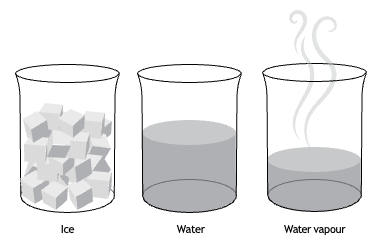
All matter, whether it is solid, liquid, or gas (Figure 1), is composed of tiny particles called atoms. Millions of these atoms could be placed on the head of a pin and still not be seen. Atoms are composed of three even smaller particles: electrons, protons, and neutrons (Figure 2).
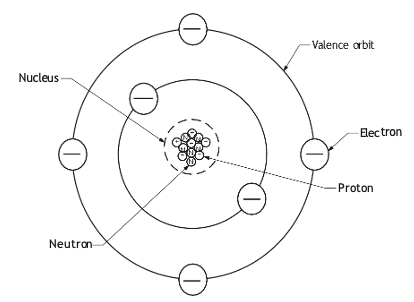
Atoms look very much like miniature solar systems. The sun is the core of the solar system; within the atom, the core is the nucleus, consisting of protons and neutrons tightly bound together. The sun has planets revolving around it; the atom’s “planets” are its electrons, which revolve around it at extremely high speeds (approximately 299,792 km/s or 186,000 miles/s).
In the solar system, the gravitational pull of the sun (its nucleus) holds its planets in orbit around it. The atom differs in that the protons and electrons are charged particles that attract one another, holding the atom together. Electrons have a negative (–) charge, and protons have a positive (+) charge. Neutrons are neutral and have no charge. Since opposite charges attract and like charges repel, the oppositely charged protons and electrons attract one another, holding electrons in orbit around the nucleus.
Electron orbits, called shells (Figure 3), vary in their distance from the nucleus. The electrons farthest from the nucleus are not bound as strongly to the atom. Atoms with one to three electrons in their outermost, or valence shell, are considered to be conductors. Under certain conditions, electrons in the valence shell can be knocked out of their orbits and become “free” electrons.
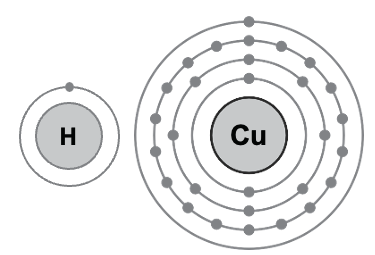
When this happens, an atom has more protons than electrons and is said to be ionized. In this condition, the atom has a positive charge and is called a cation. Since atoms normally have an equal number of protons and electrons, the positively charged atom would then try to pick up a stray electron to balance itself. This new electron might come from an atom nearby that may be experiencing the same condition that excited its atoms, and the process would repeat. Thus, there is a flow of electrons from atom to atom, and this is called electricity.
Fundamentals of Magnetism
A basic understanding of magnetism will help in your understanding of electricity. There are three classes of magnets: natural, artificial, and electric. Natural magnets, such as magnetite, are very weak and are not commonly used in the trades.
Artificial magnets are made from magnetic material such as iron, nickel, or cobalt and are permanently induced with magnetic force (magnetized) during their construction. They are used in devices such as electric motors, credit cards, and speakers.
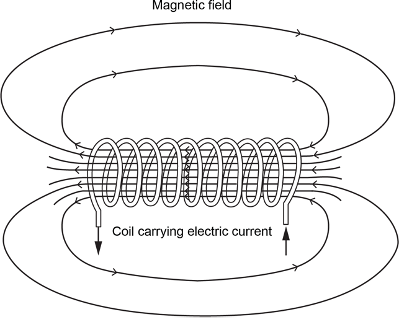
The electromagnet is created by pushing a current through a coiled conductor and can be turned on and off.
All magnets have specific rules that govern their operation:
- Magnets have two poles, north and south. Like poles will repel, and unlike poles will attract. This rule highlights the magnetic force associated with magnets and explains the science behind a compass.
- Magnetic lines of force (flux lines) are continuous and form loops from the north pole to the south pole.
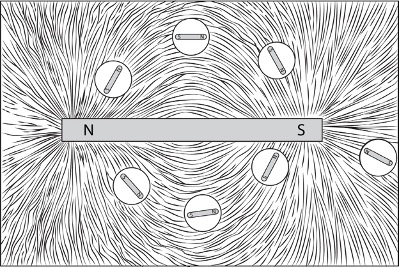
- Magnetic lines of force never cross. This is illustrated in Rule 1: like poles repel. As these lines cannot cross, they must act against each other.
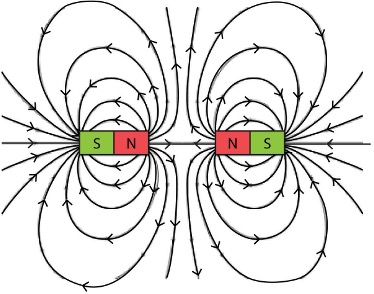
- Lines of flux form tight loops when unlike poles attract. This is illustrated in Rule 1: unlike poles attract. These tight loops act like rubber bands constricting, forcing two magnets to become one.
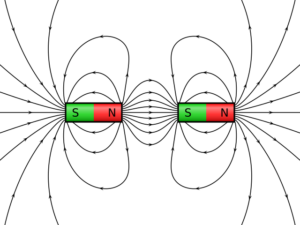
- Magnetic lines of force can pass more easily though materials that can be magnetized. This property is called permeability, the measure of response to a magnetic field of force.
- There is NO insulation against magnetic lines of force.
Electricity and Magnetism
Electricity and magnetism are directly related. If a current is pushed through a conductor, magnetic lines of force, or magnetic force, are created around it. If a conductor moves through a magnetic field, or a magnet moves through a coiled conductor, the moving magnetic field will induce a voltage potential. The faster the magnet moves, the stronger the voltage.
We see this phenomenon of electromagnetism in the generation of AC current, where kinetic energy, like falling water through a hydro dam, turns a conductor through a magnetic field called an AC generator, producing voltage potential. We see it in equipment such as a solenoid valve, where a current flow actuates a valve stem to control flow of fluid through the valve or a current pushed through a coil around a magnet moves an electrical motor. In each, the higher the voltage potential, the stronger the magnetic force, and vice versa.
We see the relationship between electricity and magnetism in Ampere’s Force Law that explains the magnetic force of attraction and repulsion by two wires carrying current. Taken further, this law explains what happens when a conductor is formed into a loop (see Transformers in C-2.2 Electrical Circuits).
Conductors
To use electrons (electricity) to do work, they must be transported from one place to another. Electrons can be made to flow in all matter; however, this flow is much easier in some kinds of matter than others. The atoms of some matter tend to hold on to their valence electrons very tightly, while other forms of matter easily lose their valence electrons. To transport electrons, select material that permits easy flow. These materials are called conductors. Examples of good conductors are silver, copper, aluminum and mercury. Conductive material is usually formed into wire. Wire permits easy transportation of electrons over great distances.
Conductors in the form of wires are one of the four basic components of an electric circuit. Conductors are not all equal in composition, and there are possible dangerous consequences of choosing the wrong size or type of conductor.
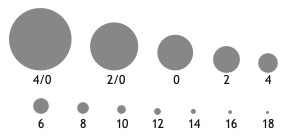
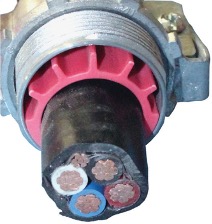
The quantity of electrons that can be safely transferred by a conductor depends upon the diameter of the conductor (Figure 8). If too many electrons flow through a small conductor, large amounts of heat are generated and, as the undersized conductor heats up, the wire’s resistance tends to rise, creating a feedback loop that has the potential for fire. Therefore, the cross-sectional area of a conductor is the basis for sizing conductors or wire. Conductors are sized according to gauge numbers. In the American wire gauge (AWG) system of wire sizing, the lower the gauge number, the larger the cross-sectional area and the greater the flow of electrons (simplified: “lower number = thicker wire”). AWG, along with wire material selection, factors in the choosing of an appropriate conductor in a given system. Actual conductor selection goes beyond the scope of this material.
Insulators are materials with extremely low conductivity (Figure 9). They have five to seven electrons in their valence shell and cling tightly to their valence electrons. Some examples of good insulators are rubber, wood, glass, and cork. The properties of conductors and insulators are essential in utilizing electricity. Conductors put electricity where it is needed, while insulators isolate the flow of electricity.
Sources of Electromotive Force
It is necessary to have a force or pressure to make electricity flow through a path called a circuit. Electrical pressure, like most other pressures, is a force. It is this force that creates the action and keeps the electrons moving in a circuit. This electrical pressure is called electromotive force (EMF) and is measured in units called volts. Voltage is the potential pressure difference measured between two points in an electrical circuit, and 6.24 quintillion (6.24 × 10¹⁸) electrons gathered at one point are known as a coulomb of potential. Voltage potential describes the source in a circuit, such as a storage battery or an AC source, and is one of the four basic components of an electric circuit.
There are six principal causes of electromotive force or potential:
- Heat
- Magnetism
- Chemicals
- Pressure
- Friction
- Light
Heat
When heat is applied to two dissimilar metals at the point where they are joined, electrons move from one metal to the other, and electricity is produced. This method is known as thermoelectricity and is called the thermoelectric effect.
The more heat applied, the greater the amount of electric charge produced. The electric charge created is a result of differences in temperatures within the hot and cold junctions of the metals and the different ability that each metal has in holding on to its electrons. Each of the metals responds to the difference in temperature in different ways. Electrons will flow from the material that gives up its electrons easily (the anode) to the other material, which has a greater tendency to hold on to its electrons (the cathode).
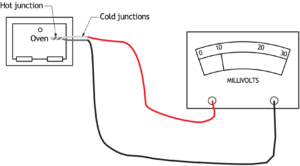
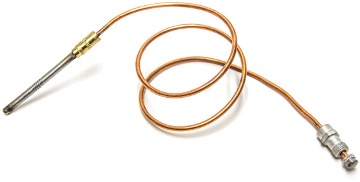
A good example of this method of generating electricity used in the heating trade is a thermocouple (Figure 10). A thermocouple is made of two dissimilar metals welded together at the tip. When a pilot flame is directed at the tip of a thermocouple, a charge of electricity is created at the thermocouple’s cold junctions. The connection of the cold junctions to a safety shutoff valve causes current to flow through a coil of wire within the valve, energizes an electromagnet that holds the valve in the open position, and allows gas to flow to the appliance.
Magnetism
Moving a conductor through a magnetic field, or moving a magnetic field across a conductor, induces a voltage and causes an electric current to flow. This process, known as electromagnetic induction, is a key principle of electromagnetism, and is used to generate alternating current (AC) electricity using permanent magnets.
The pressure of water or steam, as found in a nuclear or natural gas power plant, is used to rotate a coil of wire between the north and south poles of a magnetic field (Figure 11). The movement of the coil within the magnetic field induces current and voltage within the coil.
Watch the following video by Science ABC (2024) on YouTube titled “Electromagnetism Explained in Simple words” [4:13].
If you are using a printed copy, you can scan the QR code with your digital device to go directly to the video: Electromagnetism Explained in Simple Words

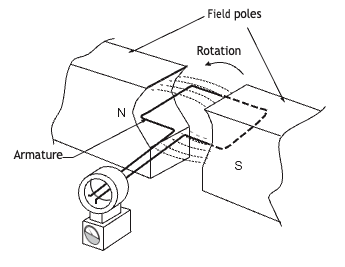
Split-ring commutators, brushes and other devices are used to harness this energy, which is called alternating current (AC). In North American–generated voltage, current and voltage build up and drop off in a positive cycle, then build up and drop off in the opposite direction 60 times every second, a frequency of 60 hertz (Hz). In Europe, the generators are turned at slightly slower speeds, causing AC electricity to be generated at a frequency of 50 cycles per second, or 50 Hertz.
Chemicals
Batteries produce electricity through electrochemical reactions. Each battery (or cell) contains electrodes and an electrolyte that allow charged particles to move. This process, called electrochemistry, produces direct current (DC) electricity.
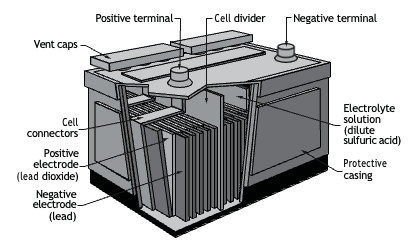
All batteries contain one or more cells, but people often use the terms battery and cell interchangeably. A cell is just the working chemical unit inside a battery; one battery can contain any number of cells. A cell has three main parts: a positive electrode (cathode), a negative electrode (anode), and a liquid or paste in contact with them called the electrolyte (Figure 12). When a battery is externally connected to an electric circuit, a chemical reaction takes place in the electrolyte. This causes ions (in this case, atoms with a positive electrical charge) to flow through the electrolyte in one direction, with electrons (particles with a negative charge) flowing through the outer circuit in the other direction. This movement of electric charge makes an electric current flow through the cell and through the circuit it is connected to.
It’s important to note that the electrodes in a battery are always made from two dissimilar materials. This is the key to how and why a battery works: one of the materials, the anode, readily gives up electrons; the second material, the cathode, readily receives electrons. If both electrodes were made from the same material, there would be no exchange of electrons and no current would flow. This phenomenon is seen in a serious nuisance condition called electrolysis, occurs naturally in metal systems such as underground pipelines, and causes material corrosion.
Pressure
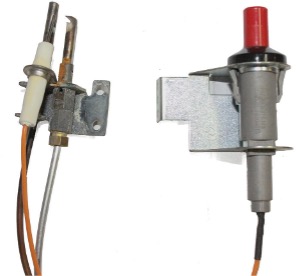
Applying pressure to certain materials produces electricity. This is called piezoelectricity. The force of the pressure passes through the material to its atoms and drives the electrons out of orbit toward the force. Positive and negative charges are built up on opposite sides of the material.
The effect is most noticeable in crystal materials. Piezoelectricity can be seen clearly in an ordinary spark igniter used to light a gas barbecue (Figure 13).
Friction
If you walk across a carpet and get a shock when you touch a metal doorknob, or get a jolt from the door handle of a car, you have experienced the creation of electricity through friction, which is known as triboelectricity or static electricity. This occurs when two dissimilar materials are rubbed together, causing electrons to migrate to one of the materials. A path for the electrons to get to ground is completed when you touch the energized material and are in contact with the earth or ground through your feet. Large trucks carrying gasoline drag chains to constantly discharge any buildup of static electricity so that there cannot be any spark created once the truck stops moving. Lightning is an extreme effect of static discharge.
Light
Light is another form of energy and is thought to consist of small particles of energy called photons. When a light beam strikes certain materials (including potassium and sodium), the energy from the photons causes the atoms to release electrons. This is called photoelectricity or the photoelectric effect (Figure 14). The best example of this is using the sun to generate electricity. Also known as photovoltaics, using solar panels to generate electricity has become common these days.
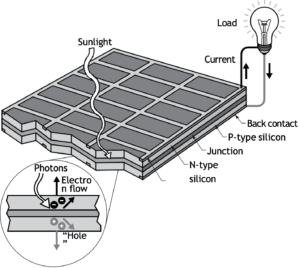
Of these six causes of electricity, all but magnetism cause direct current (DC) voltage; magnetism or electromagnetic induction causes alternating current or (AC) voltage.

Self-Test C-2.1: Electron Theory and Causes of Electricity
Complete Self-Test C-2.1 and check your answers.
If you are using a printed copy, please find Self-Test C-2.1 and Answer Key at the end of this section. If you prefer, you can scan the QR code with your digital device to go directly to the interactive Self-Test.
References
BCcampus. (n.d.). Playlist: Tools and equipment videos. BCcampus MediaSpace. https://media.bccampus.ca/playlist/details/0_3g8xp22x/categoryId/175673 Playlist Details – Trades Access Common Core Line C: Tools and Equipment Videos – BCcampus
BC Industry Training Authority. (2019). Piping trades apprenticeship program: Use Tools and Equipment—Level 1 harmonized [Binder]. Crown Publications, Queen’s Printer for British Columbia. https://www.crownpub.bc.ca/Product/Details/7960000261_S
- Plumber: Competency O-1 Use the Principles of Electricity
- Steamfitter: Level 2 Competency K-1 Use the Principles of Electricity
- Sprinkler Fitter: Competency C-1 Use Mathematics and Science
Camosun College. (2019). Line D: Tools and Equipment—Competency D-2: Apply Science Concepts to Trades Applications (Rev. ed.) [Learning guide]. BCcampus. https://collection.bccampus.ca/textbook/qFKGAJ78/
Camosun College. (2015). Line E – Electrical fundamentals competency E-1: Describe the Basic Principles of Electricity. BCcampus.
https://collection.bccampus.ca/textbook/fGcTBtJh/
Camosun College. (2015). Line E – Electrical fundamentals competency E-2: Identify common circuit components and their symbols. BCcampus.
https://collection.bccampus.ca/textbook/fGcTBtJh/
Camosun College. (2015). Trades Access Common Core Competency D-2: Apply Science Concepts to Trades Applications. Victoria, B.C.: Crown Publications. Download for free from the B.C. Open Textbook Collection (https://open.bccampus.ca/browse-ourcollection/find-open-textbooks/).
Science ABC. (2024, July 22). Electromagnetism explained in simple words [Video]. YouTube. https://www.youtube.com/watch?v=nllCgjlWAF4
Media Attributions
All figures are sourced from Industry Training Authority (2019) and/or Camosun College (2019) and are used under the Creative Commons Attribution 4.0 (CC BY 4.0) licence unless otherwise noted. Images copyrighted by the BC Industry Training Authority are licensed under a Creative Commons Attribution-NonCommercial-ShareAlike 4.0 (CC BY-NC-SA 4.0) licence.
A very small particle with a negative charge. (Section C-2.1)
Energy that travels as waves we can see, like sunlight or light from a bulb. (Section C-2.1)
Energy of movement or position, such as a moving machine or a lifted object. (Section C-2.1)
Energy that makes things warmer and can move from one object to another. (Section C-2.1)
A complete path that allows electricity to flow from a power source, through wires and devices, and back to the source. (Section C-2.2)
The smallest part of an element that still has its properties. (Section C-1.11)
A particle in an atom with a positive charge. (Section C-2.1)
A particle in an atom with no electrical charge. (Section C-2.1)
Tiny particles, like electrons or ions, that have a positive or negative electric charge. (Section C-2.1)
The outermost layer of electrons around an atom that helps determine how it reacts with other atoms. (Section C-2.1)
A material that allows electric current to flow easily because it has low electrical resistance. Conductors have free electrons that move readily when a voltage is applied.
Common examples include copper, aluminum, gold, and most metals. (Section C-2.1)
A positively charged ion (an atom that has lost electrons). (Section C-2.1)
The flow of tiny particles called electrons through a material, usually a wire. (Section C-2.1)
A force that can attract or repel objects. (Section C-2.1)
A natural magnetic rock (iron ore) that can attract metal and is used to make magnets. (Section C-2.1)
A magnet made by electricity that can be turned on and off. (Section C-2.1)
The pressure that pushes electricity through a circuit. (Section C-2.1)
The force created by electricity and magnetism working together, such as when electric current makes a magnet. (Section C-2.1)
A machine that makes electricity by spinning a coil or magnet, producing alternating current (AC). (Section C-2.1)
A valve that opens or closes using an electric current and a magnetic coil. (Section C-2.1)
A rule that explains how a magnetic field pushes on a wire when electric current flows through it. (Section C-2.1)
A measure of how much a material slows down electric flow. (Section C-2.1)
A standard way to measure how thick electrical wires are. Smaller numbers mean thicker wires. (Section C-2.1)
A material that does not allow electricity to flow easily. (Section C-2.1)
A complete path that electricity can travel through, usually made of wires and components like batteries and devices. (Section C-2.1)
The force that pushes electricity through a circuit. (Section C-2.1)
A unit used to measure voltage, which is the push that moves electricity through a circuit. (Section C-2.1)
A unit used to measure electric charge. (Section C-2.1)
The creation of electricity from heat differences between two materials. (Section C-2.1)
The process of making electricity when there is a difference in temperature between two materials. (Section C-2.1)
The electrode where electric current leaves a device or where oxidation happens in a chemical reaction. (Section C-2.1 and Section C-2.2)
The electrode where electric current enters a device or where reduction happens in a chemical reaction. (Section C-2.1)
A device made of two different metals that produces a small voltage when heated, used to measure temperature. (Section C-2.1)
The point where thermocouple wires connect to a meter, used as a reference temperature to help measure the actual temperature. (Section C-2.1)
The process of creating electricity when a magnet moves near a wire or a wire moves in a magnetic field. (Section C-2.1)
Electric current that changes direction back and forth many times per second. (Section C-2.1)
A unit used to measure frequency, meaning how many times something happens in one second. For example, 60 Hz means something happens 60 times per second. (Section C-2.1)
A chemical reaction where electrons move from one substance to another, often producing or using electrical energy. (Section C-2.1)
The study of how chemical reactions and electricity are connected, especially how chemical reactions can produce electricity or use it. (Section C-2.1)
Electric current that flows in one direction only, like the electricity from a battery. (Section C-2.1)
A liquid or substance that can carry electricity because it has charged particles in it. (Section C-2.1)
The process of using electricity to cause a chemical change, such as breaking a substance into simpler parts. (Section C-2.1)
Electricity that is produced from pressure, when certain materials are squeezed, pressed, or vibrated. (Section C-2.1)
A force that resists motion when two surfaces rub against each other, making it harder for objects to move. (Section C-2.1)
A buildup of electric charge on an object caused by rubbing two different materials together. (Section C-2.1)
Tiny packets of light energy that travel from a light source, like the Sun or a light bulb. (Section C-2.1)
The process where light hitting a material causes it to release electrons and create electricity. (Section C-2.1)
The technology that turns sunlight directly into electricity, such as in solar panels. (Section C-2.1)