C-1.4 Use Formulas to Calculate Volumes
In this section, you will learn how to calculate the volume of common shapes used in the plumbing trade, including tanks and cylinders. Volume tells us how much space an object can hold, which is important when working with water, gas, and other materials in piping systems. You will learn and apply formulas to calculate volume using consistent units, and practise solving real-world problems related to capacity and storage. These skills are essential for ensuring systems are sized correctly and operate safely and efficiently.
Volume
The definition of volume is the amount of space occupied by a three-dimensional (3D) object, expressed in cubic units. The term volume is often expressed as the holding capacity or the number of cubic units enclosed within an object such as a vat or tank. We can calculate volume using formulas based on the shape of the object. Before calculating volume, all dimensions must be in the same units, so you may have to convert one or more of the dimensions before calculating to solve the problem.
Volumes are measured in cubic units. The imperial system of volume measurement includes the following typical units:
- Cubic inches
- Cubic yards
- Cubic feet
- Gallons
The metric system of volume measurement includes the following typical units:
- Cubic centimetres
- Cubic metres
- Litres
Volume calculations are three dimensional. They involve three dimensions: length, width, and height. For example, when we multiply the length dimension of a tank (in feet) times the width dimension (in feet) times the height dimension (in feet), we get the volume or capacity measurement of the tank, in cubic feet. So the unit multiplication ft × ft × ft gives the answer ft3 (or cu. ft). Similarly, the metric unit multiplication m × m × m gives the answer m³ (or cu. m).
Volume of a Rectangular Tank
Key idea: Volume = length × width × height (for rectangular shapes).
For example, if you have a cube that is 12″ by 12″ by 12″, as shown in Figure 1, you could determine there would be 1,728 one-inch cubes that will fit into the larger cube. Another way of calculating volume is to find the area of the base and multiply that area by the height.
[latex]\quad\text{Area} \times \text{height} = \text{volume}[/latex]
In the case of a square tank where all sides are equal, you can find the volume (V) by cubing the length of one side (S3):
[latex]\quad\text{V} = \text{S}^3\\ \quad\text{V} = 12^3\\ \quad\text{V} = 1,728\text{ in.}^3[/latex]
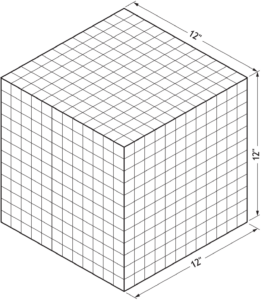
When solving for a rectangular tank, the volume (V) can be calculated by multiplying the length (L) by the width (W) by the height (H):
[latex]\quad\text{V} = \text{L} \times \text{W} \times \text{H}[/latex]
Example 1:
A rectangular tank has a length of 5′ 3″, a width of 2′ 9″ and a height of 1′ 8″. What is the volume in cubic feet?
Solution:
The first step and most important step is to determine what units you are going to work with.
For the example, you must decide between feet and inches. It is essential that you convert the dimensions to one common unit. It doesn’t really matter which one you choose, but all dimensions must be in the same units.
For example, if we used feet, then:
[latex]\quad\text{Length} = 5\text{'}3\text{"} = 5.25\text{'}\\ \quad\text{Width} = 2\text{'}9\text{"} = 2.75\text{'}\\ \quad\text{Height} = 1\text{'}8\text{"} = 1.667\text{'}\\ \quad\text{V} = \text{L} \times \text{W} \times \text{H}\\ \quad\text{V} = 5.25\text{'} \times 2.75\text{'} \times 1.667\text{'} = 24.067\text{ ft}^3[/latex]
If we used inches, then:
[latex]\quad\text{Length} = 5\text{'}3\text{"} = 63\text{"}\\ \quad\text{Width} = 2\text{'}9\text{"} = 33\text{"}\\ \quad\text{Height} = 1\text{'}8\text{"} = 20\text{"}\\ \quad\text{V} = \text{L} \times \text{W} \times \text{H}\\ \quad\text{V} = 63\text{"} \times 33\text{"} \times 20\text{"} = 41,580\text{ in.}^3[/latex]
Or
[latex]\quad\frac{41,580\text{ in.}^3}{1,728\frac{\text{ in.}^3}{\text{ ft}^3}} = 24.063\text{ ft}^3[/latex]
The slight difference between the two answers is the result of rounding off the decimals in the conversion of inches to feet. If all of the decimals are used, the difference becomes even less. In answering exercise problems, either answer is acceptable, but note that, for the greatest accuracy, the use of inches produces a more accurate answer.
Example 2:
A rectangular tank has a length of 3.21 m, a width of 4.73 m, and a height of 1,400 mm. What is the volume in cubic metres?
Solution:
The first step is to decide what units you are going to work with. In this example, you have a choice of metres or millimetres. Because a millimetre is a very small unit of measurement, it is recommended to convert millimetres to metres before substituting into the formula for all volume questions.
[latex]\quad\text{Length} = 3.21\text{ m}\\ \quad\text{Width} = 4.73\text{ m}\\ \quad\text{Height} = 1,400\text{ mm} = 1.4\text{ m}\\ \quad\text{V} = \text{L} \times \text{W} \times \text{H}\\ \quad\text{V} = 3.21\text{ m} \times 4.73\text{ m} \times 1.4\text{ m} = 21.257\text{ m}^3[/latex]
Volume of a Cylinder
Finding the volume of a cylinder requires two calculations:
First, calculate the area of the base in the same way that you would find the area of a circle [latex](\text{d}^2 \times 0.7854)[/latex].
Note: The value 0.7854 is equal to π ÷ 4, so this formula is another way of writing πr² using diameter instead of radius.
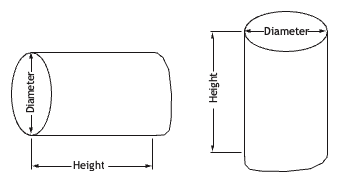
Second, multiply the base area by the height of the cylinder [latex](\text{d}^2 \times 0.7854 \times \text{H})[/latex].
The height of the cylinder is opposite to the round end, no matter which position the cylinder is in (Figure 2).
Example 1:
A cylindrical tank has a diameter of 4′ 9″ and a height of 11′ 3″. What is the volume of the tank in ft3?
Solution:
Change all of the dimensions to feet:
[latex]\quad\text{Diameter} = 4\text{'}9\text{"} = 4.75\text{'}\\ \quad\text{Height} = 11\text{'}3\text{"} = 11.25\text{'}\\ \quad\text{V} = \text{d}^2 \times 0.7854 \times \text{H}\\ \quad\text{V} = 4.75^2 \times 0.7854 \times 11.25\\ \quad\text{V} = 199.357\text{ ft}^3[/latex]
Example 2:
A cylindrical tank has a diameter of 1,200 mm and a height of 3,700 mm. What is the volume of the tank in m3?
Solution:
Change the dimensions to metres:
[latex]\quad\text{Diameter} = 1,200\text{ mm} = 1.2\text{ m}\\ \quad\text{Height} = 3,700\text{ mm} = 3.7\text{ m}\\ \quad\text{V} = \text{d}^2 \times 0.7854 \times \text{H}\\ \quad\text{V} = 1.2^2 \times 0.7854 \times 3.7\\ \quad\text{V} = 4.185\text{ m}^3[/latex]

Self-Test C-1.4: Use Formulas to Calculate Volumes
Complete Self-Test C-1.4 and check your answers.
If you are using a printed copy, please find Self-Test C-1.4 and Answer Key at the end of this section. If you prefer, you can scan the QR code with your digital device to go directly to the interactive Self-Test.
References
BCcampus. (n.d.). Playlist: Tools and equipment videos. BCcampus MediaSpace. https://media.bccampus.ca/playlist/details/0_3g8xp22x/categoryId/175673 Playlist Details – Trades Access Common Core Line C: Tools and Equipment Videos – BCcampus
BC Industry Training Authority. (2019). Piping trades apprenticeship program: Use Tools and Equipment—Level 1 harmonized [Binder]. Crown Publications, Queen’s Printer for British Columbia. https://www.crownpub.bc.ca/Product/Details/7960000261_S
- Plumber: Competency C-1 Use Mathematics and Science
- Steamfitter: Competency C-1 Use Mathematics and Science
- Sprinkler Fitter: Competency C-1 Use Mathematics and Science
Camosun College. (2019). Line C: Tools and Equipment—Competency D-1: Solve Trades Mathematical Problems (Rev. ed.) [Learning guide]. BCcampus. https://collection.bccampus.ca/textbook/qFKGAJ78/
Camosun College. (2015). Trades Access Common Core Competency D-1: Solve Trades Mathematical Problems. Victoria, B.C.: Crown Publications. Download for free from the B.C. Open Textbook Collection (https://open.bccampus.ca/browse-ourcollection/find-open-textbooks/).
Camosun Innovates. (2022). Tools and Equipment Videos [Video playlist]. Camosun College/BCcampus. https://camosuninnovates.opened.ca/
Flinn, C. (n.d.). OER for Trades: Math for Trades [Video collection]. BCcampus MediaSpace. https://media.bccampus.ca/channel/OER%2Bfor%2BTrades%3A%2BMath%2Bfor%2BTrades/175670
Note: these videos align with the open textbooks Math for Trades: Volume 1 and Math for Trades: Volume 2. All videos are by Chad Flinn and available under a Creative Commons Attribution 4.0 Licence.:
Media Attributions
All figures are sourced from Industry Training Authority (2019) and/or Camosun College (2019) and are used under the Creative Commons Attribution 4.0 (CC BY 4.0) licence unless otherwise noted. Images copyrighted by the BC Industry Training Authority are licensed under a Creative Commons Attribution-NonCommercial-ShareAlike 4.0 (CC BY-NC-SA 4.0) licence.
The amount of space inside a 3D object (Section C-1.3)
A standard amount used to measure something. For example, metres measure length, litres measure volume, and seconds measure time. (Section C-1.4)
Having depth, with measurements like length, width, and height, in both box-shaped and round objects. (Section C-1.4)
Units used to measure volume, found by multiplying three dimensions. (Section C-1.4)
The amount something can hold inside, like a tank or container (Section C-1.4)
The measurements of an object, such as length, width, and height. (Section C-1.3)
The measurement of how long something is. (Section C-1.4)
The measurement of how wide something is from side to side. (Section C-1.4)
The vertical measurement from bottom to top of an object. (Section C-1.4)
A box-shaped container with length, width, and height. (Section C-1.4)
The distance across a circle through the centre. (Section C-1.3)