Self-Test C-1.7.2: Calculate Piping Measurements
Complete Self-Test C-1.7.2 and check your answers.
- Calculate the total fall to the nearest [latex]\frac{1}{8}[/latex] inch:
Grade = [latex]\frac{1}{8}\text{"}[/latex] per foot
Length = 95 feet
Total fall = in.
- Calculate the total fall to the nearest [latex]\frac{1}{8}[/latex] inch:
Grade = 1%
Length = 125 feet
Total fall = in.
- Calculate the pipe length:
Total fall = 0.95 feet
Grade = 2%
Length = ft. in.
- Calculate the pipe length:
Total fall = 11 inches
Grade = [latex]\frac{1}{8}\text{"}[/latex] per foot
Length = ft.
- Calculate the grade in inches per foot:
Total fall = 24 inches
Length = 192 feet
Grade = [latex]\frac{\text{in.}}{\text{ft.}}[/latex]
- Calculate the grade as a percentage:
Total fall = 4.5 feet
Length = 475 feet
Grade = %
- Calculate the total fall to the nearest [latex]\frac{1}{8}[/latex] inch:
Grade = [latex]\frac{1}{8}\text{"}[/latex] per foot
Length = 130 feet
Total fall = in.
- Calculate the total fall to the nearest [latex]\frac{1}{8}[/latex] inch:
Grade = 0.5%
Length = 445 feet
Total fall = in.
- Calculate the length:
Total fall = 162 mm
Grade = 1%
Length = m
- Calculate the length:
Total fall = 18 inches
Grade = 1:133
Length = ft.
- Calculate the grade in inches per foot:
Total fall = 8 inches
Length = 128 feet
Grade = [latex]\frac{\text{in.}}{\text{ft.}}[/latex]
- Calculate the grade as a percentage:
Total fall = 3 feet
Length = 555 feet
Grade = %
- Calculate the total fall to the nearest [latex]\frac{1}{8}[/latex] inch:
Grade = [latex]\frac{1}{4}\text{"}[/latex] per foot
Length = 19 feet
Total fall = in.
- Calculate the total fall to the nearest [latex]\frac{1}{8}[/latex] inch:
Grade = 1:50
Length = 95 feet
Total fall = in.
- Calculate the pipe length:
Total fall = 18″
Grade = 1.5%
Length = ft.
- Calculate the pipe length:
Total fall = [latex]8\frac{7}{8}\text{"}[/latex]
Grade = 1:50
Length = ft. in.
- Calculate the grade in inches per foot:
Total fall = 23″
Length = 184′
Grade = [latex]\frac{\text{in.}}{\text{ft.}}[/latex]
- Calculate the grade as a percentage:
Total fall = [latex]54\frac{3}{4}\text{"}[/latex]
Length = 456′
Grade = %
- Calculate the total fall to the nearest [latex]\frac{1}{8}[/latex] inch:
Grade = [latex]\frac{1}{16}\text{"}[/latex] per foot
Length = 165′
Total fall = in.
- Calculate the total fall to the nearest [latex]\frac{1}{8}[/latex] inch:
Grade = 1.5%
Length = 325 feet
Total fall = in.
- Calculate the length:
Total fall = 18″
Grade = 1.04%
Length = ft.
- Calculate the length:
Total fall = 45″
Grade = [latex]\frac{1}{8}\text{"}[/latex] per foot
Length = ft.
- Calculate the grade as a ratio:
Total fall = 9″
Length = 37′ 6″
Grade =
- Calculate the grade as a ratio:
Total fall = 4.66′
Length = 1400′
Grade =
- Convert each measurement to engineer’s measurement (3 decimal places):
a. 18′ 6″ = d. 33′ 10″ =
b. 15′ 5″ = e. 35′ 11[latex]\frac{1}{4}[/latex]” =
c. 32′ 9″ =
- Convert each measurement to builder’s measure (nearest [latex]\frac{1}{8}\text{"}[/latex]):
a. 84.27′ = d. 123.44′ =
b. 93.08′ = e. 156.92′ =
c. 106.71′ =
- A house construction site has a benchmark of 100.00′, basement floor elevation of 94.20′, first floor elevation of 103.75′ and second floor elevation of 113.00′.
- How far below the benchmark is the basement floor?
Answer =
-
- How far above the benchmark is the first floor?
Answer =
-
- What is the distance from the basement floor to the first floor?
Answer =
-
- What is the distance from the first floor to the second floor?
Answer =
- The low end of a sanitary building drain has an elevation of 91.55 feet. The grade is [latex]\frac{1}{8}[/latex] inch per foot.
- What is the elevation of a fitting 10′ upstream of the low point?
Answer =
-
- What is the elevation of a fitting 25′ upstream of the low point?
Answer =
- Refer to Figure 27 to solve for the unknown values.
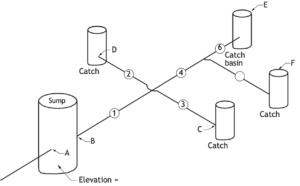
Notes:
- Main line (pipe sections 1 & 4) are 12″ in diameter
- Branch line (pipe sections 2, 3, 5 & 6) are 6″ in diameter
- Grade on all pipe sections is [latex]\frac{\frac{1}{8}\text{"}}{\text{ft.}}[/latex]
Sump:
- Liquid depth = 24″
- Inlet is 4″ higher than outlet
- Sump height = 60″
Catch basin:
- Liquid depth = 18″
- Catch basin height = 36″ Pipe lengths:
- Main sections:
▸ Pipe section 1 = 30′
▸ Pipe section 4 = 125′
- Branches:
▸ Pipe section 2 = 75′
▸ Pipe section 3 = 21′
▸ Pipe section 5 = 40′
▸ Pipe section 6 = 64′
The invert level of a pipe is the level taken from the bottom inside of the pipe, as shown.
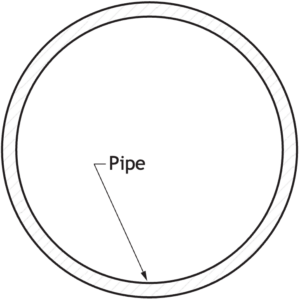
Solve for the following elevations in feet to 3 decimal places:
A. Outlet invert = D. Outlet invert =
B. Inlet invert = E. Top elevation =
C. Outlet invert = F. Top elevation =
Answer Key: Self-Test C-1.7.2 is on the other page.