C-1.19 Perform Heat Load Calculations
Heat load calculations are used to determine how much heat energy is required to change or maintain the temperature of fluids in a piping system. These calculations are important in applications such as hot water systems, boilers, hydronic heating, and process piping. To perform accurate heat load calculations, students must understand several heat-related properties, including specific heat, temperature change, and mass. The following section introduces specific heat, which is the amount of heat needed to raise or lower the temperature of a substance.
Specific Heat
Specific heat is the amount of heat necessary to raise or lower the temperature of a unit mass of a substance by one degree. In the imperial system, specific heat references the number of British thermal units (BTU) required to change 1 lb. of a substance 1 °F. For example, adding 1 BTU of heat energy to 1 lb. of water would increase the temperature by 1 °F. When substances other than water are heated, different values occur. For instance, ice and steam do not have the same specific heat as water, although they are really just water in different states. Both ice and steam have a specific heat of [latex]0.5 \frac{\frac{\text{BTU}}{\text{lb.}}}{\text{ °F}}[/latex]. Therefore, adding 1 BTU of heat energy to one pound of either of these substances would cause a 2 °F temperature rise.
In the metric system, specific heat is calculated as the number of calories needed to raise or lower the temperature of 1 gram of a given substance by 1 °C. The heat capacity of water in metric is calculated as 4.19 kJ/(kg · °C).
In either system, specific heat compares the amount of heat required to change the temperature of a substance to that required for an equal mass of water.
Table 1 gives the specific heats of several substances.
|
Substance |
Specific Heat [latex]\frac{\frac{\text{BTU}}{\text{lb.}}}{\text{ °F}}[/latex] |
Specific Heat [latex]\frac{\frac{\text{Cal}}{\text{gram}}}{\text{ °C}}[/latex] |
|
Aluminum |
0.224 |
0.224 |
|
Brick |
0.22 |
0.22 |
|
Concrete |
0.156 |
0.156 |
|
Copper |
0.092 |
0.092 |
|
Ice |
0.5 |
0.5 |
|
Steel |
0.116 |
0.116 |
|
Water |
1 |
1 |
|
Sea water |
0.94 |
0.94 |
|
Steam |
0.5 |
0.5 |
|
Air (average) |
0.24 |
0.24 |
Key Idea: Specific heat tells you how much energy is needed to change temperature. Some materials heat up quickly, while others require much more energy.
Total Heat
Total heat is the combined amount of sensible heat and latent heat needed to change a substance from one condition to another. It includes both the heat that changes temperature (sensible) and the heat that changes state, such as melting or boiling (latent).
Sensible Heat
Sensible heat is heat that can be measured by a thermometer or felt by our sense of touch (thus “sensible”). If a substance is heated and the temperature rises, the increase is called sensible heat gain. Likewise, if heat is removed and the temperature decreases, the result would be a sensible heat loss.
Sensible heat considers that there is no change of state of the material, only a temperature change. An example of this would be water heating in a pan. As heat is added to the water, its temperature will rise until it reaches its atmospheric boiling point. The temperature cannot rise above this point until all the water has boiled into steam. Once this occurs, the steam’s temperature can be raised using additional sensible heat (steam raised in temperature above its saturation temperature is called superheated steam).
Latent Heat
Latent heat is defined as the quantity of heat absorbed or released by a substance undergoing a change of state (such as ice changing to water or water changing to steam) at a constant temperature. Because there is no temperature change that can be measured or “sensed” during phase change, the heat that causes the change of state is known as hidden or latent heat. Going back to our earlier example of water heating in a pan, once the water has been brought to the boiling point, water keeps absorbing heat but the temperature remains constant. All of the input heat energy at this point is used to physically change the state from water to steam. As stated earlier, once the water has been vaporized to steam, the temperature will increase, but the heat input will now be sensible heat.
There are two separate latent heats: latent heat of fusion and latent heat of vaporization.
Latent heat of fusion is either lost or gained during the transformation of a solid to a liquid or a liquid to a solid. For example, the latent heat of fusion for ice to water or water to ice is [latex]144 \frac{\text{BTU}}{\text{lb.}}[/latex].
Latent heat of vaporization is either lost or gained during the transformation of a liquid to a gas or a gas to a liquid. For example, the latent heat of vaporization for water to steam or steam to water is [latex]970.4 \frac{\text{BTU}}{\text{lb.}}[/latex] at 0 psig.
Three States of Matter
The graph in Figure 1 illustrates the sensible and latent heat characteristics of water at atmospheric pressure. The graph begins in the lower left corner, with ice at 0 °F (–17.8 °C), and extends above the boiling point of water into the superheated steam range. Notice that the temperature (°C and °F) of the substance is plotted on the left-hand vertical axis and the heat content (BTU) is plotted on the horizontal axis. Note that during the sensible heat sections, as heat is added, the temperature rises proportionally; and that during the latent heat sections, as heat is added, no temperature increase is experienced.
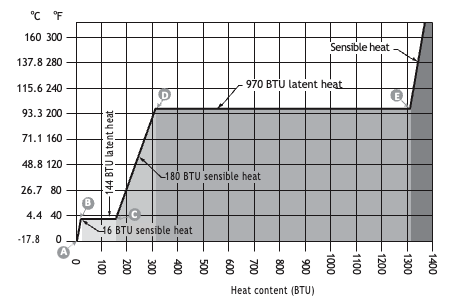
The line starting in the lower left in the graph (point A) represents the temperature of ice. As heat is added to the ice (from point A to point B), the temperature increases at a rate of [latex]0.5 \frac{\text{BTU}}{\text{lb.}} °\text{F}[/latex] (the specific heat of ice) up to freezing temperature of 32 °F. This is a sensible heat gain. Note that it takes 16 BTU to raise the temperature to 32 °F.
From point B to point C, the line is horizontal. This shows that even though the ice is absorbing heat, the temperature does not change and the ice is transformed to water. It takes [latex]144 \frac{\text{BTU}}{\text{lb.}}[/latex] to change 1 lb. of ice to 1 lb. of water. This heat gain is known as the latent heat of fusion.
Point C represents water at 32 °F. Adding more heat to the water will result in a rise in temperature, a sensible heat gain. Between the freezing and boiling points (points C and D), the water temperature will increase with added heat at the rate of 1 BTU/lb. °F (specific heat of water), which is indicated by the sloping line. Notice that the total heat energy input over this range (32–212 °F) is [latex]180 \frac{\text{BTU}}{\text{lb.}}[/latex].
At point D, we now have water saturated with heat, and any heat absorbed from this point will be used to transform the water to steam. From point D to point E, the line is once again horizontal.
This shows that even though the water is absorbing heat, the temperature does not change and the water is transformed to steam while at 212 °F. It takes [latex]970.4 \frac{\text{BTU}}{\text{lb.}}[/latex] to change 1 lb. of water to 1 lb. of steam. This heat gain is known as the latent heat of vaporization.
At point E, we now have saturated steam at 212 °F. Adding more heat to the steam will result in a rise in temperature, a sensible heat gain. The steam temperature increases with added heat at the rate of [latex]0.5 \frac{\text{BTU}}{\text{lb.}} °\text{F}[/latex] (specific heat of steam), which is indicated by the sloping line extending to the top of the graph.
The following formulas allow you to calculate how much heat energy is required in real trade applications.
Imperial Calculations (BTU Requirements)
The formula for calculating the quantity of heat required to take a given weight of a substance through a specified temperature change is the sensible heat equation. It is expressed as follows:
[latex]\quad\text{BTU required} = \text{weight of the substance (lb.)}\\ \quad\times \text{temperature change throughout the process (°F)}\\ \quad\times \text{specific heat of the substance} (\frac{\frac{\text{BTU}}{\text{lb.}}}{\text{ °F}})[/latex]
This is expressed as the following equation:
[latex]\quad\text{BTU} = \text{lb.} \times \text{ °F} \times (\frac{\frac{\text{BTU}}{\text{lb.}}}{\text{ °F}})[/latex]
The formula for calculating the quantity of heat required to take a given weight of a substance through a change of state is the latent heat equation. It is expressed as follows:
[latex]\quad\text{BTU required} = \text{weight of the substance (lb.)}\\ \quad\times \text{latent heat content } (144 \frac{\text{BTU}}{\text{lb.}} \text{ for fusion or } 970.4 \frac{\text{BTU}}{\text{lb.}} \text{ for vaporization})[/latex]
This is expressed as the following equation :
[latex]\quad\text{BTU} = \text{lb.} \times \text{latent heat content } (\frac{\text{BTU}}{\text{lb.}})[/latex]
Example 1:
Determine the quantity of heat energy (BTU) required to increase the temperature of 1 lb. of water from 40 °F to 175 °F. The specific heat of water = [latex]1 \frac{\text{BTU}}{\text{lb.}} \text{°F}[/latex].
Solution:
[latex]\quad\text{BTU} = 1\text{ lb.} \times (175 \text{ °F} - 40\text{ °F}) \times 1 \frac{\frac{\text{BTU}}{\text{lb.}}}{\text{ °F}}\\ \quad\text{BTU} = 1\text{ lb.} \times 135\text{ °F} \times 1 \frac{\frac{\text{BTU}}{\text{lb.}}}{\text{ °F}}\\ \quad\text{BTU} = 135[/latex]
The quantity of heat required to raise the temperature of 1 pound of water from 40 °F to 175 °F is 135 BTU.
Note: Always check your units. The final answer for heat should be in BTU (or kJ in metric). If units do not match, the calculation is likely incorrect.
Example 2:
Determine the quantity of heat energy required to raise the temperature of 8 imp. gallons of water from 55 °F to 130 °F.
Solution:
The first step is to change the imperial gallons of water to weight (lb.). We know that one imperial gallon of water weighs 10 lb. Therefore, 8 imp. gallons of water will weigh 80 lb. Now that the weight has been determined, the sensible heat equation can be used:
[latex]\quad\text{BTU} = 80\text{ lb.} \times (130 \text{ °F} - 55\text{ °F}) \times 1 \frac{\frac{\text{BTU}}{\text{lb.}}}{\text{ °F}}\\ \quad\text{BTU} = 80\text{ lb.} \times 75\text{ °F} \times 1 \frac{\frac{\text{BTU}}{\text{lb.}}}{\text{ °F}}\\ \quad\text{BTU} = 6,000[/latex]
The heat energy required to raise the temperature of 8 imperial gallons of water from 55 °F to 130 °F is 6,000 BTU.
Example 3:
Determine the quantity of heat energy required to raise the temperature of 4 lb. of ice at 32 °F to steam at 212 °F at atmospheric pressure.
Remember:
- Latent heat of fusion (LHF) for water is 144 [latex]\frac{\text{BTU}}{\text{lb.}}[/latex]
- Latent heat of vaporization (LHV) for water is 970.4 [latex]\frac{\text{BTU}}{\text{lb.}}[/latex] (often rounded to 970 [latex]\frac{\text{BTU}}{\text{lb.}}[/latex])
Solution:
This problem will have three heat gains: a sensible gain as we raise the temperature of the water and two latent heat gains as we transform ice to water and later from water to steam. The total heat energy required will be the sum of the three separate gains.
Step 1. Latent heat (LHF)
First, we need to determine the quantity of heat energy required to change 4 lb. of ice at 32 °F to water at 32 °F. Because this is a latent heat gain, we will use the latent heat equation:
[latex]\quad\text{BTU} = 4\text{ lb.} \times 144 \frac{\text{BTU}}{\text{lb.}}\\ \quad\text{BTU} = 576[/latex]
Step 2. Sensible heat
Next, we must determine the quantity of heat energy required to raise the temperature of 4 lb. of water at 32 °F to water at 212 °F. Because this is a sensible heat gain, we will use the sensible heat equation:
[latex]\quad\text{BTU} = 4\text{ lb.} \times (212 \text{ °F} - 32\text{ °F}) \times 1 \frac{\frac{\text{BTU}}{\text{lb.}}}{\text{ °F}}\\ \quad\text{BTU} = 4\text{ lb.} \times 180\text{ °F} \times 1 \frac{\frac{\text{BTU}}{\text{lb.}}}{\text{ °F}}\\ \quad\text{BTU} = 720[/latex]
Step 3. Latent heat (LHV)
Next, we determine the quantity of heat energy required to change 4 lb. of water at 212 °F to steam at 212 °F. Because this is a latent heat gain, we will use the latent heat equation:
[latex]\quad\text{BTU} = 4\text{ lb.} \times 970 \frac{\text{BTU}}{\text{lb.}}\\ \quad\text{BTU} = 3,880[/latex]
The total heat energy required will be the sum of the three separate gains:
[latex]\quad576 + 720 + 3,880 = 5,176 \text{ BTU}[/latex]
Example 4:
Determine the quantity of heat energy required to raise the temperature of 250 lb. of ice at 6 °F to steam at 277 °F.
Solution:
This problem will have five heat gains. Three will be sensible gains as we raise the temperatures of the ice, water and steam. There will also be two latent heat gains as we transform ice to water and water to steam. The total heat energy required will be the sum of the five separate gains.
Step 1. Sensible heat
First determine the quantity of heat energy required to raise the temperature of 250 lb. of ice at 6 °F to ice at 32 °F. Because this is a sensible heat gain, we will use the sensible heat equation :
[latex]\quad\text{BTU} = 250\text{ lb.} \times (32 \text{ °F} - 6\text{ °F}) \times 0.5 \frac{\frac{\text{BTU}}{\text{lb.}}}{\text{ °F}}\\ \quad\text{BTU} = 250\text{ lb.} \times 26\text{ °F} \times 0.5 \frac{\frac{\text{BTU}}{\text{lb.}}}{\text{ °F}}\\ \quad\text{BTU} = 3,250[/latex]
Step 2. Latent heat (LHF)
Next find the quantity of heat energy required to change 250 lb. of ice at 32 °F to water at 32 °F. Because this is a latent heat gain, we will use the latent heat equation:
[latex]\quad\text{BTU} = 250\text{ lb.} \times 144 \frac{\text{BTU}}{\text{lb.}}\\ \quad\text{BTU} = 36,000[/latex]
Step 3. Sensible heat
Now determine the quantity of heat energy required to raise the temperature of 250 lb. of water at 32 °F to water at 212 °F. Because this is a sensible heat gain, we will use the sensible heat equation:
[latex]\quad\text{BTU} = 250\text{ lb.} \times (212 \text{ °F} - 32\text{ °F}) \times 1 \frac{\frac{\text{BTU}}{\text{lb.}}}{\text{ °F}}\\ \quad\text{BTU} = 250\text{ lb.} \times 180\text{ °F} \times 1 \frac{\frac{\text{BTU}}{\text{lb.}}}{\text{ °F}}\\ \quad\text{BTU} = 45,000[/latex]
Step 4. Latent heat (LHV)
Next find the quantity of heat energy required to change 250 lb. of water at 212 °F to steam at 212 °F. Because this is a latent heat gain, we will use the latent heat equation:
[latex]\quad\text{BTU} = 250\text{ lb.} \times 970 \frac{\text{BTU}}{\text{lb.}}\\ \quad\text{BTU} = 242,500[/latex]
Step 5. Sensible heat
Now find the quantity of heat energy required to raise the temperature of 250 lb. of steam at 212 °F to steam at 277 °F. Because this is a sensible heat gain, we will use the sensible heat equation:
[latex]\quad\text{BTU} = 250\text{ lb.} \times (277 \text{ °F} - 212\text{ °F}) \times 0.5 \frac{\frac{\text{BTU}}{\text{lb.}}}{\text{ °F}}\\ \quad\text{BTU} = 250\text{ lb.} \times 65\text{ °F} \times 0.5 \frac{\frac{\text{BTU}}{\text{lb.}}}{\text{ °F}}\\ \quad\text{BTU} = 8,125[/latex]
The total heat energy required will be the sum of the five separate gains:
[latex]\quad3,250 + 36,000 + 45,000 + 242,500 + 8,125 = 334,875 \text{ BTU}[/latex]
These calculations are used in real applications such as sizing boilers, determining heating requirements, and designing hydronic systems.

Self-Test C-1.19: Perform Heat Load Calculations
Complete Self-Test C-1.19 and check your answers.
If you are using a printed copy, please find Self-Test C-1.19 and Answer Key at the end of this section. If you prefer, you can scan the QR code with your digital device to go directly to the interactive Self-Test.
References
BCcampus. (n.d.). Playlist: Tools and equipment videos. BCcampus MediaSpace. https://media.bccampus.ca/playlist/details/0_3g8xp22x/categoryId/175673 Playlist Details – Trades Access Common Core Line C: Tools and Equipment Videos – BCcampus
BC Industry Training Authority. (2019). Piping trades apprenticeship program: Use Tools and Equipment—Level 1 harmonized [Binder]. Crown Publications, Queen’s Printer for British Columbia. https://www.crownpub.bc.ca/Product/Details/7960000261_S
- Plumber: Competency C-1 Use Mathematics and Science
- Steamfitter: Competency C-1 Use Mathematics and Science
- Sprinkler Fitter: Competency C-1 Use Mathematics and Science
Camosun College. (2019). Line C: Tools and Equipment—Competency D-2 Apply Science Concepts to Trades Applications (Rev. ed.) [Learning guide]. BCcampus. https://collection.bccampus.ca/textbook/fkXxtNTn/
Camosun College. (2015). Trades Access Common Core Competency D-2 Apply Science Concepts to Trades Applications. Victoria, B.C.: Crown Publications. Download for free from the B.C. Open Textbook Collection (https://open.bccampus.ca/browse-ourcollection/find-open-textbooks/).
Camosun Innovates. (2022). Tools and Equipment Videos [Video playlist]. Camosun College/BCcampus. https://camosuninnovates.opened.ca/
Flinn, C. (n.d.). OER for Trades: Math for Trades [Video collection]. BCcampus MediaSpace. https://media.bccampus.ca/channel/OER%2Bfor%2BTrades%3A%2BMath%2Bfor%2BTrades/175670
Note: these videos align with the open textbooks Math for Trades: Volume 1 and Math for Trades: Volume 2. All videos are by Chad Flinn and available under a Creative Commons Attribution 4.0 Licence.:
Media Attributions
All figures are sourced from Industry Training Authority (2019) and/or Camosun College (2019) and are used under the Creative Commons Attribution 4.0 (CC BY 4.0) licence unless otherwise noted. Images copyrighted by the BC Industry Training Authority are licensed under a Creative Commons Attribution-NonCommercial-ShareAlike 4.0 (CC BY-NC-SA 4.0) licence.
The total amount of heat required to change the temperature of a given quantity of a substance by one degree. (Section C-1.19)
The amount of heat required to change a substance from a solid to a liquid (or vice versa) at constant temperature. (Section C-1.19)
The amount of heat required to change a substance from a liquid to a gas (or vice versa) at constant temperature. (Section C-1.19)
The pressure exerted by the weight of the air surrounding the Earth. (Section C-1.19
The temperature at which a liquid changes into a solid. (Section C-1.19)
The temperature at which a liquid changes into a gas. (Section C-1.19)
A condition in which a substance is at the temperature and pressure where a phase change is about to occur. (Section C-1.19)
Steam that is at the boiling point temperature and is in equilibrium with liquid water. (Section C-1.19)
Heat that causes a change in temperature of a substance without changing its state. (Section C-1.19)
A formula used to calculate the amount of heat energy required to change the state of a substance (such as from solid to liquid or liquid to gas) without changing its temperature. The equation is: 𝑄 = 𝑚 × 𝐿, where Q = heat energy (BTU or joules); m = mass of the substance (lb or kg); L = latent heat (BTU/lb or J/kg), depending on the type of phase change. This equation is used when a substance is melting, freezing, boiling, or condensing, where heat is absorbed or released but the temperature remains constant. (Section C-1.19)