C-1.18 Define Methods of Heat Transfer
Methods of Heat Transfer
There are three ways heat can be transferred from one substance to another or from one place to another:
- Conduction
- Convection
- Radiation
In most real-world situations, more than one method of heat transfer occurs at the same time. As a tradesperson, you need to be aware that various heat exchange processes are possible between a building and the external environment. Heat flows by direct conduction through various solid building elements such as walls, roof, ceiling, floor, etc. Heat transfer also occurs from different surfaces by convection and radiation. Solar radiation is transmitted through windows and absorbed by interior building surfaces. Evaporation of water may also occur, producing a cooling effect.
Heat is also gained in the space due to the presence of human occupants and the heat given off by lights and equipment. The interaction between a human body and the indoor environment is extensive. Due to metabolic processes, the body continuously produces heat, part of which is used to perform work, while the remainder is dissipated to the environment to maintain body temperature. The body exchanges heat with its surroundings by convection, radiation, evaporation and conduction. As heat is lost, a person feels cool. When heat is gained from the surroundings, the rate of heat loss decreases, and the person feels warm and may begin to perspire. Perspiration causes evaporation on the skin, creating a natural cooling effect.
Conduction
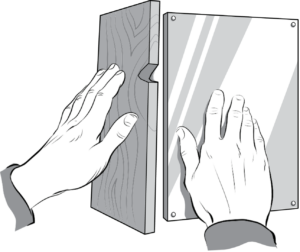
Thermal conduction is the process of heat transfer from one part of an object at a higher temperature to another (or between objects in direct contact) at a lower temperature. This happens with negligible movement of molecules, as heat is transferred from one molecule to another through direct contact. Heat can be conducted through solids, liquids and gases; however, some materials conduct more rapidly than others do (Figure 1). Materials with tight molecular structures lend themselves better to conduction. For example, metals are good conductors, while wood acts as an insulator. Metals conduct heat away from your hand quickly, which produces a “cold” sensation. When you touch a metal surface, heat flows rapidly from your hand into the metal. Wood does not conduct heat away from your hands as well as metals, so wood, even at the same temperature, feels “warmer” than the metal.
Convection
In fluids, thermal energy is transferred from warm areas to cooler areas by convection. Convection occurs when warmer regions of a fluid (liquid or gas) rise and cooler regions sink. Cooler liquid or gas then takes the place of the warmer areas that have risen higher due to a drop in density. This results in a continuous circulation pattern called a convection current.
A domestic water heater is a good example of these convection currents. The burner in the combustion chamber produces hot flue gases resulting from the combustion process. These flue gases transfer their heat to the water in the bottom of the heater initially by conduction. The hot water at the bottom of the heater has a reduction in density compared to the cooler water and rises to the top of the heater. The denser, cooler water then drops to the lower portion of the heater, where it is heated again. As layers of temperatures develop within the tank, the result is termed temperature stratification. Eventually, the whole tank will be heated to the tank set point. This continuous movement of fluid transfers heat throughout the system. The hot water collects at the top of the tank, from where it is distributed to the plumbing fixtures as required.
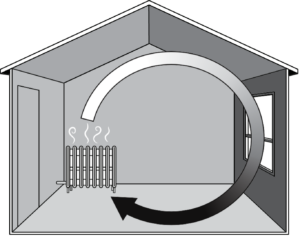
Another good example of convection is in a hydronic heating system using radiators or convectors (Figure 2). The room air surrounding the warm convector is heated and rises to the ceiling level. As the warm air loses its heat to the cooler window area and outside wall, it drops to the floor (becoming more dense), where it is drawn back into the convector to be heated again and complete the cycle, providing comfort.
Radiation
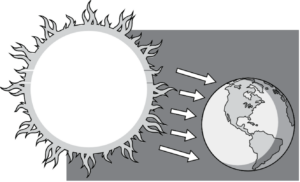
The third major form of heat transfer is radiation, which includes both visible light and invisible electromagnetic waves such as ultraviolet (UV) and infrared radiation. Unlike conduction and convection, radiation does not require a medium, which is why heat from the sun can travel through millions of miles of space to reach the earth (Figure 3). This amount of heat transfer cannot occur via convection or by conduction, as conduction requires direct contact between materials, and convection requires the movement of fluids, so neither can transfer heat through empty space.
Often the energy of heat is visible as light, such as that coming from a hot campfire. This light, being a wave, carries energy. When this light reaches you, part of the energy of the wave gets converted back into heat, which is why you feel warm sitting beside a campfire. Some of the light can be in the form of visible light that we can see, but a great deal of the light emitted is infrared light, whose longer wavelength is detectable only with special infrared detectors. As an object becomes hotter, it emits more energy at shorter wavelengths, producing more visible light while still emitting infrared radiation. For example, human beings, at a temperature of about 37 °C, emit almost exclusively infrared light, which is why we don’t see each other glowing in the dark. On the other hand, the hot filament of a light bulb emits considerably more visible light.

Self-Test C-1.18: Define Methods of Heat Transfer
Complete Self-Test C-1.18 and check your answers.
In each of the following situations, identify the method of heat transfer taking place (conduction, convection, radiation). More than one process may be occurring.
If you are using a printed copy, please find Self-Test C-1.18 and Answer Key at the end of this section. If you prefer, you can scan the QR code with your digital device to go directly to the interactive Self-Test.
References
BCcampus. (n.d.). Playlist: Tools and equipment videos. BCcampus MediaSpace. https://media.bccampus.ca/playlist/details/0_3g8xp22x/categoryId/175673 Playlist Details – Trades Access Common Core Line C: Tools and Equipment Videos – BCcampus
BC Industry Training Authority. (2019). Piping trades apprenticeship program: Use Tools and Equipment—Level 1 harmonized [Binder]. Crown Publications, Queen’s Printer for British Columbia. https://www.crownpub.bc.ca/Product/Details/7960000261_S
- Plumber: Competency C-1 Use Mathematics and Science
- Steamfitter: Competency C-1 Use Mathematics and Science
- Sprinkler Fitter: Competency C-1 Use Mathematics and Science
Camosun College. (2019). Line C: Tools and Equipment—Competency D-2 Apply Science Concepts to Trades Applications (Rev. ed.) [Learning guide]. BCcampus. https://collection.bccampus.ca/textbook/fkXxtNTn/
Camosun College. (2015). Trades Access Common Core Competency D-2 Apply Science Concepts to Trades Applications. Victoria, B.C.: Crown Publications. Download for free from the B.C. Open Textbook Collection (https://open.bccampus.ca/browse-ourcollection/find-open-textbooks/).
Camosun Innovates. (2022). Tools and Equipment Videos [Video playlist]. Camosun College/BCcampus. https://camosuninnovates.opened.ca/
Flinn, C. (n.d.). OER for Trades: Math for Trades [Video collection]. BCcampus MediaSpace. https://media.bccampus.ca/channel/OER%2Bfor%2BTrades%3A%2BMath%2Bfor%2BTrades/175670
Note: these videos align with the open textbooks Math for Trades: Volume 1 and Math for Trades: Volume 2. All videos are by Chad Flinn and available under a Creative Commons Attribution 4.0 Licence.:
Media Attributions
All figures are sourced from Industry Training Authority (2019) and/or Camosun College (2019) and are used under the Creative Commons Attribution 4.0 (CC BY 4.0) licence unless otherwise noted. Images copyrighted by the BC Industry Training Authority are licensed under a Creative Commons Attribution-NonCommercial-ShareAlike 4.0 (CC BY-NC-SA 4.0) licence.
The process by which a liquid changes to a gas at its surface, removing heat and producing a cooling effect. (Section C-1.18)
Heat produced by the body as a result of metabolic processes. (Section C-1.18)
The transfer of heat through a material by direct molecular interaction. (Section C-1.18)
How much mass is packed into a certain space; mass per unit volume of a substance; affects whether a fluid rises or sinks during convection. (Section C-1.13; Section C-1.18)
A continuous circulation of fluid caused by temperature and density differences. (Section C-1.18)
The layering of fluids at different temperatures, typically with warmer, less dense fluid above cooler, denser fluid. (Section C-1.18)
Waves of energy that travel through space, including visible light, infrared, and ultraviolet radiation. (Section C-1.18)
A type of electromagnetic radiation with shorter wavelengths than visible light. (Section C-1.18)
A type of electromagnetic radiation associated with heat that is not visible to the human eye. (Section C-1.18)