C-1.17 Calculate the Expansion and Contraction of Various Piping Materials Due to Heating and Cooling
All piping systems expand and contract with changes in temperature. This issue must be addressed with appropriate system design to prevent damage to the system. Expansion during heating and contraction during cooling are typically accommodated at changes in direction within the piping system. Long, straight runs are more susceptible to measurable movement, so expansion loops or offsets are required to absorb these forces without damaging the system.
The rate of linear expansion does not vary with pipe size; the primary factor is the type of piping material. The effects of expansion/contraction are most pronounced on hot water or steam lines in which the temperature changes (∆T) are greater.
To calculate the amount of expansion or contraction, the coefficient of expansion (COE) must be known for the material. These coefficients are standardized and are based on temperature change. Separate coefficients are provided for °F and °C for each material. Because the COE is a ratio, it can be applied to any unit of length (inches, feet, millimetres, metres, etc.).
Table 1 shows the coefficients of linear expansion for commonly used piping materials including ferrous metals (alloys that contain iron), non-ferrous metals (alloys without iron), and thermoplastic pipe (sometimes called thermosoftening plastic). These are used in calculating the amount of expansion or contraction that may occur in piping systems.
|
Piping Material |
Coefficient of Linear Expansion (COE) |
|
|
Units of Measure / °F |
Units of Measure / °C |
|
|
Aluminum |
0.0000128 |
0.0000231 |
|
Carbon steel |
0.0000065 |
0.0000117 |
|
Cast iron |
0.0000059 |
0.0000106 |
|
Copper |
0.0000093 |
0.0000168 |
|
Stainless steel |
0.0000099 |
0.0000178 |
|
ABS (acrylonitrile-butadiene styrene) |
0.000035 |
0.000063 |
|
HDPE (high-density polyethylene) |
0.000067 |
0.00012 |
|
PE (polyethylene) |
0.000083 |
0.00015 |
|
CPVC (chlorinated polyvinyl chloride) |
0.000044 |
0.000079 |
|
PVC (polyvinyl chloride) |
0.000028 |
0.0000504 |

Note: The high expansion coefficients for the plastic materials make plastic piping extremely sensitive to change in temperature. The design of plastic piping systems must include accommodation for high expansion.
Linear expansion can be expressed through the following equation:
[latex]\quad\text{Ch} = \text{COE} \times \text{L} \times \Delta\text{T}[/latex]
Where:
[latex]\quad\text{Ch} = \text{Change in length due to expansion or contraction}\\ \quad\text{COE} = \text{Coefficient of linear expansion}\\ \quad\text{L} = \text{Original length}\\ \quad\text{∆T} = \text{Temperature change of the piping material}[/latex]
Example:
Calculate the change in length of 55 feet of copper tube for a temperature change from 43°F to 185°F.
Solution:
[latex]\quad\text{Ch} = \text{COE} \times \text{L} \times \Delta\text{T}\\ \quad\text{Ch} = 0.0000093 \times 55\text{ ft} \times (185°\text{F} - 43°\text{F})\\ \quad\text{Ch} = 0.0000093 \times 55\text{ ft} \times 142°\text{F}\\ \quad\text{Ch} =0.072633 \text{ ft}[/latex]
Convert the answer to the nearest [latex]\frac{1}{16}\text{in.}[/latex]:
[latex]\quad0.072633 \text{ ft} \times 12 = 0.8716 \text{ in.} \times 16 = \frac{13.95}{16} \text{ in.} = \frac{14}{16} \text{ in.} = \frac{7}{8} \text{ in.}[/latex]
Note: When calculating the change in length (Ch), the answer displayed on your calculator will be in the same units as the original length entered. This observation is true for both the metric and imperial systems. If you need to solve for an answer in inches or millimetres, it is sometimes more convenient to enter the original length into your calculator in that unit.
Example:
Calculate the change in length of 22 m of cast iron for a temperature change from 8°C to 22°C.
Solution:
[latex]\quad\text{Ch} = \text{COE} \times \text{L} \times \Delta\text{T}\\ \quad\text{Ch} = 0.0000106 \times 22\text{ m} \times (22°\text{C} - 8°\text{C})\\ \quad\text{Ch} = 0.0000106 \times 22\text{ m} \times 14°\text{C}\\ \quad\text{Ch} =0.0032648 \text{ m}[/latex]
Convert the answer to mm:
[latex]\quad0.0032648 \text{ m} \times 1,000 = 3.26 \text{ mm}[/latex]
Piping System Flexibility
The piping system must be sufficiently flexible to accommodate the movements of the components as they expand. In many cases the flexibility of the piping system, due to the length of the pipe and the number of bends and supports, means that no undue stress is imposed. In other installations, however, it will be necessary to incorporate some specific means of achieving this required flexibility. These include expansion fittings and expansion loops.
Expansion Fittings
An expansion fitting is one method of accommodating expected expansion. These fittings are placed within a pipeline and are designed to accommodate expansion and contraction without the total length of the pipeline changing. These are often referred to as an expansion bellows due to the bellows-type construction of the expansion sleeve (Figure 1).
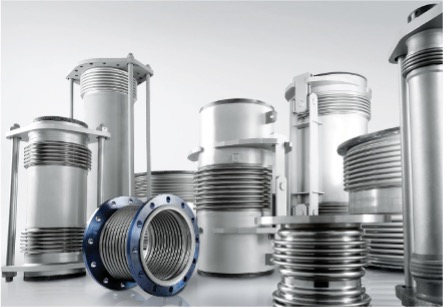
Other expansion fittings can be made from the same piping in the form of a fabricated expansion loop. This can be a less-expensive option to satisfy the requirement for expansion control, but more space is typically needed to accommodate the piping arrangement.
Expansion Loops
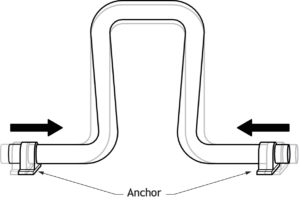
Expansion loops can be fabricated from straight pipe and elbows welded together. If job-site specifications do not allow fabricated loops, manufacturers provide a variety of pre-made loop designs that may be used (Figure 2).

Self-Test C-1.17: Calculate the Expansion and Contraction of Various Piping Materials Due to Heating and Cooling
Complete Self-Test C-1.17 and check your answers.
If you are using a printed copy, please find Self-Test C-1.17 and Answer Key at the end of this section. If you prefer, you can scan the QR code with your digital device to go directly to the interactive Self-Test.
References
BCcampus. (n.d.). Playlist: Tools and equipment videos. BCcampus MediaSpace. https://media.bccampus.ca/playlist/details/0_3g8xp22x/categoryId/175673 Playlist Details – Trades Access Common Core Line C: Tools and Equipment Videos – BCcampus
BC Industry Training Authority. (2019). Piping trades apprenticeship program: Use Tools and Equipment—Level 1 harmonized [Binder]. Crown Publications, Queen’s Printer for British Columbia. https://www.crownpub.bc.ca/Product/Details/7960000261_S
- Plumber: Competency C-1 Use Mathematics and Science
- Steamfitter: Competency C-1 Use Mathematics and Science
- Sprinkler Fitter: Competency C-1 Use Mathematics and Science
Camosun College. (2019). Line C: Tools and Equipment—Competency D-2 Apply Science Concepts to Trades Applications (Rev. ed.) [Learning guide]. BCcampus. https://collection.bccampus.ca/textbook/fkXxtNTn/
Camosun College. (2015). Trades Access Common Core Competency D-2 Apply Science Concepts to Trades Applications. Victoria, B.C.: Crown Publications. Download for free from the B.C. Open Textbook Collection (https://open.bccampus.ca/browse-ourcollection/find-open-textbooks/).
Camosun Innovates. (2022). Tools and Equipment Videos [Video playlist]. Camosun College/BCcampus. https://camosuninnovates.opened.ca/
Flinn, C. (n.d.). OER for Trades: Math for Trades [Video collection]. BCcampus MediaSpace. https://media.bccampus.ca/channel/OER%2Bfor%2BTrades%3A%2BMath%2Bfor%2BTrades/175670
Note: these videos align with the open textbooks Math for Trades: Volume 1 and Math for Trades: Volume 2. All videos are by Chad Flinn and available under a Creative Commons Attribution 4.0 Licence.:
Media Attributions
All figures are sourced from Industry Training Authority (2019) and/or Camosun College (2019) and are used under the Creative Commons Attribution 4.0 (CC BY 4.0) licence unless otherwise noted. Images copyrighted by the BC Industry Training Authority are licensed under a Creative Commons Attribution-NonCommercial-ShareAlike 4.0 (CC BY-NC-SA 4.0) licence.
When a material gets bigger or longer when it is heated. (Section C-1.17)
When a material gets shorter as it cools down. (Section C-1.17)
A bend or loop in a pipe that allows it to expand and move without breaking. (Section C-1.17)
A small change in direction in a pipe that helps absorb movement caused by expansion or contraction. (Section C-1.17)
When a material gets longer as it heats up. (Section C-1.17)
A pipe that carries hot steam from one place to another, usually for heating or power. (Section C-1.17)
The difference between the starting temperature and the final temperature of a substance. (Section C-1.19)
A number that shows how much a material will expand or contract when the temperature changes. (Section C-1.17)
Metals that contain iron, such as steel. (Section C-1.17)
Metals that do not contain iron, such as copper or aluminum. (Section C-1.17)
(thermosoftening plastic); a type of plastic that softens when heated and hardens when cooled. (Section C-1.17)
How much longer or shorter a material becomes after heating or cooling. (Section C-1.17)
The force inside a pipe or material that can cause it to bend, crack, or break if it is too high. (Section C-1.17)
A special pipe part that allows a pipe to expand and contract without causing damage. (Section C-1.17)
A flexible, accordion-shaped fitting that stretches and compresses to handle pipe movement. (Section C-1.17)
A part inside an expansion fitting that slides or moves to allow a pipe to expand and contract without being damaged. (Section C-1.17)