C-1.16 Describe Factors that Affect Gas Volumes, Pressures and Temperatures
Gases behave differently from solids and liquids, so we use specific methods to calculate and understand how they act under different conditions. Unlike liquids and solids, gases have no fixed volume or shape; they expand or contract to fill whatever container they are in. When studying gases, we focus on three key variables that determine their behaviour:
- Pressure
- Volume
- Temperature
Pressure is measured as force per unit area. The standard metric unit for pressure is the kilopascal (kPa). In the imperial system, the units of [latex]\frac{\text{lb.}}{\text{ in.}^2} \text{(psi)}[/latex] are commonly used. The equation below shows the conversion between these units:
[latex]\quad1 \text{ psi} = 6.8947 \text{ kPa}[/latex]
When converting these pressures in many of the code books and on the job site, we use a soft conversion to make the task easier:
[latex]\quad1 \text{ psi} = 7\text{ kPa}[/latex]
The Gas Laws of Boyle, Gay-Lussac, and Charles
The early gas laws were developed at the end of the eighteenth century, when scientists began to realize a common relationship between the pressure, volume and temperature characteristics of all gases. Gases behave in a similar way over a wide variety of conditions because they all have widely-spaced particles (molecules). These gas laws provide predictable results for most gases under moderate pressure and temperature.
It should be noted that when working with these gas laws, all temperatures and pressures must be expressed in absolute units. This means using psia or kPa (absolute) for pressure, and Rankine (°R) or Kelvin (K) for temperature.
Absolute pressure conversion
- psig + 14.7 = psia
- kPa + 101.325 = kPa (ab)
Absolute temperature conversion
- °F + 460 = °R
- °C + 273 = K
Boyle’s Law
Boyle’s law (named after Irish physicist Robert Boyle) describes the relationship between the pressure and volume of a gas. According to this law, the absolute pressure exerted by a gas held at a constant temperature varies inversely with the volume of the gas.
For example, if the volume of a gas is halved, the absolute pressure would be doubled; and if the volume of a gas is doubled, then the absolute pressure is halved. The reason for this effect is that a gas is made up of loosely spaced molecules moving at random. If a gas is compressed in a container, these molecules are pushed together; thus the gas occupies less volume. The molecules, having less space in which to move, collide with the walls of the container more frequently and thus exert an increased pressure.
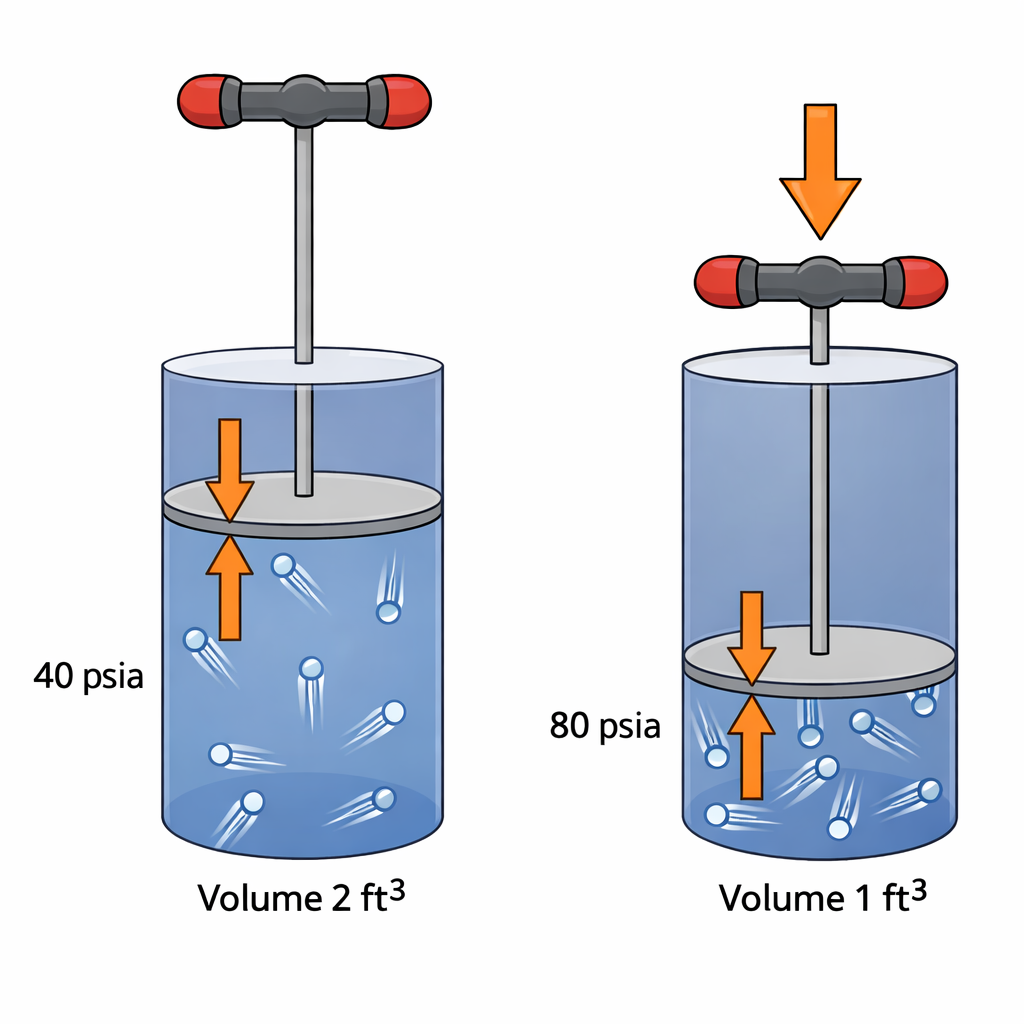
Boyle’s Law Calculations
Boyle’s law may be stated as follows:
The volume of any dry gas varies inversely with the absolute pressure when the temperature remains constant.
This is expressed in the following formula:
[latex]\quad\text{V}_1 \text{P}_1 = \text{V}_2 \text{P}_2[/latex]
Where:
[latex]\quad\text{V}_1 = \text{the original volume}\\ \quad\text{V}_2 = \text{the new volume}\\ \quad\text{P}_1 = \text{the original absolute pressure}\\ \quad\text{P}_2 = \text{the new absolute pressure}[/latex]
Example 1:
If the volume of a gas is 9 ft3 at a pressure of 25 psig, what will be the volume at 47 psig?
Solution:
The first step is to find the values for the given variables, which will isolate the unknown variable for us to solve:
[latex]\quad\text{V}_1 =\text{the original volume} = 9\text{ ft}^3\\\quad\text{V}_2 = \text{the new volume} = \text{the unknown variable. This is what we will solve for.}\\\quad\text{P}_1 = \text{the original absolute pressure} = 25\text{ psig} + 14.7\text{ psia} = 39.7\text{ psia}\\ \quad\text{P}_2 = \text{the new absolute pressure} = 47\text{ psig} + 14.7\text{ psia} = 61.7\text{ psia}[/latex]
The second step is to transpose the Boyle’s law formula to isolate the unknown variable. In this example it is V2:
[latex]\quad\frac{\text{V}_1\text{P}_1}{\text{P}_2} = \text{V}_2[/latex]
The third step is to substitute the known variable into the transposed equation and solve:
[latex]\begin{aligned} \frac{9\,\text{ft}^3 \times 39.7\,\text{psia}}{61.7\,\text{psia}} &= \text{V}_2 \\ 5.79\,\text{ft}^3 &= \text{V}_2 \end{aligned}[/latex]
Example 2:
If the volume of a gas is 17 ft3 at a pressure of 87 psig, what will be the gauge pressure in the container if the volume is reduced to 4 ft3?
Solution:
As in the previous example, the first step is to find the values for the known variables, which will isolate the unknown variable for us to solve:
[latex]\quad\text{V}_1 = \text{the original volume} = 17\text{ ft}^3\\ \quad\text{V}_2 = \text{the new volume} = 4\text{ ft}^3\\ \quad\text{P}_1 = \text{the original absolute pressure} = 87\text{ psig} + 14.7\text{ psia} = 101.7\text{ psia}\\ \quad\text{P}_2\text{ = the new absolute pressure = the unknown variable. This is what we will solve for.}[/latex]
The second step is to transpose the Boyle’s law formula to isolate the unknown variable. In this example it is P2:
[latex]\quad\frac{\text{V}_1\text{P}_1}{\text{V}_2} = \text{P}_2[/latex]
The third step is to substitute the known variables into the transposed equation and solve. Note that the answer in your calculator will be in psia. This is because you entered P1 as an absolute pressure. In order to get gauge pressure, you will have to subtract an atmosphere (14.7 psia):
[latex]\quad\frac{17\text{ ft}^3 \times 101.7\text{ psia}}{4\text{ ft}^3} = \text{P}_2\\ \quad\frac{17\text{ ft}^3 \times 101.7\text{ psia}}{4\text{ ft}^3} = 432.23\text{ psia}\\ \quad432.23\text{ psia} - 14.7\text{ psia} = 417.53\text{ psig}[/latex]
Example 3:
A captive volume of gas is pressurized to 200 kPa. When the volume of the gas is reduced to 0.75 m3, the gauge pressure increased to 370 kPa. What was the original volume the gas occupied when the pressure was 200 kPa?
Solution:
Find the values for the known variables, which will isolate the unknown variable for us to solve:
[latex]\quad\text{V}_1\text{= the original volume = the unknown variable. This is what we will solve for.}\\ \quad\text{V}_2 = \text{the new volume} = 0.75\text{ m}^3\\ \quad\text{P}_1\text{= the original absolute pressure = 200 kPa} + 101.325 = 301.325\text{ kPa (ab)}\\ \quad\text{P}_2 = \text{the new absolute pressure} = 370\text{ kPa} + 101.325 = 471.325\text{ kPa (ab)}[/latex]
Transpose the Boyle’s law formula to isolate the unknown variable. In this example it is V1:
[latex]\quad\text{V}_1 = \frac{\text{P}_2 \text{V}_2}{\text{P}_1}[/latex]
Substitute the known variable into the transposed equation and solve:
[latex]\quad\text{V}_1 = \frac{471.325 \text{ kPa (ab)} \times 0.75\text{ m}^3}{301.325 \text{ kPa (ab)}}\\ \quad\text{V}_1 = 1.17 \text{ m}^3[/latex]
Example 4:
A captive volume of gas occupies a volume of 7 m3. When the volume of the gas is reduced to 4.6 m3, the gauge pressure increases to 420 kPa. What was the original gauge pressure of the gas before the volume was reduced?
Solution:
Find the values for the known variables, which will isolate the unknown variable for us to solve:
[latex]\quad\text{V}_1 = \text{the original volume} = 7\text{ m}^3\\ \quad\text{V}_2 = \text{the new volume} = 4.6\text{ m}^3\\ \quad\text{P}_1\text{= the original absolute pressure = the unknown variable. This is what we will solve for.}\\ \quad\text{P}_2 = \text{the new absolute pressure} = 420\text{ kPa} + 101.325 = 521.325\text{ kPa (ab)}[/latex]
Transpose the Boyle’s law formula to isolate the unknown variable. In this example it is P1:
[latex]\quad\text{P}_1 = \frac{\text{P}_2 \text{V}_2}{\text{V}_1}[/latex]
Substitute the known variables into the transposed equation and solve. Note that the answer in your calculator will be in kPa (ab). This is because you entered P2 as an absolute pressure. In order to get gauge pressure, you will have to subtract an atmosphere (101.325 kPa (ab)).
[latex]\quad\text{P}_1 = \frac{4.6 \text{ m}^3 \times 521.325\text{ kPa (ab)}}{7 \text{ m}^3}\\ \quad\text{P}_1 = 342.59 \text{ kPa (ab)}\\ \quad\text{P}_1 = 342.59 \text{ kPa (ab) - 101.325 kPa (ab) = 241.27 kPa}[/latex]
Gay-Lussac’s Law
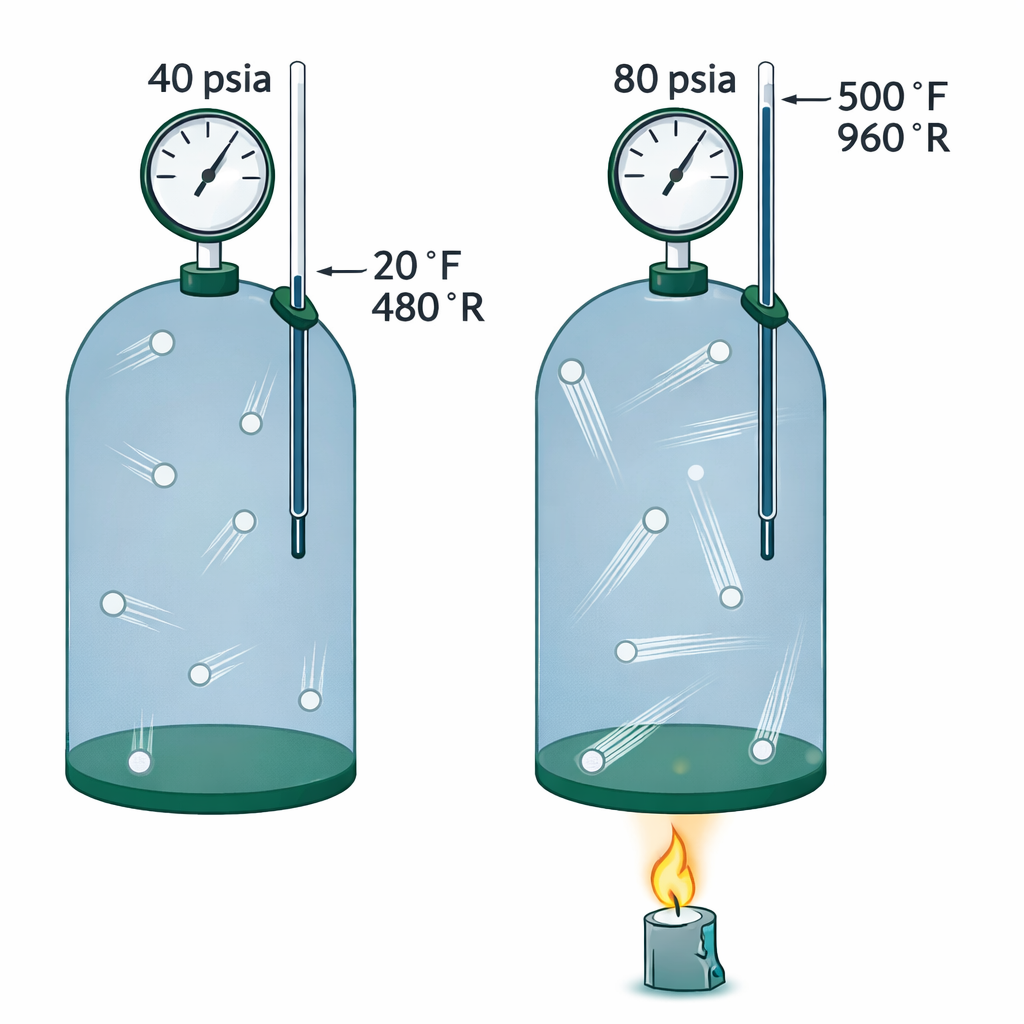
Joseph-Louis Gay-Lussac, a French physicist who experimented with the effect of temperature on the pressure exerted by a gas, concluded that with the volume held constant, the absolute pressure exerted by a gas is in direct proportion to the absolute temperature.
In Figure 2, the volume was held constant, while the absolute temperature was raised from 480°R to 960°R. As a result, there was a corresponding increase in absolute pressure in the container from 40 psia to 80 psia.
Gay-Lussac’s Law Calculations
Gay-Lussac's law may be stated as follows:
The absolute pressure of any dry gas varies directly with the absolute temperature when the volume remains constant.
This relationship may be expressed using the following formula:
[latex]\quad\frac{\text{P}_1}{\text{T}_1} = \frac{\text{P}_2}{\text{T}_2}[/latex]
Where:
[latex]\quad\text{P}_1 = \text{the original absolute pressure}\\ \quad\text{P}_2 = \text{the new absolute pressure}\\ \quad\text{T}_1 = \text{the original absolute temperature}\\ \quad\text{T}_2 = \text{the new absolute temperature}[/latex]
Example 1:
The pressure of a gas in a container is 25 psig at 70 °F room temperature. What will be the gauge pressure when the gas is heated to 115 °F?
Solution:
Find the values for the known variable, which will isolate the unknown variable for us to solve:
[latex]\quad\text{P}_1 = \text{the original absolute pressure} = 25\text{ psig} + 14.7 = 39.7\text{ psia}\\ \quad\text{P}_2\text{= the new absolute pressure = the unknown variable. This is what we will solve for.}\\ \quad\text{T}_1 = \text{the original absolute temperature} = 70\text{ °F} + 460 = 530\text{°R}\\ \quad\text{T}_2 = \text{the new absolute temperature} = 115\text{ °F} + 460 = 575\text{°R}[/latex]
Transpose the Charles’s law 1 formula to isolate the unknown variable. In this example it is P2:
[latex]\quad\frac{\text{P}_1 \text{T}_2}{\text{T}_1} = \text{P}_2[/latex]
Substitute the known variables into the transposed equation and solve. Remember that the answer in your calculator will be in psia, so you must change this value to psig:
[latex]\quad\frac{39.7\text{ psia} \times 575^\circ \text{R}}{530^\circ \text{R}} = \text{P}_2\\ \quad43.07 \text{ psia} = \text{P}_2\\ \quad43.07 \text{ psia} - 14.7 \text{ psia} = 28.37 \text{ psig}[/latex]
Example 2:
The pressure of a gas in a container is 46 psig at 6 °F. The gas is heated until the gauge pressure reaches 62 psig. What is the final temperature of the gas in °F when the pressure gauge reaches 62 psig?
Solution:
Find the values for the known variables, which will isolate the unknown variable for us to solve:
[latex]\quad\text{P}_1 = \text{the original absolute pressure} = 46\text{ psig} + 14.7 = 60.7\text{ psia}\\ \quad\text{P}_2 = \text{the new absolute pressure} = 62\text{ psig} + 14.7 = 76.7\text{ psia}\\ \quad\text{T}_1 = \text{the original absolute temperature} = 6\text{ °F} + 460 = 466\text{°R}\\ \quad\text{T}_2\text{= the new absolute temperature = the unknown variable. This is what we will solve for.}[/latex]
Transpose the Charles’s law 1 formula to isolate the unknown variable. In this example it is T2:
Substitute the known variables into the transposed equation and solve. Remember that the answer in your calculator will be in °R, so you must change this value to °F :
[latex]\quad\text{T}_2 = \frac{76.7\text{ psia} \times 466^\circ \text{R}}{60.7}\\ \quad\text{T}_2 = 588.83^\circ \text{R}\\ \quad588.83^\circ \text{R} - 460 = 128.83^\circ \text{F}[/latex]
Example 3:
The pressure of a gas in a container is 55 kPa. The gas is heated until it reaches 110 °C and the gauge pressure reaches 130 kPa. What was the temperature of the gas in °C when the heating process began?
Solution:
Find the values for the known variables, which will isolate the unknown variable for us to solve:
[latex]\quad\text{P}_1\text{= the original absolute pressure = 55 kPa + 101.325 kPa (ab) = 156.325 kPa (ab)}\\ \quad\text{P}_2\text{= the new absolute pressure = 130 kPa + 101.325 kPa (ab) = 231.325 kPa (ab)}\\ \quad\text{T}_1\text{= the original absolute temperature = the unknown variable. This is what we will solve for.}\\ \quad\text{T}_2 = \text{the new absolute temperature} = 110\text{°C} + 273 = 383\text{ K}[/latex]
Transpose the Charles’s law 1 formula to isolate the unknown variable. In this example it is T1:
[latex]\quad\frac{\text{P}_1 \text{T}_2}{\text{P}_2} = \text{T}_1[/latex]
Substitute the known variables into the transposed equation and solve. Remember that the answer in your calculator will be in K, so you must change this value to °C :
[latex]\quad\frac{156.325\text{ kPa (ab)} \times 383\text{ K}}{231.325 \text{ kPa (ab)}} = \text{T}_1 \\ \quad258.82 \text{ K} = \text{T}_1 \\ \quad258.82 \text{ K} - 273 = 14.18^\circ \text{C}[/latex]
Charles’ Law
Working with unpublished material by Joseph Louis Gay-Lussac, Jacques Charles studied how heat affects the expansion of gases. He observed that when the pressure of a gas remains constant, its volume increases in direct proportion to its absolute temperature. This means that if the temperature of a gas doubles, its volume also doubles; if the temperature is reduced by half, the gas occupies half the original volume.
Charles' Law may be stated as follows: The volume of any dry gas varies directly with the absolute temperature when the pressure remains constant.
This may be expressed as the following formula:
[latex]\quad\frac{\text{V}_1}{\text{T}_1} = \frac{\text{V}_2}{\text{T}_2}[/latex]
Where:
[latex]\quad\text{V}_1 = \text{the original volume}\\ \quad\text{V}_2 = \text{the new volume}\\ \quad\text{T}_1 = \text{the original absolute temperature}\\ \quad\text{T}_2 = \text{the new absolute temperature}[/latex]
Example 1:
The volume of a gas sample is 43 ft3 at 90 °F. What volume would this gas sample occupy if it were heated to 115 °F and the gas pressure remained constant?
Solution:
Find the values for the known variables, which will isolate the unknown variable for us to solve:
[latex]\quad\text{V}_1 = \text{the original volume} = 43\text{ ft}^3\\ \quad\text{V}_2 = \text{the new volume} = \text{the unknown variable. This is what we will solve for.} \quad\text{T}_1 = \text{the original absolute temperature} = 90\text{ °F} + 460 = 550\text{ °R}\\ \quad\text{T}_2 = \text{the new absolute temperature} = 115\text{ °F} + 460 = 615\text{ °R}\\[/latex]
Transpose the Gay-Lussac’s law formula to isolate the unknown variable. In this example it is V2:
[latex]\quad\frac{\text{V}_1 \text{T}_2}{\text{T}_1} = \text{V}_2[/latex]
Substitute the known variables into the transposed equation and solve:
[latex]\quad\frac{43\text{ ft}^3 \times 615^\circ \text{R}}{550^\circ \text{R}} = \text{V}_2\\ \quad48.08 \text{ ft}^3 = \text{V}_2[/latex]
Example 2:
The temperature of a gas sample is measured at 22°C. The same sample is heated to 61°C with a heater. After the heating process, the gas sample has volume of 33 m3 and the gas pressure has remained constant. What volume did this gas sample occupy before it was heated?
Solution:
Find the values for the known variable, which will isolate the unknown variable for us to solve:
[latex]\quad\text{V}_1\text{= the original volume = the unknown variable. This is what we will solve for.}\\ \quad\text{V}_2 = \text{the new volume} = 33\text{ m}^3\\ \quad\text{T}_1 = \text{the original absolute temperature} = 22\text{°C} + 273 = 295\text{ K}\\ \quad\text{T}_2 = \text{the new absolute temperature} = 61\text{°C} + 273 = 334\text{ K}[/latex]
Transpose the Gay-Lussac’s law formula to isolate the unknown variable. In this example it is V1:
[latex]\quad\text{V}_1 = \frac{\text{V}_2 \text{T}_1}{\text{T}_2}[/latex]
Substitute the known variables into the transposed equation and solve:
[latex]\quad\text{V}_1 = \frac{33\text{ m}^3 \times 295 \text{ K}}{334 \text{K}} = \text{V}_2\\ \quad\text{V}_2 = 29.15 \text{ m}^3[/latex]
Example 3:
The volume of a gas sample is measured at 42 m3 when the temperature is –17°C. The air is heated to the point where the volume of the air is now 49 m3. Assuming constant pressure, what is the temperature (°C) of the air sample at the new volume?
Solution:
Find the values for the known variables, which will isolate the unknown variable for us to solve:
[latex]\quad\text{V}_1 = \text{the original volume} = 42\text{ m}^3\\ \quad\text{V}_2 = \text{the new volume} = 49\text{ m}^3\\ \quad\text{T}_1 = \text{the original absolute temperature} = –17\text{°C} + 273 = 256\text{ K}\\ \quad\text{T}_2 = \text{the unknown variable. This is what we will solve for.}[/latex]
Transpose the Gay-Lussac’s law formula to isolate the unknown variable. In this example it is T2:
[latex]\quad\text{T}_2 = \frac{\text{V}_2 \text{T}_1}{\text{V}_1}[/latex]
Substitute the known variables into the transposed equation and solve. Remember that the answer in your calculator will be in K, so you must change this value to °C:
[latex]\quad\text{T}_2 = \frac{49\text{ m}^3 \times 256 \text{ K}}{42 \text{ m}^3}\\ \quad\text{T}_2 = 298.67 \text{ K}\\ \quad298.67 \text{K} - 273 = 25.67^\circ \text{C}[/latex]
Combined Gas Law
All the gas laws studied in this section have had a constant involved:
- In Boyle’s law, the temperature of the gas is assumed constant.
- In Charles’s law, the pressure of the gas is assumed constant.
- In Gay-Lussac’s law, the temperature of the gas is assumed constant.
Many times, however, a change in temperature or another of these factors may simultaneously change both the pressure and volume occupied by a gas. The combined gas law enables us to deal with such circumstances.
The combined gas law is not a new law but a combination of Boyle’s and Charles’s laws, hence the name the combined gas law. In short, this law is used when it is difficult to keep the volume, temperature or pressure constant.
Combined Gas Law Calculations
The combined gas law may be expressed by the following formula:
[latex]\frac{\text{V}_1 \text{P}_1}{\text{T}_1} = \frac{\text{V}_2 \text{P}_2}{\text{T}_2}[/latex]
Where:
[latex]\quad\text{V}_1 = \text{the original volume}\\ \quad\text{V}_2 = \text{the new volume}\\ \quad\text{P}_1 = \text{the original absolute pressure}\\ \quad\text{P}_2 = \text{the new absolute pressure}\\ \quad\text{T}_1 = \text{the original absolute temperature}\\ \quad\text{T}_2 = \text{the new absolute temperature}[/latex]
Remember: as with all gas laws, the temperature and pressure must be in absolute terms.
Example 1:
An air sample has a volume of 44 ft3 when the pressure is 20 psig and the temperature is 80 °F. The air is cooled to 70 °F, at which time the pressure also drops to 18 psig. What volume does the air now occupy in order to result in these findings?
Solution:
Find the values for the known variables, which will isolate the unknown variable for us to solve:
[latex]\quad\text{V}_1 = \text{the original volume} = 44\text{ ft}^3\\ \quad\text{V}_2 = \text{the new volume} = \text{the unknown variable. This is what we will solve for.} \quad\text{P}_1 = \text{the original absolute pressure} = 20\text{ psig} + 14.73\text{ psia} = 34.73\text{ psia}\\ \quad\text{P}_2 = \text{the new absolute pressure} = 18\text{ psig} + 14.73\text{ psia} = 32.73\text{ psia}\\ \quad\text{T}_1 = \text{the original absolute temperature} = 80\text{ °F} + 460 = 540\text{°R}\\ \quad\text{T}_2 = \text{the new absolute temperature} = 70\text{ °F} + 460 = 530\text{°R}[/latex]
Transpose the combined gas law formula to isolate the unknown variable. In this example, it is V2:
[latex]\quad\frac{\text{V}_1 \text{P}_1 \text{T}_2}{\text{T}_1 \text{P}_2} = \text{V}_2[/latex]
Substitute the known variables into the transposed equation and solve :
[latex]\quad\frac{44\text{ ft}^3 \times 34.73 \text{ psia} \times 530^\circ \text{R}}{540^\circ \text{R} \times 32.73 \text{ psia}} = \text{V}_2\\ \quad45.82 \text{ ft}^3 = \text{V}_2[/latex]
Example 2:
A 3-m3 expansion bladder is filled with air to a pressure of 50 kPa on a warm summer day. The temperature of the air is measured at 22°C during the filling process. Six months later, the bladder conditions are measured. The volume of the bladder is now 2.7 m3 and the pressure has dropped to 42 kPa. Assuming the bladder isn’t leaking, what is the current temperature of the air (°C)?
Solution:
Find the values for the known variables, which will isolate the unknown variable for us to solve:
[latex]\quad\text{V}_1 = \text{the original volume} = 3\text{ m}^3\\ \quad\text{V}_2 = \text{the new volume} = 2.7\text{ m}^3\\ \quad\text{P}_1\text{= the original absolute pressure = 50 kPa + 101.325 kPa (ab) = 151.325 kPa (ab)}\\ \quad\text{P}_2\text{= the new absolute pressure = 42 kPa + 101.325 kPa (ab) = 143.325 kPa (ab)}\\ \quad\text{T}_1 = \text{the original absolute temperature} = 22\text{°C} + 273 = 295\text{ K}\\ \quad\text{T}_2\text{= the new absolute temperature = the unknown variable. This is what we will solve for.}[/latex]
Transpose the combined gas law formula to isolate the unknown variable. In this example it is T2:
[latex]\quad\text{T}_2 = \frac{\text{V}_2 \text{P}_2 \text{T}_1}{\text{V}_1 \text{P}_1}[/latex]
Substitute the known variables into the transposed equation and solve. Remember that the answer in your calculator will be in K, so you must change this value to °C:
[latex]\quad\text{T}_2 = \frac{2.7\text{ m}^3 \times 143.325 \text{ kPa (ab)} \times 295 \text{ K}}{3 \text{ m}^3 \times 151.325 \text{ kPa (ab)}}\\ \quad\text{T}_2 = 251.46 \text{ K}\\ \quad251.46 \text{ K} - 273 = -21.53^\circ \text{C}[/latex]
Example 3:
A captive nitrogen sample is measured with a volume of 32 ft3, a temperature of 39 °F and a pressure of 76 psig. The nitrogen is heated to a point where the conditions change so that the temperature is now 60 °F and the volume is now 55 ft3 What pressure (psig) would the nitrogen be at in order to cause the new conditions?
Solution:
Find the values for the known variables, which will isolate the unknown variable for us to solve:
[latex]\quad\text{V}_1 = \text{the original volume} = 32\text{ ft}^3\\ \quad\text{V}_2 = \text{the new volume} = 55\text{ ft}^3\\ \quad\text{P}_1 = \text{the original absolute pressure} = 76\text{ psig} + 14.7\text{ psia} = 90.7\text{ psia}\\ \quad\text{P}_2\text{= the new absolute pressure = the unknown variable. This is what we will solve for.}\\ \quad\text{T}_1 = \text{the original absolute temperature} = 39\text{ °F} + 460 = 499\text{°R}\\ \quad\text{T}_2 = \text{the new absolute temperature} = 60\text{ °F} + 460 = 520\text{°R}[/latex]
Transpose the combined gas law formula to isolate the unknown variable. In this example it is P2:
[latex]\quad\frac{\text{V}_1 \text{P}_1 \text{T}_2}{\text{T}_1 \text{V}_2} = \text{P}_2[/latex]
Substitute the known variables into the transposed equation and solve. Remember that the answer in your calculator will be in psia, so you must change this value to psig:
[latex]\quad\frac{32\text{ ft}^3 \times 90.7 \text{ psia} \times 520^\circ \text{ R}}{499^\circ \text{R} \times 55 \text{ ft}} = \text{P}_2\\ \quad54.99 \text{ psia} = \text{P}_2\\ \quad54.99 \text{ psia} - 14.7 = 40.29\text{ psig}[/latex]

Self-Test C-1.16: Describe Factors that Affect Gas Volumes and Pressures
Complete Self-Test C-1.16 and check your answers.
If you are using a printed copy, please find Self-Test C-1.16 and Answer Key at the end of this section. If you prefer, you can scan the QR code with your digital device to go directly to the interactive Self-Test.
References
BCcampus. (n.d.). Playlist: Tools and equipment videos. BCcampus MediaSpace. https://media.bccampus.ca/playlist/details/0_3g8xp22x/categoryId/175673 Playlist Details – Trades Access Common Core Line C: Tools and Equipment Videos – BCcampus
BC Industry Training Authority. (2019). Piping trades apprenticeship program: Use Tools and Equipment—Level 1 harmonized [Binder]. Crown Publications, Queen’s Printer for British Columbia. https://www.crownpub.bc.ca/Product/Details/7960000261_S
- Plumber: Competency C-1 Use Mathematics and Science
- Steamfitter: Competency C-1 Use Mathematics and Science
- Sprinkler Fitter: Competency C-1 Use Mathematics and Science
Camosun College. (2019). Line C: Tools and Equipment—Competency D-2 Apply Science Concepts to Trades Applications (Rev. ed.) [Learning guide]. BCcampus. https://collection.bccampus.ca/textbook/fkXxtNTn/
Camosun College. (2015). Trades Access Common Core Competency D-2 Apply Science Concepts to Trades Applications. Victoria, B.C.: Crown Publications. Download for free from the B.C. Open Textbook Collection (https://open.bccampus.ca/browse-ourcollection/find-open-textbooks/).
Camosun Innovates. (2022). Tools and Equipment Videos [Video playlist]. Camosun College/BCcampus. https://camosuninnovates.opened.ca/
Flinn, C. (n.d.). OER for Trades: Math for Trades [Video collection]. BCcampus MediaSpace. https://media.bccampus.ca/channel/OER%2Bfor%2BTrades%3A%2BMath%2Bfor%2BTrades/175670
Note: these videos align with the open textbooks Math for Trades: Volume 1 and Math for Trades: Volume 2. All videos are by Chad Flinn and available under a Creative Commons Attribution 4.0 Licence.:
Media Attributions
All figures are sourced from Industry Training Authority (2019) and/or Camosun College (2019) and are used under the Creative Commons Attribution 4.0 (CC BY 4.0) licence unless otherwise noted. Images copyrighted by the BC Industry Training Authority are licensed under a Creative Commons Attribution-NonCommercial-ShareAlike 4.0 (CC BY-NC-SA 4.0) licence.
A state of matter that spreads out to fill its container; A substance that has no fixed shape or volume and spreads out to fill any container. (Section C-1.11; Section C-1.16)
The force pushing on a surface, like how air pushes on the inside of a pipe. (Section C-1.16)
Changing a value from one unit to another (like psi to kPa). (Section C-1.16)
Rules that explain how gases behave when pressure, volume, or temperature change. These laws help us predict what will happen to a gas in different conditions. (Section C-1.16)
The amount of space something takes up. (Section C-1.16)
How hot or cold something is. (Section C-1.16)
A tiny particle that makes up a substance. (Section C-1.16)
A temperature scale used in the imperial system that starts at absolute zero. (Section C-1.16)
A temperature scale used in science that starts at absolute zero. (Section C-1.6)
A rule that says when pressure goes up, volume goes down (if temperature stays the same). (Section C-1.16)
(Known number); a number that does not change. It stays the same in a math problem. (Section C-1.2)
The total pressure, including air pressure from the atmosphere. (Section C-1.16)
(sometimes referred to as overpressure); the pressure measured above atmospheric pressure. (Section C-1.6)
A temperature measured from a true zero point, where all motion stops. (Section C-1.16)
A rule that says when the temperature goes up, pressure goes up (if volume stays the same). (Section C-1.16)
A rule that says when temperature goes up, volume goes up (if pressure stays the same). (Section C-1.16)
A formula that shows how pressure, volume, and temperature all change together. (Section C-1.16)