C-1.11 Define the Properties of Matter
Describe the Structure of Matter
Matter is generally defined as anything that occupies space and has a measurable weight or mass. You can think of matter as all the materials or substances existing on Earth (Figure 1).
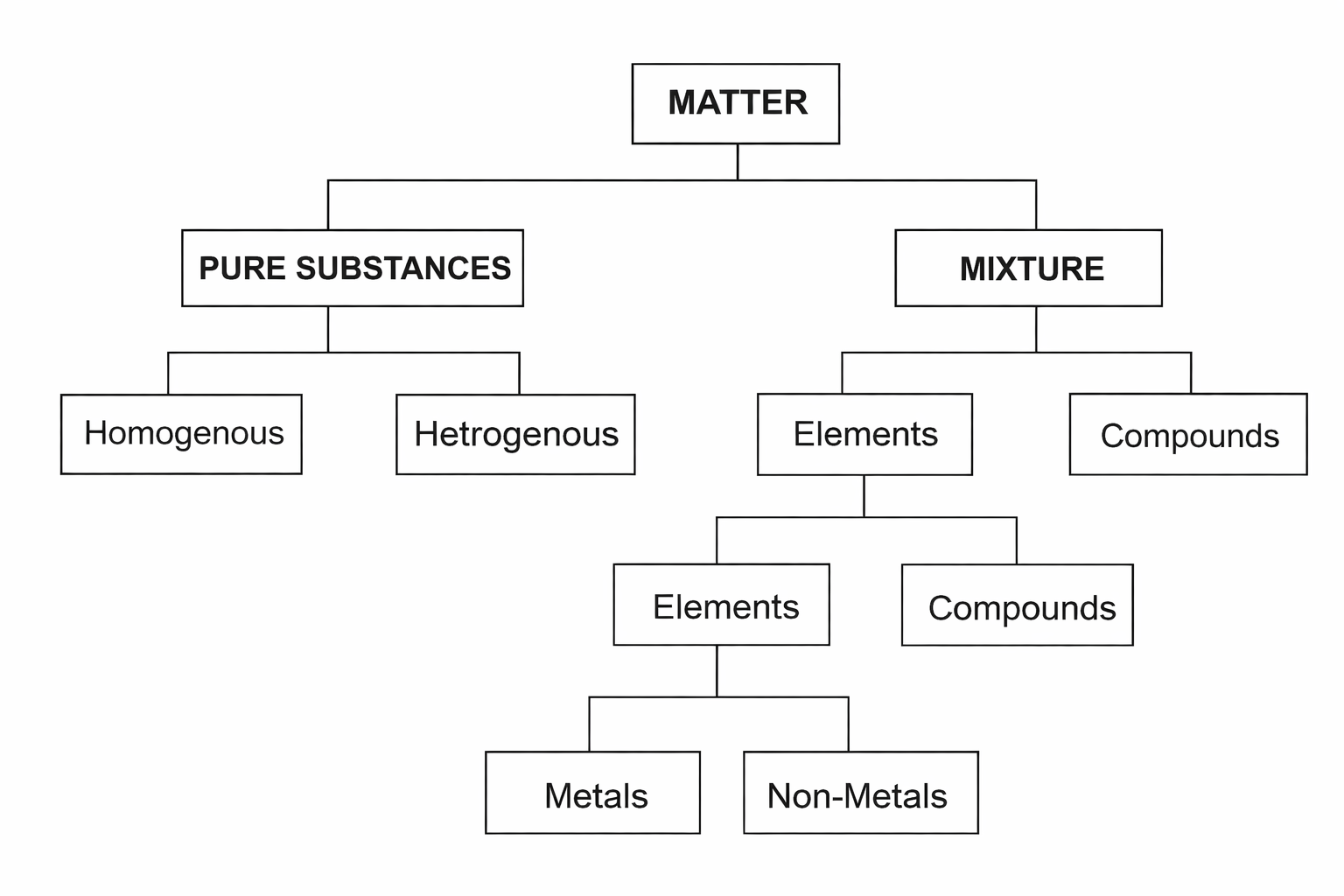
All matter is composed of submicroscopic particles. When combined with one another, these particles assume one of two different forms: either they are pure substances, or they are mixtures.
Pure Substances
Pure substances are a form of matter containing only one type of particle. The particles in pure substances are made of either unique elements or molecules that are present in fixed definite proportions.
Some examples of pure substances are water, oxygen gas, carbon dioxide, and sodium chloride (table salt).
Elements
Elements are unique in that they cannot be broken down or decomposed into other materials by ordinary means. For example, pure gold contains only gold particles. Gold is an example of an element. The smallest particle of an element is called an atom.
There are currently 118 confirmed elements, including hydrogen, oxygen, carbon, copper, lead, silver, and gold.
Note: An element is considered a pure substance. All elements are pure substances, but not all pure substances are elements. For example, water is a pure substance but not an element because it is made of hydrogen and oxygen.
Molecules
Atoms of elements can unite to form more complex structures called molecules. Molecules are made up of atoms arranged in fixed proportions, either of the same element, or of two or more different elements. When two or more different elements are present in a molecule, it is classified as a compound. When two or more pure substances are combined without a chemical change, the result is called a mixture.
Thousands of substances can be produced by chemically or physically combining different proportions of the 118 basic elements. For example, two atoms of the element hydrogen can combine with a single element of oxygen to produce water. Or atoms of oxygen and hydrogen can combine with atoms of iron to produce ferric hydroxide (common rust).
Aside from some elements that can exist as single atoms (for example, helium), most matter is composed of molecules that contain two or more atoms. This means that although the number of different atoms is limited, the number of different molecules is almost infinite.
The arrangement and structure of the molecules in a substance are unique and determine the characteristics of a material. For example, iron is harder than copper because of differences in the arrangement and structure of their molecules (molecular structure). The colour of gold is determined by its molecular structure.
The choice of the tools used to work a material depends on the molecular structure of both the tool and the material. For example, if a tool designed for use on wood is used on a block of iron, it will quickly become dull. Conversely, a hacksaw blade that is designed to cut metal is inappropriate for cutting wood. Because wood is softer than metal, a hacksaw blade will easily become clogged with fibres, limiting its effectiveness. When a hacksaw is used to cut metal, metal filings fall off of the blade, making it more effective.
Compounds
A compound is formed when two or more elements chemically combine to create a pure substance. The elements in a compound are always present in definite or fixed proportions. For example, the ratio of sodium to chlorine in sodium chloride (table salt) is always 0.65:1. If extra sodium or chlorine is present, the extra atoms will not combine.
There are many examples of compounds. Water is a compound of hydrogen and oxygen. Sugar and alcohol are both compounds of carbon, hydrogen and oxygen, although the number and arrangement of the atoms in the sugar and the alcohol molecules are different. Water, sugar, and alcohol are all compounds made of different combinations of elements.
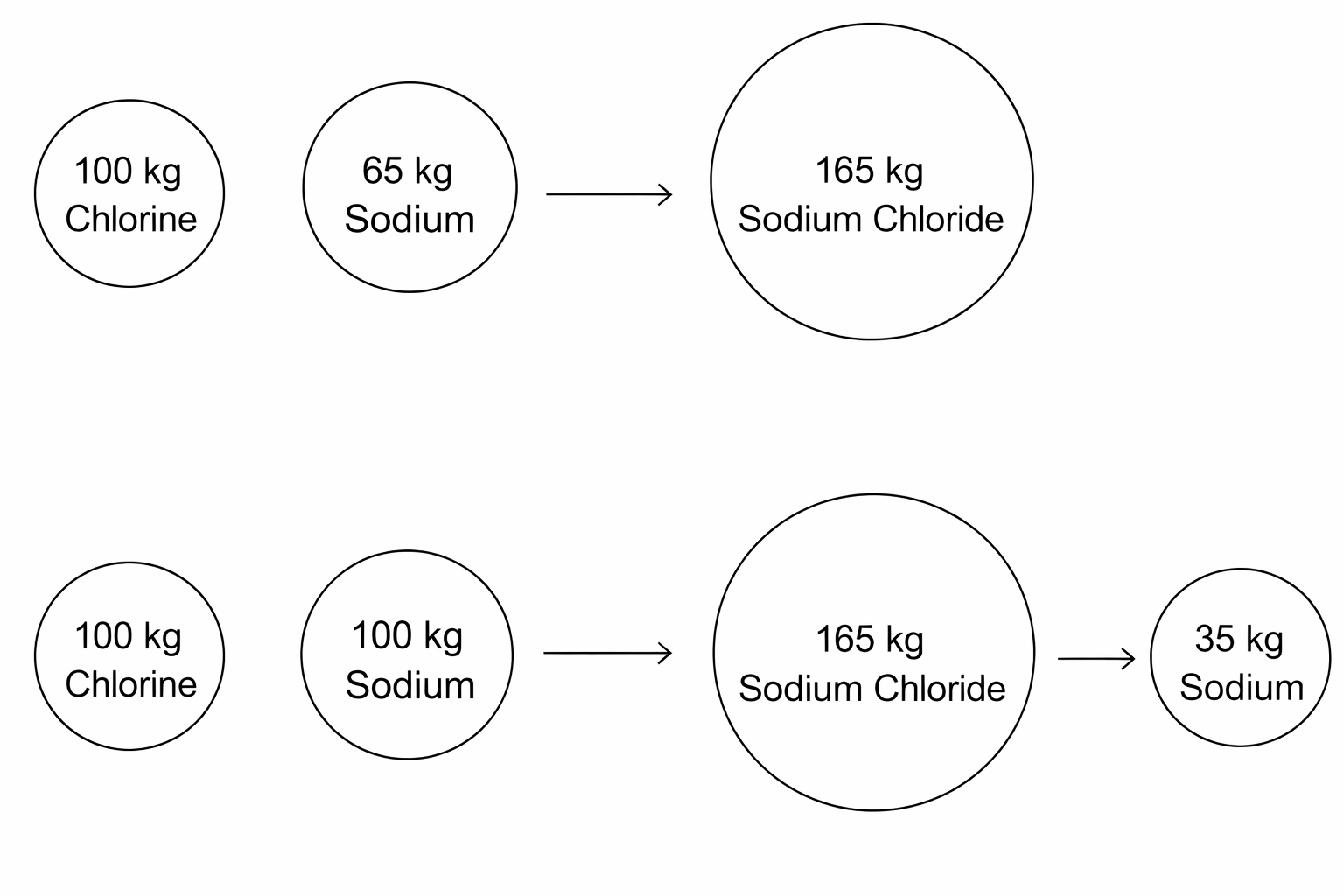
Molecules of compounds have all the properties of the compound and represent the smallest unit of that substance.
Mixtures
A mixture is formed when two or more elements or compounds are combined, but the substances retain their original properties.
Unlike compounds, mixtures can be made using different proportions of each ingredient. For example, concrete is a mixture of cement, water, and aggregate. The proportion of cement, water, and rock can vary, but the mixture will still be concrete. Changing the proportions changes the properties of the concrete—the physical characteristics of the concrete will be determined by the ratio of the ingredients.
Alloys are mixtures of a metal with other metals or non-metals. Like concrete, the final properties of the alloy mixture depend on the proportion of its constituent parts. Brass, for example, is essentially a mixture of copper and zinc. The proportion of copper and zinc varies widely, producing different types of brass with different properties. For example, if you wish to produce a bronze-coloured alloy, you would use 90% copper and 10% zinc. To produce silvery-white metal, use a mixture of 55% copper and 45% zinc. Brass is produced in about a dozen formulations, each with its own distinct characteristics, yet all are brass!
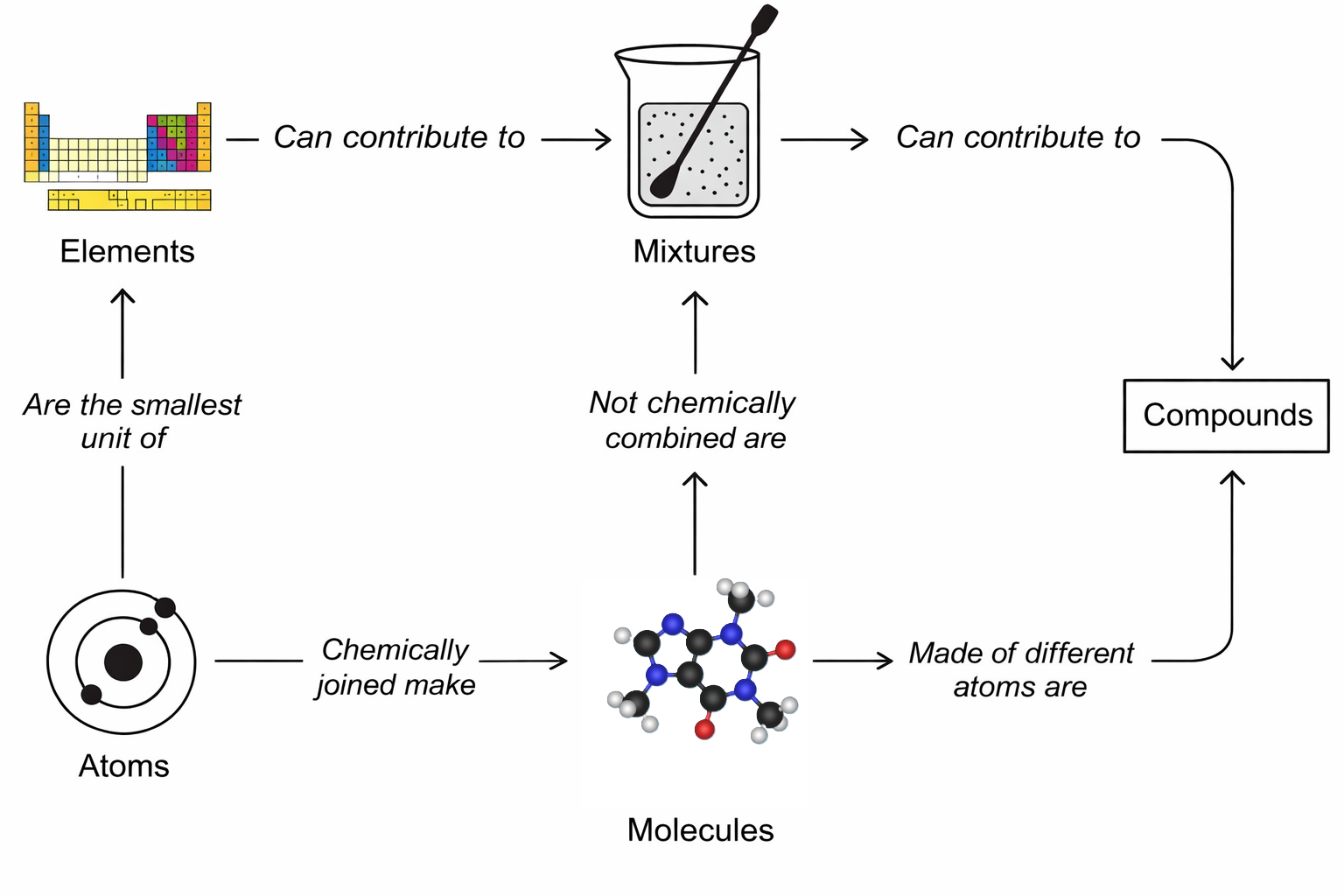
There are numerous examples of alloys used in the trades. Babbitt is used in bearings, stainless steel in construction, copper and silver in brazing rods, and aluminum/magnesium alloy in aircraft. Figure 3 shows the relationship between elements, compounds, and mixtures.
Describe Matter
Matter is defined as anything that occupies space and has a measurable weight or mass. Matter commonly exists in one of three forms or states:
- solid
- liquid
- gas
Solids have particles (ions, atoms, or molecules) that are closely packed together. The forces between particles are strong so that the particles cannot move freely but can only vibrate. As a result, solids have a stable, definite shape and definite volume. Solids can only change their shape by force, as when being broken or cut.
A liquid is a nearly incompressible fluid that conforms to the shape of its container but retains a (nearly) constant volume independent of pressure. The volume is definite if the temperature and pressure are constant.
Gases are compressible fluids. Not only will a gas conform to the shape of its container, but it will also expand to fill the container.
In this context, the term fluid means any substance—liquid or gas—that can flow and has no fixed shape, taking the shape of its container.
Density
Density is the ratio of a mass to a volume, or the ratio of a weight to a volume. Density compares the masses of equal volumes of different kinds of matter. In the metric system, mass density is found by using the following equation:
Metric formula:
[latex]\quad\text{(Metric) Density} = \frac{\text{mass}}{\text{volume}}\\ \quad\text{D} = \frac{\text{ m}}{\text{v}}[/latex]
The most common units of mass density are kilograms per cubic metre ([latex]\frac{\text{kg}}{\text{ m}^3}[/latex]) and grams per cubic centimetre ([latex]\frac{\text{g}}{\text{ cm}^3}[/latex]).
In the imperial system of measurements, we find weight density using the following equation:
Imperial formula:
[latex]\quad\text{Density} = \frac{\text{Weight}}{\text{Volume}}[/latex]
The most common weight density units are pound per cubic foot ([latex]\frac{\text{lb.}}{\text{ ft.}^3}[/latex]) and pounds per cubic inch ([latex]\frac{\text{lb.}}{\text{ in.}^3}[/latex]). The density values for a variety of materials are shown in Table 1.
|
Substance |
Mass Density [latex]\frac{\text{kg}}{\text{m}^3}[/latex] |
Unit [latex]\frac{\text{lb.}}{\text{ft.}^3}[/latex] |
|
Air |
1.3 |
0.08 |
|
Aluminum |
2,700 |
170 |
|
Concrete |
2,300 |
140 |
|
Ice @ 0°C |
920 |
58 |
|
Iron and steel |
7,800 |
480 |
|
Mercury |
13,600 |
830 |
|
Water (pure) @ 4°C |
1,000 |
62.4 |
|
Water (sea) |
1,030 |
64.3 |
Comparing densities demonstrates that some substances weigh more than others do, even though they all take up the same amount of space.
Example 1:
Calculate the density of a 700-g rectangular block with the following dimensions: length = 9 cm, width = 10 cm, height = 7 cm.
Solution:
[latex]\quad\text{Mass} = 700 \text{ g}\\ \quad\text{Volume} = 9\text{ cm} \times 10\text{ cm} \times 7\text{ cm} = 630 \text{ cm}^3\\ \quad\text{D} = \frac{700\text{ g}}{630\text{ cm}^3} = 1.11\frac{\text{g}}{\text{ cm}^3}[/latex]
Answer:
[latex]\quad1.11 \frac{\text{g}}{\text{ cm}^3}[/latex]
Example 2:
Calculate the density of a mixture of water and glycol when a 77-ft.3 tank contains 4,375 lb. of liquid.
Solution:
[latex]\quad\text{Weight} = 4,375\text{ lb.}\\ \quad\text{Volume} = 77\text{ ft.}^3\\ \quad\text{D} = \frac{4,375\text{ lb.}}{77\text{ ft.}^3} = 56.818\frac{\text{lb.}}{\text{ ft.}^3}[/latex]
Answer:
[latex]\quad56.818\frac{\text{lb.}}{\text{ ft.}^3}[/latex]
Specific Gravity (Weight)
Specific gravity (SG), sometimes called relative density particularly when referring to gases, is closely related to density. Specific gravity is considered to be the ratio of the density of a substance to the density of water (for liquids/solids) or air (for gases). Therefore, water and air have both been assigned a specific gravity of 1.0. Therefore, water has been assigned a specific gravity of 1.0 and air assigned a relative density of 1.0. Specific gravities are used in industry as a means of obtaining information about the concentration of solutions of various materials such as brines, hydrocarbons and glycol solutions.
The specific gravity of a solid or liquid tells you how heavy the object is compared to an equal volume of water. A material with a specific gravity less than 1.0 will float on water, while a material with a specific gravity more than 1.0 will sink in water. As well, a gas with a relative density less than 1.0 will rise in the atmosphere, while a gas with a relative density of more than 1.0 will sink.
For example, the specific gravity of aluminum is found by dividing either the mass density of aluminum by the mass density of water, or by dividing the weight density of aluminum by the weight density of water. The answers are the same in both cases, as the specific “number” is merely a ratio comparing densities.
Metric calculation:
[latex]\quad\text{Specific gravity} = \frac{\text{mass density of a substance}}{\text{mass density of water}}\\ \quad\text{Specific gravity aluminum} = \frac{2,700\frac{\text{kg}}{\text{ m}^3}}{1,000\frac{\text{kg}}{\text{ m}^3}}\\ \quad\text{Specific gravity aluminum} = 2.7[/latex]
Imperial calculation:
[latex]\quad\text{Specific gravity} = \frac{\text{mass density of a substance}}{\text{mass density of water}}\\ \quad\text{Specific gravity aluminum} = \frac{170\frac{\text{lb}}{\text{ft}^3}}{62.4\frac{\text{lb}}{\text{ft}^3}}\\ \quad\text{Specific gravity aluminum} = 2.7[/latex]
Specific gravity is a unitless number, or ratio, comparing same units. When divided as above, the units cancel out.
It is interesting to note that the specific gravity of any material that will float in water tells you what percentage of the volume will be submerged below the water line. For example, if a pine log (specific gravity of pine = 0.37) is floating on a body of water, it will have only 37% of its volume submerged.
If the specific gravity (SG) of a substance is known, it can be used to find the density of a solid or liquid by multiplying the SG times the density of an equal volume of water.
Example:
Calculate the density of mercury (SG 13.6) in [latex]\frac{\text{lb.}}{\text{ ft.}^3}[/latex]
[latex]\quad\text{Density of a substance} = \text{SG of a substance} \times \text{density of water}\\ \quad\text{Density of mercury} = 13.6 \times 62.4 \frac{\text{lb.}}{\text{ ft.}^3}\\ \quad\text{Density of mercury} = 848.64 \frac{\text{lb.}}{\text{ ft.}^3}\\[/latex]
Specific gravity will be covered more closely in C-1.13 Use Archimedes’ Principles of Displacement and Floatation when we will explore Archimedes’ principle of buoyancy.
It is a unitless value.
- SG < 1 → floats
- SG > 1 → sinks
Adhesion and Cohesion
The state a substance is in (solid, liquid or gas) is determined by the spacing and motion of the individual molecules. The spacing among the molecules is determined by several attracting forces.
- Cohesion is the attraction between similar molecules.
- Adhesion is the attraction between different molecules.
These forces affect how fluids behave in pipes.
Cohesive Forces
Solids consist of molecules that are strongly attracted to one another. This mutual molecular attraction, called cohesive force, limits the space around individual molecules and creates a closely packed situation that allows solids to hold definite shapes.
Cohesive forces in solids can be extremely strong. For example, a mass of several thousand kilograms can be suspended from a steel rod one centimetre in diameter without causing the molecules in the rod to separate. This is due to steel’s high rate of cohesion.
Gas molecules exhibit little cohesion. Individual molecules are, relatively speaking, widely separate. Indeed, under certain standard conditions, the distance between molecules in a gas can be more than 10 times greater than the diameter of a single molecule. The lack of cohesion allows a gas to diffuse (expand) quickly and broadly.
If not confined, a gas has almost unlimited expandability. For example, a cubic centimetre of water has a mass of one gram. When the single gram of water is vaporized, the resulting steam contains the same number of water molecules as were present in the liquid form but can occupy a space of several thousand cubic centimetres.
Liquids are also composed of tightly packed molecules, but the cohesive force is not as great as that found in solids. This reduction in intermolecular force allows some molecules to slip over other molecules. Molecular slippage allows liquids to flow.
Adhesive Forces
Dissimilar molecules often exhibit a force of attraction similar to cohesion. The intermolecular force acting between dissimilar molecules is called the adhesive force. The adhesive force between unlike molecules allows water to cling to the walls of glass, allows paint to stick to wood, oil to lubricate bearings, etc.
Sometimes a substance has an adhesive capability that exceeds its cohesiveness. This is true of many types of glue used in the furniture industry. A thin layer of glue creates a stronger bond between two pieces of wood than a thick layer of glue because the cohesive force between glue molecules is less than the adhesive force between glue molecules and wood molecules.
The vast majority of work done by individuals employed in the pipe trades involves the transportation of fluids through pipelines. It is important that a pipe tradesman have a good understanding of how fluids react with each other in addition to a good knowledge of the piping system they are being conveyed in.
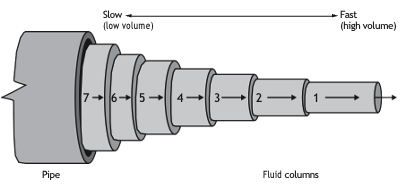
The behaviour of fluids within a piping system demonstrates these characteristics. Adhesion is the force that occurs between a liquid and the piping material that contains it. This adhesion causes a layer of molecules to bond tightly to the pipe’s inner surface. Cohesion is the attractive force that occurs between the fluid molecules and causes them to hold together.
To illustrate these forces in a pipe, Figure 5 shows a water column flow profile viewed from the side. The water column moves as a series of concentric layers, some of which may be just a few molecules thick. The outer layer, which is in contact with the surface of the pipe, does not move at all, while the one in the very centre of the pipe moves at the highest velocity. This illustrates that the adhesive forces between the water and the pipe are stronger than the cohesive forces between the water molecules.
Mechanical Properties
- Tensile strength — resistance to breaking when pulled
- Ductility — ability to stretch into wires
- Malleability — ability to be shaped under compression
- Elasticity — ability to return to original shape
Tensile Strength
Several properties of solids depend on the cohesive force between molecules. One of these properties is tensile strength. Tensile strength measures the force required to pull something (such as a rope, wire or structural beam) to the point where it breaks. The tensile strength of a material is the maximum amount of tensile stress that can be applied before failure occurs.
If two metal rods of the same diameter, one copper and one steel, are placed in the tensile testing machine shown in Figure 6, it will be found that a greater force must be exerted to break or pull apart the steel rod than that required to break or pull apart copper. Steel, therefore, has a higher tensile strength.
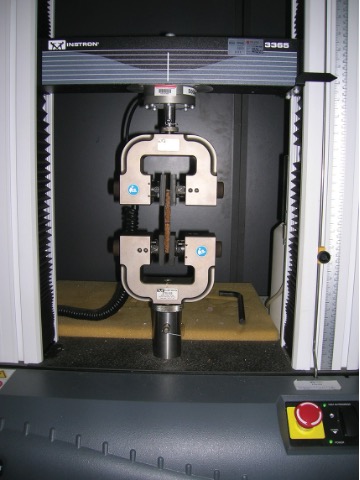
The tensile strength of a material is defined as the force needed to break a rod or wire of that material having a unit cross-sectional area of either one square inch or one square centimetre. The tensile strength of mild steel pipe, for example, is 60 000 psi.
Tensile strength tests are performed for several reasons. The results of tensile strength tests are useful in selecting materials for engineering applications. Tensile properties frequently are included in material specifications to ensure quality. Tensile properties often are measured during development of new materials, so that different materials can be compared under different forms of loading.
Ductility
Ductility is the ability of material to be drawn out into thin wires or flat sheets without pulling apart or breaking. Ductility allows a material to maintain its formed shape while under tensile stress. The finer the wire produced, the more ductile the material is. This is a desirable quality, especially in metals.
Many manufacturers want materials that will not break even when thin pieces are required.
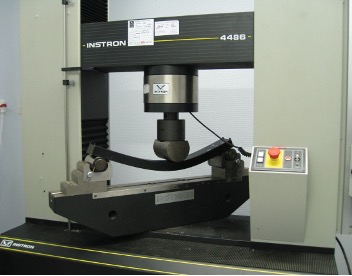
When the ductility of a material needs to be determined, a commonly used method is the bend test (Figure 7). The ductility test or bend test is a very common test for welded joints, piping products, and reinforcing (rebar) materials.
Malleability
While ductility is the property of a material to strain without rupturing under tension, malleability describes the ability to do so under compression. The most typical example given is that a malleable material can be hammered or rolled into thin and flat sheets without tearing. Most malleable materials are also ductile, though lead is one exception. Gold leaf and aluminum foil are common products demonstrating high malleability.
Elasticity
Elasticity is the ability of a material to return to its original dimensions after it has been subjected to a force. All solids have some elasticity. However, the term elastic is used to describe a substance that quickly resumes its original shape when the deforming force is removed.
The maximum force or stress that a solid can withstand and still “snap” back to its original shape and so not be permanently deformed is called the elastic limit. The elastic limit is not the material’s breaking point, although the object may or may not be far from breaking. Brittle materials (such as glass and cast iron) break at or close to their elastic limit. Other materials, notably most metals, can be flatted or shaped long after the elastic limit is reached, particularly if they are heated.
Conductivity
Conductivity refers to the ability of a material to transfer energy from one place to another. Thermal conductivity describes a substance’s ability to transmit heat, while electrical conductivity describes a substance’s ability to transmit electrical current.
- Thermal conductivity — heat transfer
- Electrical conductivity — current flow
Thermal Conductivity
Heat transfer occurs at a higher rate across materials of high thermal conductivity than across materials of low thermal conductivity. The reciprocal of thermal conductivity is thermal resistance. Thermal resistance is a measure of a material’s ability to resist heat transfer. The more a material is able to block heat transfer through its surface, the greater its thermal resistance. This concept is often applied to the building industry as a measure of insulation effectiveness and energy efficiency. As thermal insulation is added to the building to improve efficiency levels, the thermal resistance of the structure increases.
Throughout most of the world, R-value is used to measure thermal resistance. The higher the R-value of a material, the better it is able to resist heat transfer. The lower the R-value, the easier it is for heat to pass through the material’s surface.
Electrical Conductivity
Electrical conductivity is a property that describes how well a material allows electrical current to flow through it. Examples of metals that have a high electrical conductivity include gold, silver, copper, aluminum and steel. Copper and aluminum are the most common materials used in electrical wires. Interestingly, most thermal conductors are good electrical conductors.
Another important property that is measured in electrical systems is electrical resistance, which is measured in units called ohms (Ω). Resistance, in electrical terms, describes the forces that oppose the flow of electrical current in a conductor. Certain materials that are low in electrical conductivity are termed electrical insulators. Good insulators have high resistance.
Ohm's law describes the relationship of current flowing through a resistance when a different electric potential (voltage) is applied at each end of the resistance. A comparison would be to imagine water flowing through a pipe. Voltage would be the water’s pressure, current (or amps) would be the amount of water flowing through the pipe, and resistance is similar to the friction incurred due to the size of the pipe. More water will flow through the pipe (current) as more pressure is applied (voltage). Resistance would also change as the pipe size changes, thereby increasing or decreasing flow accordingly.

Self-Test C-1.11: Define the Properties of Matter
Complete Self-Test C-1.11 and check your answers.
If you are using a printed copy, please find Self-Test C-1.11 and Answer Key at the end of this section. If you prefer, you can scan the QR code with your digital device to go directly to the interactive Self-Test.
References
BCcampus. (n.d.). Playlist: Tools and equipment videos. BCcampus MediaSpace. https://media.bccampus.ca/playlist/details/0_3g8xp22x/categoryId/175673 Playlist Details – Trades Access Common Core Line C: Tools and Equipment Videos – BCcampus
BC Industry Training Authority. (2019). Piping trades apprenticeship program: Use Tools and Equipment—Level 1 harmonized [Binder]. Crown Publications, Queen’s Printer for British Columbia. https://www.crownpub.bc.ca/Product/Details/7960000261_S
- Plumber: Competency C-1 Use Mathematics and Science
- Steamfitter: Competency C-1 Use Mathematics and Science
- Sprinkler Fitter: Competency C-1 Use Mathematics and Science
Camosun College. (2019). Line C: Tools and Equipment—Competency D-2 Apply Science Concepts to Trades Applications (Rev. ed.) [Learning guide]. BCcampus. https://collection.bccampus.ca/textbook/fkXxtNTn/
Camosun College. (2015). Trades Access Common Core Competency D-2 Apply Science Concepts to Trades Applications. Victoria, B.C.: Crown Publications. Download for free from the B.C. Open Textbook Collection (https://open.bccampus.ca/browse-ourcollection/find-open-textbooks/).
Camosun Innovates. (2022). Tools and Equipment Videos [Video playlist]. Camosun College/BCcampus. https://camosuninnovates.opened.ca/
Flinn, C. (n.d.). OER for Trades: Math for Trades [Video collection]. BCcampus MediaSpace. https://media.bccampus.ca/channel/OER%2Bfor%2BTrades%3A%2BMath%2Bfor%2BTrades/175670
Note: these videos align with the open textbooks Math for Trades: Volume 1 and Math for Trades: Volume 2. All videos are by Chad Flinn and available under a Creative Commons Attribution 4.0 Licence.:
Media Attributions
All figures are sourced from Industry Training Authority (2019) and/or Camosun College (2019) and are used under the Creative Commons Attribution 4.0 (CC BY 4.0) licence unless otherwise noted. Images copyrighted by the BC Industry Training Authority are licensed under a Creative Commons Attribution-NonCommercial-ShareAlike 4.0 (CC BY-NC-SA 4.0) licence.
Anything that takes up space and has mass or weight; all the materials or substances existing on Earth. (Section C-1.11)
The force of gravity pulling on an object. It tells how heavy something is. (Section C-1.11)
The amount of matter in a substance, usually measured in pounds (lb.) or kilograms (kg). (Section C-1.19)
Very tiny particles, like atoms and molecules, that are too small to be seen even with a microscope. (Section C-1.11)
A material made of only one type of particle; e.g., copper (Cu), which is used in pipes and wiring—it's an element made of only one type of atom or distilled water, used in some systems (like testing or labs)—it contains only water molecules. (Section C-1.11)
A combination of substances that are not chemically joined; e.g., brass (a mixture (alloy) of copper and zinc used in fittings and valves); concrete (a mixture of cement, water, sand, and gravel—used in construction); air (a mixture of gases found in HVAC systems); and glycol–water solution (used in heating and cooling systems—mixture of water and antifreeze). (Section C-1.11)
A tiny particle that makes up a substance. (Section C-1.16)
A set amount of each substance that always combines in the same ratio to make a compound. The proportions do not change. (Section C-1.11)
A pure substance made of only one type of atom. (Section C-1.11)
The smallest part of an element that still has its properties. (Section C-1.11)
A substance made when two or more different elements chemically join together. (Section C-1.11)
A mixture made by combining a metal with other metals or materials. (Section C-1.11)
Babbitt is a mixture of metals (usually tin, lead, copper, or antimony) that is used as a lining in bearings because it is soft, durable, and helps reduce wear and friction. (Section C-1.11)
A state of matter that has a fixed shape and a fixed volume because its particles are packed closely together and only move by vibrating. (Section C-1.11)
A state of matter that flows and takes the shape of its container. (Section C-1.11)
A state of matter that spreads out to fill its container; A substance that has no fixed shape or volume and spreads out to fill any container. (Section C-1.11; Section C-1.16)
A substance that can flow, like a liquid or gas, taking the shape of its container. (Section C-1.11)
How much mass is packed into a certain space; mass per unit volume of a substance; affects whether a fluid rises or sinks during convection. (Section C-1.13; Section C-1.18)
(relative density); A number that compares how heavy a gas is compared to air (or a liquid compared to water). (Section C-1.20)
The upward force a liquid pushes on an object. (Section C-1.13)
The attraction between particles of the same substance that holds them together; for example, cohesive forces between water molecules help them stick together and form droplets. (Section C-1.11)
The force that holds similar particles together. (Section C-1.11)
To spread out or move from an area of higher concentration to an area of lower concentration. For example, a gas will diffuse to fill all available space. (Section C-1.11)
The attraction between molecules that helps hold a substance together. These forces are weaker than the bonds within a molecule but affect properties like boiling point, melting point, and how substances stick or flow. (Section C-1.11)
The force that pulls different materials together and makes them stick to each other. (Section C-1.11)
The force that makes different substances stick to each other, like water sticking to glass or paint sticking to a wall. (Section C-1.11)
The ability of a material to resist breaking when pulled. (Section C-1.11)
The ability of a material to be stretched into a wire without breaking. (Section C-1.11)
A test used to see how flexible a material is by bending it to check if it cracks or breaks. (Section C-1.11)
The ability of a material to be hammered or pressed into thin sheets. (Section C-1.11)
The ability of a material to return to its original shape after being stretched or compressed. (Section C-1.11)
The maximum amount a material can be stretched, compressed, or bent and still return to its original shape when the force is removed. (Section C-1.11)
The ability of a material to let heat or electricity pass through it. (Section C-1.11)
A measure of how well a material can transfer heat; materials with high thermal conductivity, like metal, let heat pass through them easily, while materials with low thermal conductivity, like insulation, resist heat flow. (Section C-1.11)
A measure of how well a material can allow electric current to flow through it; materials like copper have high electrical conductivity and let electricity pass easily, while materials like rubber have low conductivity and resist the flow of electricity. (Section C-1.11)
A measure of how well a material resists the flow of heat; materials with high thermal resistance slow down heat transfer. (Section C-1.11)
A material or method used to reduce the transfer of heat; it helps keep heat in or out of a space, such as insulation in walls or around pipes. (Section C-1.11)
A measure of how well a material resists the flow of heat; a higher R-value means better insulation and less heat transfer. (Section C-1.11)
A measure of how much a material opposes the flow of electricity; materials with high resistance make it harder for electric current to pass through them. a measure of how much a material opposes the flow of electricity. Materials with high resistance make it harder for electric current to pass through them. (Section C-1.11)
Materials that do not allow electricity to flow through them easily; they have high electrical resistance and are used to protect people and equipment from electric current, such as rubber or plastic coatings on wires. (Section C-1.11)
A rule that explains how electricity moves in a circuit. It says that the amount of electrical push (voltage) equals the flow of electricity (current) multiplied by how much the material resists it (resistance). (Section C-1.1)