C-1.6 Perform Conversions
Metric System
The International System of Units (SI, from the French Le Système international d’unités) is the modern The International System of Units (SI) is the modern version of the metric system and is the most widely used system of measurement in the world—used in both everyday commerce and science.
In the United States, metric units are not commonly used outside of science, medicine, and the government. In Canada, both metric and imperial units are used. While metric units are standard for science and government, imperial units are still common in the building trades. As a result, trades workers must be comfortable working in both systems.
In the metric (SI) system, there is a standard unit for each type of measurement. The metre is used for length or distance, the gram is used for weight or mass, and the litre is used for capacity or volume. There is also a series of prefixes that are added to the standard units to indicate measures greater than the standard units or less than the standard units.
Many consider the metric system to be easier to use than the imperial system. One reason is that all measures greater than or less than the standard unit are in powers of 10. Changing from larger to smaller, or from smaller to larger measures simply requires multiplying or dividing by 10 or a power of 10. Another reason the metric system is easier to use than the imperial system is that the prefixes used with the standard unit represent the power of 10 by which the standard unit is to be divided or multiplied.
Prefixes of the Metric System
Before we start our study of metric measurements, look at the prefixes that are used in the metric system. Keep in mind that the prefix will have the same meaning no matter which unit (metre, gram, or litre) the prefix is attached to.
The prefixes used in this section for smaller units than the standard unit are:
[latex]\quad\text{deci}=\frac{1}{10}\text{ of}\\ \quad\text{centi}=\frac{1}{100}\text{ of}\\ \quad\text{milli}=\frac{1}{1,000}\text{ of}[/latex]
The prefixes used for larger units than the standard unit are:
[latex]\quad\text{deca}= 10\text{ times}\\ \quad\text{hecto}= 1,00\text{ times}\\ \quad\text{kilo}= 1000\text{ times}[/latex]
There are other prefixes that are used with very large and very small measures, but they will not be discussed in this section.
The use of prefixes can be related to our decimal system of numeration. Let’s compare our decimal-place-value chart, shown below, with these prefixes. The standard unit (whether metre, gram, or litre) corresponds to the ones place. All the places to the left are powers of the standard unit. That is, the value of deca- is 10 times the standard unit; the value of hecto- is 100 times this unit; the value of kilo- is 1,000 times this unit; and so on.
All the places to the right of the standard unit are subdivisions of the standard unit. That is, the value of deci- is [latex]\frac{1}{10}[/latex] of the standard unit; the value of centi- is [latex]\frac{1}{100}[/latex] of this unit; the value of milli- is [latex]\frac{1}{1,000}[/latex] of this unit; and so on.
|
Prefix |
Abbreviation |
Unit Place Value |
|
Kilo |
k |
Thousands (1,000) |
|
Hecto |
h |
Hundreds (100) |
|
Deca |
da |
Tens (10) |
|
Standard Unit |
|
Units of Ones (1) |
|
Deci |
d |
Tenths ([latex]\frac{1}{10}[/latex]) |
|
Centi |
c |
Hundredths ([latex]\frac{1}{100}[/latex]) |
|
Milli |
m |
Thousandths ([latex]\frac{1}{1,000}[/latex]) |
Fractions and Decimals in the Trades
In the piping trades, measurements are often written as fractions (such as [latex]\frac{1}{2}[/latex]″ or [latex]\frac{3}{4}[/latex]″) or as decimals (such as 0.50 or 0.75). Being able to change between fractions and decimals is an important skill when reading drawings, using measuring tools, and completing calculations.
Changing a fraction to a decimal:
Divide the top number (numerator) by the bottom number (denominator).
Example:
[latex]\quad\frac{3}{4} = 3 \div 4 = 0.75[/latex]
Changing a decimal to a fraction:
Write the decimal as a fraction over 10, 100, or 1000, then simplify if needed.
Example:
[latex]\quad0.75 = \frac{75}{100} = \frac{3}{4}[/latex]
Why This Matters in Plumbing
Tradespeople often:
- Read measurements on drawings that use fractions
- Use calculators or formulas that give answers in decimals
- Convert between systems (imperial and metric)
Being able to switch between fractions and decimals helps ensure accurate measurements, proper fitting, and safe installations.
Convert Length, Area, Volume, Weight, and Capacity
Measures of Length
Metre: The metre is the standard unit for measuring length. One metre is equal to 3.281 ft or 39.37 in. The metre is the appropriate unit to use to measure lengths and distances like room dimensions, site dimensions and heights of buildings. The abbreviation for metre is ”m”.
Kilometre: To measure long distances, a larger measuring unit is typically used. One kilometre is 1,000 metres and is used for these longer distances. The abbreviation for kilometre is km. The prefix kilo attached to the word metre means “1,000.”
Centimetre: When measuring objects less than 1 m long, one of the most common units used is the centimetre (cm). Since the prefix centi- means “[latex]\frac{1}{100}[/latex] of,” a centimetre is one hundredth of a metre. One centimetre is about the width of a thumbtack head, somewhat less than [latex]\frac{1}{2}[/latex]“.
Millimetre: Many objects are too small to be measured in centimetres, so an even smaller unit of measure is needed. One millimetre (mm) is [latex]\frac{1}{1,000}[/latex] of a meter, or about the thickness of a plastic credit card or a dime. Many modern projects will state the size of pipe and fittings in millimetres.
Other units and their abbreviations are decimetre (dm), decametre (dam) and hectometre (hm).
Measures of Area and Volume
Square metre: A square metre occupies an area that is 1 metre long and 1 metre wide. It is a little larger than a square yard since the metre is a little longer than a yard. A square that is 10 metres on each side would have an area of 100 square metres.
There are 1,000,000 square metres in a square kilometre, just as there are 1,000,000 square millimetres in a square metre. For comparison, you might think of a square millimetre as the area of a pinhead and a square metre as the area of a desktop. The 10-metre square (10 m × 10 m) or area is about the floor area of a large classroom, and the 100-metre square (100 m × 100 m) or hectare is about the area of two football fields. The square kilometre is about 200 acres, or roughly a third of a square mile.
Cubic units were used to measure volumes long before the metric system was defined. Cubic inches of ice (ice cubes), cubic feet of gas (measured through a gas meter) and cubic yards of dirt, gravel or concrete are still in common use. The cubic metre is 30% larger than the cubic yard. There are exactly 1 billion cubic millimetres in a cubic metre, and 1 billion cubic metres in a cubic kilometre.
Calculating area (square units) and volume (cubed units) in the metric system is done in the same way as with the imperial system. Only the units of measure change.
Area of a Rectangle: [latex]\quad\text{Area} = \text{length} \times \text{width}[/latex]
Example:
A sheet of material is 2.5 m long and 1.2 m wide.
[latex]\quad\text{Area} = 2.5 \times 1.2[/latex]
[latex]\quad\text{Area} = 3.0\ \text{m}^2[/latex]
The area of the sheet is 3.0 m²
Area of a Circle: [latex]\quad\text{Area} = \text{d}^2 \times 0.7854\\[/latex]
Example:
A pipe has a diameter of 0.4 m.
[latex]\quad\text{Area} = (0.4)^2 \times 0.7854[/latex]
[latex]\quad\text{Area} = 0.16 \times 0.7854[/latex]
[latex]\quad\text{Area} = 0.1257\ \text{m}^2[/latex]
The cross-sectional area of the pipe is 0.126 m² (rounded)
Volume of a rectangular solid: [latex]\quad\text{Volume} = \text{length} \times \text{width} \times \text{height}[/latex]
Example:
A tank is 2.0 m long, 1.5 m wide, and 1.2 m high.
[latex]\quad\text{Volume} = 2.0 \times 1.5 \times 1.2[/latex]
[latex]\quad\text{Volume} = 3.6\ \text{m}^3[/latex]
The volume of the tank is 3.6 m³
Volume of a cylinder (pipe): [latex]\quad\text{Volume} = \text{d}^2 \times 0.7854 \times \text{H}[/latex]
Example:
A pipe has a diameter of 0.3 m and a length (height) of 5 m.
[latex]\quad\text{Volume} = (0.3)^2 \times 0.7854 \times 5[/latex]
[latex]\quad\text{Volume} = 0.09 \times 0.7854 \times 5[/latex]
[latex]\quad\text{Volume} = 0.3534\ \text{m}^3[/latex]
The volume inside the pipe is 0.353 m³
Measures of Weight
Gram: The standard unit for measuring weight in the metric system is the gram. A gram is described as the weight of 1 cubic centimetre (cm3) of water. A cubic centimetre is a cube in which each edge is equal to 1 centimetre in length. It is a little smaller than a sugar cube. The abbreviation g is used for gram. The gram is used for measuring small, light objects.
Kilogram: One kilogram (kg) is 1,000 grams. Since a cube 10 cm on each edge (1 dm³) can be divided into 1,000 cm3, the weight of the amount of water required to fill this cube would be 1,000 grams or 1 kilogram. One kilogram is equivalent to approximately 2.2 lb.
Milligram: The milligram ([latex]\frac{1}{1,000}[/latex] of a gram) is used to measure very small weights. Milligrams (mg) are used when measuring very small amounts of chemicals that may be present in a fluid sample, for example. One [latex]\frac{\text{mg}}{\text{L}}[/latex] is equal to one part per million (ppm) when discussing mineral concentrations in water treatment systems.
Other units and their abbreviations are decigram, dg; centigram, cg; decagram, dag; and hectogram, hg.
Measures of Capacity
Litre: One litre (L) is the volume of a cube 10 cm on each edge, equal to one decimetre (dm). It is the standard metric unit of capacity. Since a cube 10 cm on each edge filled with water (at 4°C) weighs 1 kg, then 1 L of water weighs 1 kg. One litre is just a little smaller than a liquid quart (an imperial unit for measuring capacity). There are nearly four litres per US gallon, and approximately 4.5 litres per imperial gallon. Water storage tanks are often listed by their capacity in litres.
Millilitre: Since one litre is 1,000 cm3, one millilitre has the same capacity or volume as a cubic centimetre. Most liquid medicine is labelled and sold in millilitres (mL) or cubic centimetres (cc or cm3). Liquids available in very small quantities are measured in millilitres.
Some other units and their abbreviations are decilitre (dL); centilitre (cL); decalitre (daL); hectolitre (hL); and kilolitre (kL).
Example:
If you were to find the capacity of the pipe from our Volume of a Cylinder (Pipe) example above:
Convert to Litres (Capacity)
Since the volume of inside the pipe is 0.353 m³:
[latex]\quad 1\ \text{m}^3 = 1000\ \text{L}[/latex]
[latex]\quad 0.3534 \times 1000 = 353.4\ \text{L}[/latex]
The pipe can hold 353.4 L of water
Imperial to Metric (SI) Conversions
Learning to convert between the imperial system and the metric (SI) system is important because both systems are used in the piping trades. While working within one system is straightforward, converting between systems requires careful attention.
To convert measurements, you only need one conversion factor for each type of measurement (length, area, volume, mass, and capacity).
It is important to note that U.S. and imperial measurements are not the same, particularly for capacity. For example, a U.S. gallon is 32 ounces, or 3.785 L, while an imperial gallon is 40 ounces, or 4.546 L. Because of these differences, always make sure you are using the correct conversion factor for the system specified in your problem.
Table 2 lists commonly used conversion factors between metric and imperial units. Some values have been rounded for practical use in the trades.
Note: It is not necessary to memorize these values. In practice, tradespeople refer to charts, calculators, or reference manuals when performing conversions.
|
From |
To |
Multiply by |
|
inches |
millimetres |
25.4 |
|
millimetres |
inches |
0.0394 |
|
inches |
centimetres |
2.54 |
|
centimetres |
inches |
0.3937 |
|
feet |
metres |
0.3048 |
|
metres |
feet |
3.281 |
|
yards |
metres |
0.9144 |
|
metres |
yards |
1.094 |
|
miles |
kilometres |
1.609 |
|
kilometres |
miles |
0.6214 |
|
sq. inches |
sq. centimetres |
6.452 |
|
sq. centimetres |
sq. inches |
0.155 |
|
sq. metres |
sq. feet |
10.76 |
|
sq. feet |
sq. metres |
0.0929 |
|
sq. yards |
sq. metres |
0.8361 |
|
sq. metres |
sq. yards |
1.196 |
|
sq. miles |
sq. kilometres |
2.589 |
|
sq. kilometres |
sq. miles |
0.3861 |
|
acres |
hectares |
0.4047 |
|
hectares |
acres |
2.471 |
|
cu. inches |
cu. centimetres |
16.39 |
|
cu. centimetres |
cu. inches |
0.06102 |
|
cu. feet |
cu. metres |
0.02832 |
|
cu. metres |
cu. feet |
35.315 |
|
cu. yards |
cu. metres |
0.7646 |
|
cu. metres |
cu. yards |
1.308 |
|
cu. inches |
litres |
0.01639 |
|
litres |
cu. inches |
61.03 |
|
imp. pints |
litres |
0.5682 |
|
litres |
imp. pints |
1.76 |
|
US pints |
litres |
0.47311 |
|
litres |
US pints |
2.114 |
|
US gallon |
litres |
3.785 |
|
imp. gallons |
litres |
4.546 |
|
litres |
US gallons |
0.2642 |
|
litres |
imp. gallons |
0.22 |
|
grains |
grams |
0.0648 |
|
grams |
grains |
15.43 |
|
ounces |
grams |
28.35 |
|
grams |
ounces |
0.03527 |
|
pounds |
grams |
453.6 |
|
grams |
pounds |
0.002205 |
|
pounds |
kilograms |
0.4536 |
|
kilograms |
pounds |
2.205 |
|
tons |
kilograms |
1,016.05 |
|
kilograms |
tons |
0.0009842 |

Self-Test C-1.6.1: Perform Conversions
Complete Self-Test C-1.6.1 and check your answers.
If you are using a printed copy, please find Self-Test C-1.6.1 and Answer Key at the end of this section. If you prefer, you can scan the QR code with your digital device to go directly to the interactive Self-Test.
Convert Heat Energy, Temperature, and Pressures
Heat Energy Conversions
Heat energy can be measured in many different units. The most common units for heat are:
- British thermal unit (BTU)
- kilowatt hour (kWh)
- calorie (cal)
- joule (J)
British Thermal Unit (BTU): The unit of energy in the imperial system—the BTU—is the amount of heat required to raise or lower the temperature of one pound of water 1 °F. BTUs are commonly used in heating systems to describe how much heat energy is produced. One BTU is approximately equal to the energy released when a wood match burns. How quickly this energy is converted to do work is a measurement of power. Typically, in the piping industry, power requirements and outputs are calculated on a per-hour basis. For example, heating 100 pounds of water 100°F would require 100,000 BTUs of energy; doing that amount of work in 2 hours would require a power output of 50,000 BTU per hour, whereas it would require 200,000 [latex]\frac{\text{BTU}}{\text{hr}}[/latex] for an appliance to perform that work in 30 minutes.
[latex]\quad1 \text{ BTU} = 1,055\text{ joules} = 0.00029295\text{ kilowatt hours} = 252 \text{ calories}[/latex]
A boiler firing at 1 kilowatt generates the equivalent of 3,412 BTU of heat energy in the combustion chamber.
Calorie: One calorie is the amount of heat required to raise the temperature of 1 gram of water 1°C. The calorie is outdated and commonly replaced by the metric unit joule.
[latex]\quad1 \text{ calorie} = 4.187\text{ joules} = 0.003968\text{ BTU} = 1.1629 \times 10^{-6}\text{ kilowatt hour}[/latex]
Note: that number is written in scientific notation.

Some very large or very small numbers are written using scientific notation. In general, a number written in scientific notation will be multiplied by 10 raised to an exponent. When the exponent is positive, move the decimal point to the right the number of places indicated by the exponent: 6.45 × 103 = 6,450
When the exponent is negative, move the decimal point to the left the number of places indicated by the exponent:
6.45 × 10-3 = .00645
Joule: A joule is the general metric unit in measuring energy. Cooling down a mug of hot coffee to room temperature will free about 100,000 joules. 4.187 joules of heat energy (or 1 calorie) is required to raise the temperature of a unit weight (1 g) of water 1°C.
[latex]\quad1 \text{ J (joule)} = 0.2388\text{ calories} = 2.778 \times 10^{-7}\text{ kWh} = 9.478 \times 10^{-4}\text{ BTU}\\\quad\text{1 Gigajoule is 1,000,000,000 joules or 238,834,488 calories.}[/latex]
|
Metric Units |
Imperial Units |
||
|
Joules |
Kilowatt Hours |
Calories |
BTUs |
|
1 |
2.778 × 10⁻⁷ |
0.2388 |
0.0009478 |
|
4.187 |
1.1629 × 10⁻⁶ |
1 |
0.003968 |
|
1,055 |
0.00029295 |
252 |
1 |
|
3,600,000 |
1 |
859,824 |
3,412 |
Power
Power is the rate of doing work. It is the equivalent to an amount of energy used per unit of time.
Kilowatt (kW): The kilowatt is the metric unit typically used for power. The watt is named after Scottish engineer James Watt, who pioneered the success of the steam engine. Watts are a measurement of the rate of energy transfer and are equal to 1 joule per second ([latex]\frac{\text{J}}{\text{sec}}[/latex]).
[latex]\quad1 \text{ kilowatt} = 1,000\text{ watts} = 3,412 \frac{\text{BTU}}{\text{hr}} = 3,600,000 \frac{\text{joules}}{\text{hr}} = 859,824 \frac{\text{calories}}{\text{hr}}\\ \quad= 0.0036 \text{ Gigajoules}[/latex]
A furnace operated at a rate of 100,000 BTU per hour is operating at a rate of 29.3 kilowatts.
Temperature Conversions
Many vocational-technical applications require conversions between different temperature scales. In this section, we will be concerned with temperature conversions involving the Celsius, Kelvin, Rankin and Fahrenheit scales.
Celsius–Kelvin Conversions
One scale used to measure temperature in the metric system of measurement is called the Kelvin scale. Units on this scale are abbreviated with a capital K (without the symbol ° because these units are simply called Kelvins) and are measured from absolute zero, the temperature at which all heat is said to be removed from matter. Another metric temperature scale is the Celsius scale (abbreviated °C), sometimes referred to as the centigrade scale, which has zero as the freezing point of water. Kelvin is often used in science, while Celsius is used in everyday temperature measurements. The Kelvin and Celsius scales are related, so that each unit of change on the Kelvin scale is equal to one degree of change on the Celsius scale. That is, the size of a Kelvin and a Celsius degree are the same on both scales. Absolute zero (the zero for the Kelvin scale) corresponds to 273 degrees below zero on the Celsius scale.
To convert Celsius to Kelvin:
K = °C + 273
[latex]\quad\text{K} = \text{°C} + 273[/latex]
To convert Kelvin to Celsius:
°C = K – 273
[latex]\quad\text{°C} = \text{K} - 273[/latex]
Rankin–Fahrenheit Conversions
The imperial system temperature scale that starts at absolute zero is called the Rankin scale. It is related to the Fahrenheit scale, which places the freezing point of water at 32 °F. The Rankin (°R) and Fahrenheit (°F) scales have the same relationship as the Kelvin and Celsius scales in the metric system. That is, one degree of change on the Rankin scale is equal to one degree of change on the Fahrenheit scale. Absolute zero (the zero for the Rankin scale) corresponds to 460 degrees below zero on the Fahrenheit scale.
To convert Fahrenheit to Rankin:
[latex]\quad\text{°R} = \text{°F} + 460[/latex]
To convert Rankin to Fahrenheit:
[latex]\quad\text{°F} = \text{°R} - 460[/latex]
Because both the Kelvin and Rankin scales originate from absolute zero, their respective temperatures are frequently referred to as the absolute temperature of a substance.
Fahrenheit–Celsius Conversions
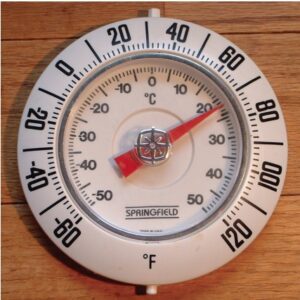
The Celsius and Fahrenheit scales are the most common temperature scales used for reporting air and fluid temperatures. Since we still use both scales, we need to be able to convert Fahrenheit temperatures to Celsius and Celsius temperatures to Fahrenheit. The formulas used for converting temperatures using these two scales are more complicated than the previous ones because one degree of change on the Celsius scale does not equal one degree of change on the Fahrenheit scale.
To convert Fahrenheit to Celsius:
[latex]\quad\text{°C}=\frac{5}{9} \times (\text{°F}-32)[/latex]
To convert Celsius to Fahrenheit:
[latex]\quad\text{°F}=\frac{9}{5} \times (\text{°C}+32)[/latex]
Pressure Measurement Conversions
All pressure measurements are relative measurements, which means the measurement of pressure at the measurement point is always relative to a reference pressure. The reference pressure can be local atmospheric pressure, a perfect vacuum or the pressure at some other location. The type of reference pressure partially describes the measurement. Following are definitions of pressure terminology, types of pressure and different ways of measuring pressure.
Atmospheric pressure: There is a layer of atmosphere surrounding the Earth that is held in place by gravity. Although it is only [latex]\frac{1}{100}[/latex] the diameter of the Earth, this film increases in density as it approaches the surface of the Earth. At the surface, the weight of the mixture of mostly nitrogen (78%) and oxygen (21%) that we call air creates a pressure on the surface of the Earth that we measure at approximately 14.73 psia (pounds per square inch absolute). 14.73 psia is generally accepted as atmospheric pressure at sea level. This pressure varies depending on your location and altitude.
Gauge pressure: Pressure gauges and most other pressure measuring devices generally measure pressures above atmospheric pressure. In other words, a gauge not attached to any pressure source will show the “gauge” pressure as 0 even though, as stated above, the atmospheric or “absolute” pressure is actually 14.73 psia. In general, we are interested in the difference between the atmospheric pressure and what is in our pipe, so we want to know the gauge pressure. This is sometimes referred to as overpressure. For example, if the gauge needle indicates 10 pounds, the pressure in the pipe is 10 pounds greater than the atmospheric pressure, or 10 psig. In psi units, it should be referred to as psig, but the “g” is sometimes assumed.
Gauge pressure = the difference between a measured pressure and atmospheric pressure.
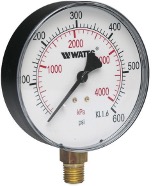
Absolute pressure: Absolute pressure is measured relative to absolute zero pressure, which would occur at absolute vacuum, or zero pounds per square inch (0 psia). Absolute pressure is the total pressure, which includes both the pressure you measure (gauge pressure) and the pressure from the air around us (atmospheric pressure). If we add the gauge pressure of 10 pounds to an atmospheric pressure of 14.73 pounds, we get 24.73 pounds absolute (psia) pressure. This pressure is sometimes referred to as total system pressure.
Absolute pressure = gauge pressure + atmospheric pressure (a “perfect” vacuum).
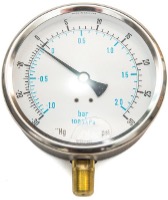
Vacuum: When atmospheric pressure is removed from a closed vessel, such as an evacuated refrigeration system, a vacuum is created. A vacuum is created when pressure is lower than atmospheric pressure. The more atmospheric pressure removed, the greater the vacuum. A perfect vacuum is attained only when all atmospheric pressure is exhausted, and is practically impossible to achieve. The amount of vacuum is registered on a vacuum gauge, which operates on the same principle as a standard pressure gauge, except that the face is typically graduated in inches or millimetres of mercury (in. Hg or mm Hg) instead of psi. Each inch of graduation is equal to 0.491 pound of absolute pressure.
This mean if the absolute pressure is 10 psia, or 4.73 psi below atmosphere, this would read as 9.6 in. of Hg vacuum (245 mm or Hg vacuum). At 0 psia, a perfect vacuum, this measures approximately 29.92 in. of Hg vacuum (760 mm Hg vacuum). As the vacuum increases (pressure decreases), the mercury reading (in. Hg or mm Hg) becomes larger.
More vacuum = higher Hg reading
or
Low pressure = high vacuum = high Hg reading
[latex]\quad(0.491 \frac{\text{lb.}}{\text{ in.}^3} \times 30\text{ in.} = 14.73 \text{ psia})[/latex]
Differential pressure: For applications like backflow prevention, you need to know differential pressures, or the difference between two measured pressures. Differential pressure measurements are designated with the suffix “d.” so that in imperial units the pressure might be measured in psid, meaning pounds per square inch differential. Often differential pressure is stated as delta P, or ΔP.
Note that the use of the Greek letter delta (Δ) indicates that there is a difference assumed between two measuring points, such as two pressure or temperature readings.
Differential pressure = the difference between two measured pressures.
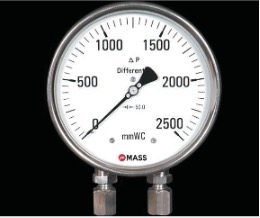
Gauge pressure is actually a differential pressure where one of the measured pressures is atmospheric pressure.
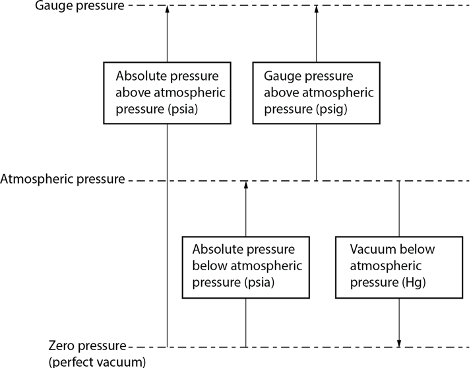
Pressure Scales
The metric unit for pressure is pascal (Pa). Some other units are pounds per square inch (psi) and bar (1 bar is = 100 kPa). There are actually many varied units to express pressure. Every field of science and discipline has different preferences, and it is the same with various regions and organizations.
At times, pressure is expressed as a depth of a particular fluid. The most commonly used are mercury (Hg), based on its high density, and water (H2O), based on its availability. However, measuring pressure with a column of liquid is not always precise. Density of the fluid and gravity can vary in any given region. These pressure units are still used as standard increments on many analogue gauges. There are also other kinds of pressure units, such as atmospheres.
|
Pressure Units |
psi |
kPa |
Inches of Hg |
Inches of H20 |
Atmospheres (atm) |
|
1 psi = |
1 |
6.895 |
2.036 |
27.68 |
.068 |
|
1 kPa = |
0.145 |
1 |
.295 |
4.015 |
.009869 |
|
1 in. of Hg = |
0.491 |
3.386 |
1 |
13.6 |
.03342 |
|
1 in. of H2O = |
0.036 |
.249 |
.07355 |
1 |
.002458 |
|
1 atmosphere (atm) = |
14.73 |
101.325 |
29.92 |
406.9 |
1 |
Things to Remember
- Absolute pressure is measured in relation to a perfect vacuum, while gauge pressure is the difference between the absolute pressure and the atmospheric pressure.
- Gauge pressure is what is most commonly used in the piping trades, while absolute pressure is used more often for scientific experimentations and calculations.
- Due to varying atmospheric pressure, gauge pressure measurement is not precise at all times, while absolute pressure is always definite.
Self-Test C-1.6.2: Perform Conversions
Complete Self-Test C-1.6.2 and check your answers.
If you are using a printed copy, please find Self-Test C-1.6.2 and Answer Key at the end of this section. If you prefer, you can scan the QR code with your digital device to go directly to the interactive Self-Test.
References
BCcampus. (n.d.). Playlist: Tools and equipment videos. BCcampus MediaSpace. https://media.bccampus.ca/playlist/details/0_3g8xp22x/categoryId/175673 Playlist Details – Trades Access Common Core Line C: Tools and Equipment Videos – BCcampus
BC Industry Training Authority. (2019). Piping trades apprenticeship program: Use Tools and Equipment—Level 1 harmonized [Binder]. Crown Publications, Queen’s Printer for British Columbia. https://www.crownpub.bc.ca/Product/Details/7960000261_S
- Plumber: Competency C-1 Use Mathematics and Science
- Steamfitter: Competency C-1 Use Mathematics and Science
- Sprinkler Fitter: Competency C-1 Use Mathematics and Science
Camosun College. (2019). Line C: Tools and Equipment—Competency D-1: Solve Trades Mathematical Problems (Rev. ed.) [Learning guide]. BCcampus. https://collection.bccampus.ca/textbook/qFKGAJ78/
Camosun College. (2015). Trades Access Common Core Competency D-1: Solve Trades Mathematical Problems. Victoria, B.C.: Crown Publications. Download for free from the B.C. Open Textbook Collection (https://open.bccampus.ca/browse-ourcollection/find-open-textbooks/).
Camosun Innovates. (2022). Tools and Equipment Videos [Video playlist]. Camosun College/BCcampus. https://camosuninnovates.opened.ca/
Flinn, C. (n.d.). OER for Trades: Math for Trades [Video collection]. BCcampus MediaSpace. https://media.bccampus.ca/channel/OER%2Bfor%2BTrades%3A%2BMath%2Bfor%2BTrades/175670
Note: these videos align with the open textbooks Math for Trades: Volume 1 and Math for Trades: Volume 2. All videos are by Chad Flinn and available under a Creative Commons Attribution 4.0 Licence.:
Media Attributions
All figures are sourced from Industry Training Authority (2019) and/or Camosun College (2019) and are used under the Creative Commons Attribution 4.0 (CC BY 4.0) licence unless otherwise noted. Images copyrighted by the BC Industry Training Authority are licensed under a Creative Commons Attribution-NonCommercial-ShareAlike 4.0 (CC BY-NC-SA 4.0) licence.
- Figure 1 Thermometer with Fahrenheit and Celcius units is by Camosun College/BCcampus (2019 and are used under the CC BY-NC-SA 4.0license.
The standard system of measurement used around the world, based on units such as metres, litres, and grams, and organized in powers of 10 to make calculations easier. (Section C-1.6)
A system of measurement based on units of 10 (metres, litres, grams). (Section C-1.6)
The standard unit used to measure length in the metric system; it is about the distance across your outstretched arms. (Section C-1.6)
The standard unit used to measure mass in the metric system; it is about the weight of a small paperclip. (Section C-1.6)
The amount of matter in an object; it stays the same no matter where the object is. In plumbing, mass is important because it affects weight—the more mass something has, the heavier it is under gravity, which impacts how pipes, fluids, and materials are handled and supported. (Section C-1.6)
A unit used to measure volume, or how much space a liquid takes up. It is commonly used to measure liquids like water, milk, or fuel. (Section C-1.6)
The amount something can hold inside, like a tank or container (Section C-1.4)
The amount of space an object takes up or can hold. (Section C-1.4)
A system of measurement using units such as inches, feet, and pounds. (Section C-1.6)
A word part added to a unit to show size (for example, kilo-, milli-). (Section C-1.6)
A number system based on powers of 10. (Section C-1.6)
Units used to measure volume, found by multiplying three dimensions. (Section C-1.4)
A number used to change one unit of measurement into another. (Section C-1.6)
A unit of heat energy; it is the amount of heat needed to raise the temperature of one pound of water by 1°F. (Section C-1.6)
A unit of heat energy; it is the amount of energy needed to raise the temperature of 1 gram of water by 1°C. (Section C-1.6)
The standard metric unit used to measure energy. (Section C-1.6)
A way of writing very large or very small numbers using powers of 10. (Section C-1.6)
A way of showing how many times a number is multiplied by itself using an exponent (for example, 2³ = 2 × 2 × 2) (Section C-1.2)
A unit of power equal to 1,000 watts; it measures how quickly energy is used or produced, such as the output of a heater or boiler. (Section C-1.6)
A temperature scale used in science that starts at absolute zero. (Section C-1.6)
(Sometimes referred to as the centigrade scale); a temperature scale used in the metric system where 0°C is the freezing point of water and 100°C is the boiling point of water. (Section C-1.6)
A temperature scale used in the imperial system that starts at absolute zero and uses the same size degree as the Fahrenheit scale. (Section C-1.6)
A temperature scale commonly used in the imperial system where water freezes at 32°F and boils at 212°F.
A measurement that is compared to another value rather than measured from zero; in pressure, it is measured relative to a reference pressure. (Section C-1.6)
The baseline pressure used for comparison when measuring pressure, such as atmospheric pressure or a vacuum.(Section C-1.6)
A mixture of gases that surrounds the Earth, mainly nitrogen and oxygen, which creates atmospheric pressure. (Section C-1.6)
The pressure created by the weight of air around the Earth. (Section C-1.6)
(sometimes referred to as overpressure); the pressure measured above atmospheric pressure. (Section C-1.6)
Pressure in a system that is higher than atmospheric pressure; it is the amount of pressure above normal air pressure. (Section C-1.6)
The total pressure measured from a perfect vacuum (zero pressure). (Section C-1.6)
(pounds per square inch absolute); a unit of pressure measured from a perfect vacuum; it includes both atmospheric pressure and any additional pressure in a system. (Section C-1.6)
The total pressure in a system, including both atmospheric pressure and gauge pressure; also called absolute pressure. (Section C-1.6)
A space where there is little or no pressure; in plumbing and piping systems, it means pressure that is lower than atmospheric pressure. (Section C-1.6)
A device used to measure pressure below atmospheric pressure; it shows how strong a vacuum is inside a system. (Section C-1.6)
A device used to measure pressure above atmospheric pressure; it shows how much pressure is in a pipe or system compared to the surrounding air. (Section C-1.6)
A way of measuring vacuum (low pressure) using a column of mercury; it shows how much pressure is below atmospheric pressure. (Section C-1.6)
(often stated as delta P, or ΔP.); the difference between two pressure measurements. (Section C-1.6)
An imperial unit of pressure that measures the difference between two pressure readings in a system (i.e., differential pressure).
The metric unit used to measure pressure. (Section C-1.6)
“Pounds per square inch.” It is a unit used to measure pressure, or how much force is pushing on a surface. For example, it can be used to measure the air pressure in a tire. (Section C-1.2)
A unit of pressure in the metric system; 1 bar is equal to 100 kilopascals (kPa) and is close to normal atmospheric pressure. (Section C-1.6, Section C-1.12)
A unit of pressure based on average air pressure at sea level; 1 atmosphere is about 101.3 kilopascals (kPa) or 14.7 psi. (Section C-1.6)
A unit of pressure based on average air pressure at sea level; 1 atmosphere is about 101.3 kilopascals (kPa) or 14.7 psi. (Section C-1.6)