C-1.3 Use Formulas to Calculate Perimeter, Circumference, and Area
Working with pipe and conduit requires knowledge of the area and volume of circles and cylinders, as do many aspects of engine work in the mechanics trades. Most trades require working with these dimensions on a regular basis. The precise dimensions required for detail and layout work in all trades are equally dependent on careful calculation.
Key Terms
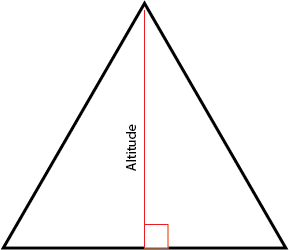
Altitude: Also referred to as height. The perpendicular distance between the base of a triangle or other figure and its uppermost side or point
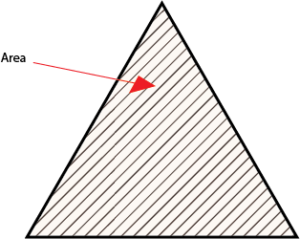
Area: The amount of surface enclosed by a figure
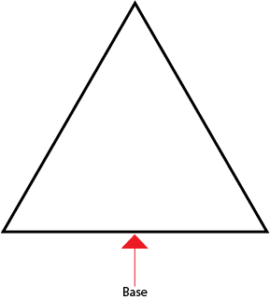
Base: The lower side of a triangle or other figure
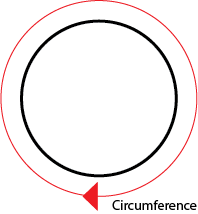
Circumference: The distance around a circle
Composite: Something made up of several simpler parts
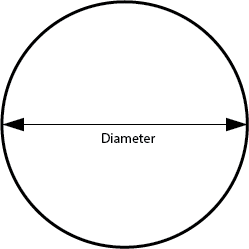
Diameter: The line segment that joins two points on a circle and passes through the centre of the circle
Formula: A shortcut method of finding an unknown numerical quantity when other quantities are known; for example, a formula to find the area of a rectangle:
[latex]\quad\text{Area} = \text{length} \times \text{width, or A} = \text{L} \times \text{W}[/latex]
Height: See Altitude
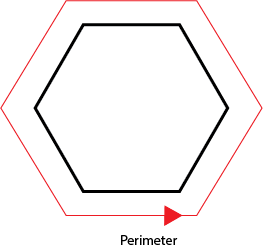
Perimeter: The distance around a figure
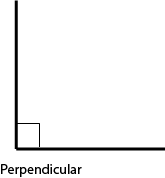
Perpendicular: A term used to mean “at right angles.” Two lines are perpendicular when the angle between them is a right angle or has a measure of 90°
Pi (π): A Greek letter that stands for the irrational number that begins as 3.14159265…
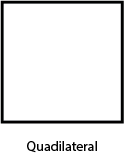
Quadrilateral: A four-sided figure
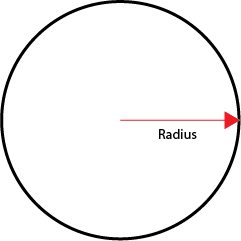
Radius: The line segment from the centre of a circle to any point on the circle. The length of a radius is one-half the length of a diameter
Figures (Shapes)
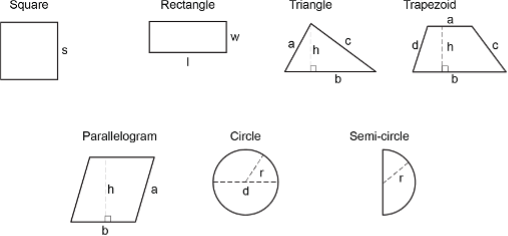
Perimeter
The perimeter of a figure is the total distance around the figure.
Example
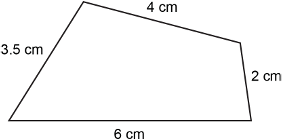
Find the perimeter of the quadrilateral shown. (A quadrilateral is a four-sided figure.)
Solution
Measure and label each side of the figure. Add the four sides.
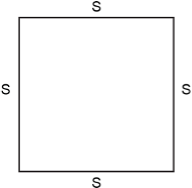
Finding the perimeter of a figure by measuring all of its sides can sometimes take a long time. For certain figures, such as squares, rectangles and circles, we can use perimeter formulas that shortcut the measuring process. For example, the perimeter of a square can be found by just measuring one side then multiplying by four. The formula is:
[latex]\quad\text{Perimeter} = 4 \times \text{side}[/latex]
[latex]\quad\text{P} = 4\text{s}[/latex]
[latex]\quad\text{(Recall that “4s” means “4 times s”)}[/latex]
[latex]\quad\text{P} = 4\text{ cm} + 2\text{ cm} + 6\text{ cm} + 3.5\text{ cm} = 15.5\text{ cm}[/latex]
[latex]\quad\text{(The letter P is the symbol for perimeter.)}[/latex]
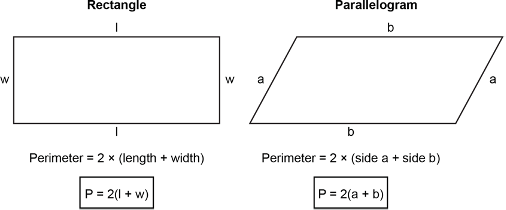
Perimeter of Shapes
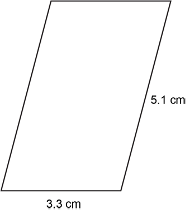
Find the perimeter of the parallelogram shown.
Solution
Measure two adjacent sides. Use the formula:
[latex]\quad\text{P} = 2(a + b)[/latex]
[latex]\quad\text{P} = 2(3.3\text{ cm} + 5.1\text{ cm})[/latex]
[latex]\quad\text{P} = 2(8.4\text{ cm})[/latex]
[latex]\quad\text{P} = 16.8\text{ cm}[/latex]
Circles
You already learned that the perimeter is the distance around a shape. However, the distance around a circle is called the circumference. It is the same idea as perimeter, but we use a different word for circles.
Think of it this way: If you could cut a circle’s edge and stretch it into a straight line, that length would be the circumference.
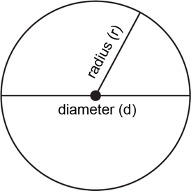
A circle has two important measurements:
- Radius (r): the distance from the centre of the circle to the edge
- Diameter (d): the distance straight across the circle through the centre
The diameter is always twice the radius:
[latex]\quad d = 2r[/latex]
Understanding Circumference
The circumference of a circle is directly related to its diameter.
No matter how big or small the circle is, the ratio of the circumference to the diameter is always the same number. This number is called pi (π).
What is Pi (π)?
The number pi (π) is a special number that is used when working with circles. The symbol π is the Greek letter pronounced “pi.” It is a constant used to relate straight-line measurements (radius/diameter) to a curved edge (circumference). The number, pi or π is impossible to state exactly. A good approximation for π is 3.1416. The number π can only be approximated. It is one of many irrational numbers and is quite “famous.”
- π ≈ 3.1416
- It cannot be written exactly (it goes on forever without repeating)
- Most calculators have a π button
Circumference Formulas
We can use π to calculate the circumference of a circle.
There are two equivalent formulas:
[latex]\quad C = \pi d[/latex]
[latex]\quad C = 2\pi r[/latex]
- Use C = πd when you know the diameter
- Use C = 2πr when you know the radius
Example 1
Find the circumference of the circle. Round to one decimal place.
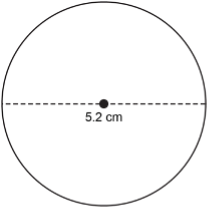
Solution
Measure the circumference of the circle. Use the formula:
[latex]\quad\text{P} = \pi \text{d}[/latex]
[latex]\quad\text{P} = 3.1416 \times 5.2[/latex]
[latex]\quad\text{P} = 16.33632\text{ cm} \approx 16.3\text{ cm}[/latex]
[latex]\quad\text{The symbol ≈ means “approximately equal to”}[/latex]
Find the perimeter of the semicircle in Figure 8. Round to one decimal place.
Solution
Measure the diameter. Find the perimeter of the semicircle.
[latex]\quad\text{P} = \pi \text{d} \div 2\\ \quad\text{P} = 3.1416 \times 5.8\text{ cm} \div 2\\ \quad\text{P} = 18.22128\text{ cm} \div 2\\ \quad\text{P} = 9.11064 \text{ cm}[/latex]
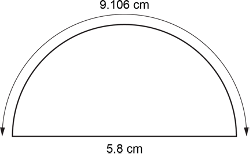
Now add the diameter length and round the answer to one decimal place.
[latex]\quad9.11064 + 5.8\text{ cm} = 14.91064 \approx 14.9\text{ cm}[/latex]
Area
Area tells us how much surface a shape covers. In the piping and construction trades, we use area to estimate material, plan layouts, and interpret drawings. Area is always expressed in square units, such as square metres (m²), square feet (ft²), or square inches (in²). To calculate area, we multiply one dimension by another. For example, length × width for a rectangle.
Working With Area Units
Because drawings, specifications, and tools can use different units, you will often need to convert between square units. It’s important to remember that square units do not convert the same way linear units do. For example, since there are 12 inches in a foot, there are 144 square inches in a square foot (12 × 12). This is why converting area requires multiplying or dividing by the square of the linear conversion factor.
In practice, very small units like square millimetres can lead to extremely large numbers, so tradespeople typically convert their measurements to metres or feet first before calculating area. This keeps the math simple and the results easy to understand.
Area of a Square or Rectangle
This very basic area calculation is simply the length multiplied by the height or width of the surface. Remember to keep the units in the calculation, as they act as a guide in the resulting units in the answer. For example, if you have inches times inches, you end up with an answer in square inches (in.2).
Example:
Find the area of the rectangle in Figure 9.
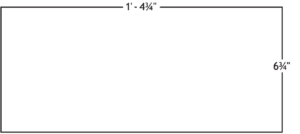
Step 1: Convert the given dimensions to inches:
[latex]\quad1\text{'} 4\frac{3}{4}\text{"} = 16.75\text{"}\\ \quad6\frac{3}{4}\text{"} = 6.75\text{"}[/latex]
Step 2: Solve for the area using [latex]\text{A} = \text{L} \times \text{W}[/latex]:
[latex]\quad\text{A} = 16.75 \times 6.75\\ \quad\text{A} = 113.07 \text{ in.}^2[/latex]
Area of a Triangle
A triangle’s surface is essentially half of a rectangle. To determine the area of a triangle, calculate one half of the area of a rectangle with the same length and width:
[latex]\quad\text{AREA}=\frac{\text{B} \times \text{H}}{2}[/latex]
This calculation is shown in the example below, using a simple right-angled (90°) triangle.
Example:
Step 1: Convert the millimetres to metres:
[latex]\quad\text{B} = 0.92\text{ m (920 mm)}\\ \quad\text{H} = 0.81\text{ m (810 mm)}[/latex]
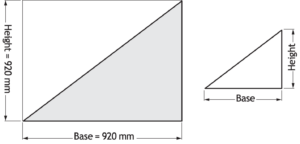
Step 2: Calculate total surface area:
[latex]\quad\text{A} = \frac{\text{B} \times \text{H}}{2}\\ \quad\text{A} = \frac{0.92 \times 0.81}{2}\\ \quad\text{A} = 0.373 \text{ m}^2[/latex]
The area of the rectangle would be 0.745 m2, and the triangle has half that area, or 0.373 m2.
Area of a Circle
The area of a circle can be calculated by taking the radius of the circle, squaring it, and multiplying by π:
[latex]\quad\text{A} = \pi \text{r}^2[/latex]
When using the above formula, ensure that you use the radius. Often the diameter of the circle is given, and it must be divided in half to get the radius.
As pipe trades workers, we are usually dealing with the diameter of pipe. If you find it easier, the area of a circle can be found by taking the diameter squared times 0.7854:
[latex]\quad\text{A} = \text{d}^2 \times 0.7854\\ \quad\text{Note: } 0.7854 \text{ is } \frac{1}{4} \text{ of } \pi[/latex]
Example:
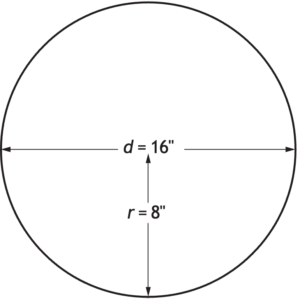
Find the area of the circle shown in Figure 11 using [latex]\text{A} = \pi \text{r}^2[/latex]:
[latex]\quad\text{A} = \pi \times 8^2\\ \quad\text{A} = \pi \times 64\\ \quad\text{A} = 201.06 \text{ in.}^2[/latex]
Find the area of the same circle using [latex]\text{d}^2 \times 0.7854[/latex]:
[latex]\quad\text{A} = 16^2 \times 0.7854\\ \quad\text{A} = 256 \times 0.7854\\ \quad\text{A} = 201.06 \text{ in.}^2[/latex]
Surface Area of a Square or Rectangular Box
A square or rectangular box has a total of six sides: top and bottom, front and back, and right and left ends (Figure 12). The total surface area of the box is calculated simply by finding the area of each side and adding the areas together.
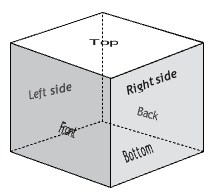
Note that if the top is open (missing), there are only five sides.
Example:
Calculate the surface area of the totally enclosed rectangular tank shown below.
[latex]\quad\text{Surface area} = 2(\text{L} \times \text{H}) + 2(\text{L} \times \text{W}) + 2(\text{W} \times \text{H})[/latex]
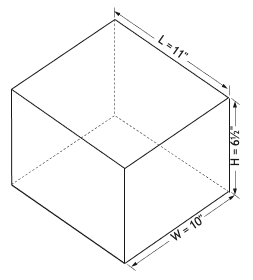
[latex]\quad\text{SA} = (\text{two front areas}) + (\text{two top areas}) + (\text{two side areas})\\ \quad\text{SA} = (\text{L} \times \text{H} \times 2) + (\text{L} \times \text{W} \times 2) + (\text{W} \times \text{H} \times 2)\\ \quad\text{SA} = (11\times6.5\times2) + (11\times10\times2) + (10\times6.5\times2)\\ \quad\text{SA} = 143 + 220 + 130\\ \quad\text{SA} = 493 \text{ in.}^2[/latex]
Area of a Cylinder
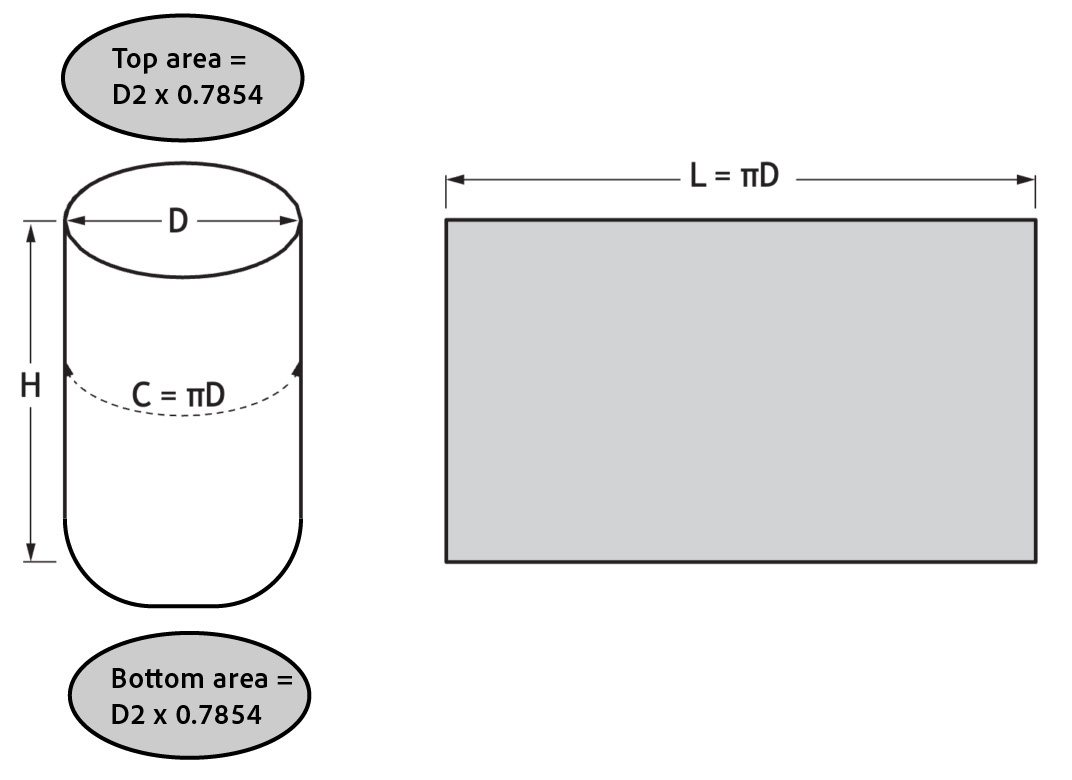
A cylinder has three components: two circular ends, which are identical, and a shell (which is really a rolled-up flat sheet or rectangle). The surface area of the cylinder is the sum of the areas of the two circles (ends) and the “rectangle” (shell). If it is an open top tank or vat, there is only one end in the calculation.
The area of the shell (or rectangle) is L × W. The length of the rectangle is the same dimension as the circumference of the end. The width of the rectangle is the same dimension as the height of the cylinder (Figure 14).
To find the circumference of a circle, you multiply the diameter by π:
[latex]\quad\text{C} = \pi \text{d}[/latex]
The area of the shell is:
[latex]\quad\text{A} = \pi \text{d} \times \text{H}, \text{ or } \pi \text{DH}[/latex]
The area of each end is:
[latex]\quad\text{d}^2 \times 0.7854.[/latex]
Therefore the formula for the surface of a cylinder closed at both ends is:
[latex]\quad\text{Surface area} = (\pi \text{dH}) + (2 \times \text{d}^2 \times 0.7854)[/latex]
If one end is open, the formula becomes:
[latex]\quad\text{Surface area} = (\pi \text{dH}) + (\text{d}^2 \times 0.7854)[/latex]
Example:
Calculate the surface area of the totally enclosed cylinder in Figure 16:
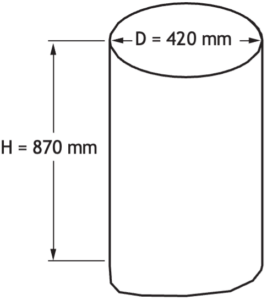
Step 1: Convert the millimetres to metres:
[latex]\quad\text{d} = 0.42 \text{ m (420 mm)}\\ \quad\text{r} = 0.21 \text{ m (210 mm)}\\ \quad\text{H} = 0.87 \text{ m (870 mm)}[/latex]
Step 2: Calculate total surface area = [latex](\pi \text{DH}) + (2 \times \text{D}^2 \times 0.7854)[/latex]:
[latex]\quad\text{SA} = (\pi \times 0.42 \times 0.87) + (2 \times 0.42^2 \times 0.7854)\\ \quad\text{SA} = 1.425 \text{ m}^2[/latex]
The total surface area of the totally enclosed cylinder is 1.425 m2. If the tank or vat had an open top, the resulting surface area would be minus the area of one end or 1.286 m2.
 Self-Test C-1.3: Use Formulas to Calculate Perimeter, Circumference and Area
Complete Self-Test C-1.3 and check your answers.
Complete the following questions. Use the π key on your calculator or 3.1416, when required.
If you are using a printed copy, please find Self-Test C-1.3 and Answer Key at the end of this section. If you prefer, you can scan the QR code with your digital device to go directly to the interactive Self-Test.
References
BCcampus. (n.d.). Playlist: Tools and equipment videos. BCcampus MediaSpace. https://media.bccampus.ca/playlist/details/0_3g8xp22x/categoryId/175673 Playlist Details – Trades Access Common Core Line C: Tools and Equipment Videos – BCcampus
BC Industry Training Authority. (2019). Piping trades apprenticeship program: Use Tools and Equipment—Level 1 harmonized [Binder]. Crown Publications, Queen’s Printer for British Columbia. https://www.crownpub.bc.ca/Product/Details/7960000261_S
- Plumber: Competency C-1 Use Mathematics and Science
- Steamfitter: Competency C-1 Use Mathematics and Science
- Sprinkler Fitter: Competency C-1 Use Mathematics and Science
Camosun College. (2019). Line C: Tools and Equipment—Competency D-1: Solve Trades Mathematical Problems (Rev. ed.) [Learning guide]. BCcampus. https://collection.bccampus.ca/textbook/qFKGAJ78/
Camosun College. (2015). Trades Access Common Core Competency D-1: Solve Trades Mathematical Problems. Victoria, B.C.: Crown Publications. Download for free from the B.C. Open Textbook Collection (https://open.bccampus.ca/browse-ourcollection/find-open-textbooks/).
Camosun Innovates. (2022). Tools and Equipment Videos [Video playlist]. Camosun College/BCcampus. https://camosuninnovates.opened.ca/
Flinn, C. (n.d.). OER for Trades: Math for Trades [Video collection]. BCcampus MediaSpace. https://media.bccampus.ca/channel/OER%2Bfor%2BTrades%3A%2BMath%2Bfor%2BTrades/175670
Note: these videos align with the open textbooks Math for Trades: Volume 1 and Math for Trades: Volume 2. All videos are by Chad Flinn and available under a Creative Commons Attribution 4.0 Licence.:
Media Attributions
All figures are sourced from Industry Training Authority (2019) and/or Camosun College (2019) and are used under the Creative Commons Attribution 4.0 (CC BY 4.0) licence unless otherwise noted. Images copyrighted by the BC Industry Training Authority are licensed under a Creative Commons Attribution-NonCommercial-ShareAlike 4.0 (CC BY-NC-SA 4.0) licence.
The distance around a shape (Section C-1.3)
Any shape or drawing used in math, such as a triangle, circle, or square. It helps show or explain a problem visually. (Section C-1.3)
A shape with four sides (Section C-1.3)
The distance around a circle. (Section C-1.3)
A unit used to measure length or distance in a straight line, such as metres, centimetres, inches, or feet. (Section C-1.3)
A number you use to change one measurement into another by multiplying. It shows how two units are related in a straight (one-step) way, like converting metres to centimetres or inches to feet. (Section C-1.2)