C-1.1 Add, Subtract, Multiply and Divide Whole Numbers, Fractions, Decimals and Percentages
Calculating Whole Numbers
Whole numbers, fractions and decimals are fundamental parts of trade mathematics. To be successful in any trade, you must be proficient when working with whole numbers, fractions and decimals.
Careful work is the key to solving these and more difficult problems without making discouraging and frustrating mistakes. You should consciously follow these steps:
- Read the question twice. Make sure you understand what is being asked and what information has been provided.
- Plan how you are going to solve the problem. Do you need to add, subtract, multiply, or divide? Write the solution down carefully, making sure the calculation is written clearly and correctly. Take time to organize your work in a logical progression for future reference. Don’t sacrifice accuracy for speed; it’s much more important to be accurate.
You will use a calculator to find the answers to most of the problems in this competency. While on your work site, however, you will often need to perform manual calculations. To help you become proficient at this, DO NOT USE YOUR CALCULATOR WHILE COMPLETING THE FIRST SELF-TEST.
Place Value
The idea of place value is at the heart of our number system. If you look at the number 333, it only involves one numeral, 3. The numeral 3 has a different meaning based on its position in the overall number. The first 3 stands for 300, the second 3 stands for 30, and the last 3 only stands for 3. The fact that this one numeral can stand for multiple numbers is called place value. This means that the numeral’s value is determined by what place it is within the number (Table 1).
Beginning with the ones place at the right, each place value is multiplied by increasing powers of 10. For example, the value of the first place on the right is one, the value of the place to the left of it is ten, which is 10 times 1. The place to the left of the tens place is hundreds, which is 10 times 10, and so forth. The “ones” place is also called the “units” place. In the trades, you may hear “units” used more often, but both terms mean the same thing.
The decimal system of numbers lets us write numbers as large or as small as we want using the decimal point. In our number system, digits can be placed to the left and right of a decimal point, to indicate numbers greater than one or less than one. The decimal point helps us to keep track of where the units place is; it’s placed just to the right of the units place. As we move right from the decimal point, each number place is divided by 10.
|
THE PLACE VALUE |
|||||||||
|
Millions |
Hundred Thousands |
Thousands |
Hundreds |
Tens |
Units (or Ones) |
. (Decimal Point) |
Tenths |
Hundredths |
Thousandths |
Addition
Addition is the process of finding the total of two or more numbers. The result of addition is called the sum. The sign for addition is “+” and the word indicating addition is plus. The digits must be properly lined up in a column: all units, tens and hundreds, etc., must be in a dedicated column, as in Table 2.
|
Thousands |
Hundreds |
Tens |
Units (or “Ones”) |
|
|
8 |
4 |
6 |
|
7 |
4 |
2 |
3 |
|
|
|
7 |
8 |
|
|
|
|
6 |
|
8 |
3 |
5 |
3 |
To solve the addition problem in Table 2, first add the numbers in the units column. The sum of the column is 23. Place the 3 in the units column under the total line (the last row) and carry the 2 into the tens column. The total of the tens column is thus 15. Place the 5 under the total line and carry the 1 into the hundreds column. The total of the hundreds column is 13, so we place the 3 under the total line and carry the 1 into the thousands column, giving 8 as a total for this column. The total is 8,353.
If decimal fractions are used, line up the decimals to the right of the units column and proceed as normal, adding up the columns from right to left.
Example:
Some plumbing fixtures are to be shipped to a construction site on a truck that can carry 1,750 kg. The load includes 378.45 kg of water closets, 622.48 kg of bathtubs and 208.6 kg of sinks. Will this overload the truck?
Solution:
Add all the masses together and see if the sum exceeds 1,750 kg.
|
Thousands |
Hundreds |
Tens |
Units |
. |
Tenths |
Hundredths |
|
|
3 |
7 |
8 |
. |
4 |
5 |
|
|
6 |
2 |
2 |
. |
4 |
8 |
|
|
2 |
0 |
8 |
. |
6 |
0 |
|
1 |
2 |
0 |
9 |
. |
5 |
3 |
Note: Zeros have been added where necessary in the hundredths column to make all numbers contain the same number of decimal places. For example, 208.6 kg → 208.60 kg.
Answer:
The total weight of the shipment is 1,209.53 kg, so the 1,750 kg-capacity truck can safely carry the shipment of fixtures to the site.
Subtraction
As with addition, you must line up the columns when subtracting numbers. You may find that a number on the bottom is too large to subtract from the number on the top. When you encounter this, simply borrow ten from the next number on the left. (Remember to reduce the number on the left by one, as shown in the example below.) To check your work, add your answer to the number you subtracted. The sum should equal the number you subtracted from. The result of subtraction is called the difference. The sign for subtraction is “−” and the word indicating subtraction is minus.
Example:
If the sinks were left off the truck in the previous problem, could the rest of the material be safely carried by a smaller 1,000 kg-capacity truck?
Solution:
Using the previous example, subtract the mass of the sinks from the 1,209.53 kg total. See if the difference is less than 1,000 kg.
|
Thousands |
Hundreds |
Tens |
Units |
. |
Tenths |
Hundredths |
|
1 |
2 |
0 |
9 |
. |
5 |
3 |
|
|
2 |
0 |
8 |
. |
6 |
0 |
|
1 |
0 |
0 |
0 |
. |
9 |
3 |
Note: 10 was borrowed from the 9 in the units column and added to the 5 in the tenths column to make it 15. The 9 was reduced to 8.
Answer:
The truck will be just over the safe rated load capacity and should not be used for this shipment.
Multiplication
Multiplication is really a short method of adding two or more numbers. Instead of saying [latex]6 + 6 + 6 = 18[/latex], we say [latex]3\times6=18[/latex]. The result of multiplication is called the product. The sign for multiplication is “×,” and the word indicating multiplication is times.
When solving a multiplication problem in which the numbers have two or more digits, make sure that you write your answer for each step of the problem in proper alignment with the answers for the other steps. When each step of the multiplication is complete, add up all the answers to get the final product. If there are decimal numbers involved, ignore them until you have found the product. Then count the total number of places occupied by numbers on the right of the decimals and place the decimal in the answer so the same total number of places will be found to the right of it.
Example 1:
Multiply 4,328 by 129.
The calculation will look like this:
[latex]\quad\begin{array}{cccccc}&&4&3&2&8\\&&\times&1&2&9\\\hline&3&8&9&5&2\\&8&6&5&6&0 \\4&3&2&8&0&0\\\hline5&5&8&3&1&2\end{array}[/latex]
We read the product as five hundred fifty-eight thousand, three hundred twelve.
Sometimes we will multiply by a number containing one or more zeroes, such as 206.
Example 2:
Multiply 511 by 206.
[latex]\quad\begin{array}{cccccc} &&&5&1&1\\ &&\times&2&0&6\\\hline &&3&0&6&6\\ &&0&0&0&0\\ 1&0&2&2&0&0\\\hline 1&0&5&2&6&6 \end{array}[/latex]
First multiply 511 by 6. Next is the zero, but since any number multiplied by zero is zero, simply add a row of zeroes, as shown, and continue with the next digit, which in this case is 2.
To check a multiplication problem, reverse the two numbers and carry out the multiplication:
[latex]\quad\begin{array}{cccccc} &&&2&0&6\\ &&\times&5&1&1\\\hline &&&2&0&6\\ &&2&0&6&0\\ 1&0&3&0&0&0\\\hline 1&0&5&2&6&6 \end{array}[/latex]
The two results match, so your calculation is correct.
Division
Division is the process of finding how many times one number is found in a larger number. For instance, 9 is found in 18 twice, and in 27, three times. The terms for division are divisor (the number you divide by), the dividend (the number being divided), and quotient, which is the result of the division, or the answer to the problem.

To solve a division problem, write the answer for each step above the last number that was divided into. If the divisor has a decimal in it, the decimal must be removed at the start. To do this, move the decimal to the right end of the divisor and do the same with the dividend. To keep the question correct, the decimal in the divisor and dividend must be moved to the right the same number of places. Add zeroes if necessary to make this possible; write the decimal point in the answer directly above the decimal point in the dividend.
Example:
A construction heater will run for 7.35 hours on one cylinder of propane before the fuel supply is exhausted. How many cylinders would be required if the general contractor wanted the heater to run for 128.65 hours?
Solution:
Divide 128.65 hours by 7.35 hours per cylinder.

Note: Move the decimal two spaces to the right to eliminate the decimal in the question.
Answer:
17.5 cylinders would be required, so the contractor would order 18 cylinders from the supplier.
(The decimal in the remainder can be located by noting the original position of the decimal in the question.)
 Self-Test C-1.1.1: Add, Subtract, Multiply and Divide Whole Numbers, Fractions, Decimals and Percentages
Complete Self-Test C-1.1.1 and check your answers.
If you are using a printed copy, please find Self-Test C-1.1.1 and Answer Key at the end of this section. If you prefer, you can scan the QR code with your digital device to go directly to the interactive Self-Test.
Fractions
Common fractions are numbers that express parts of a whole. Common fractions are written as two numbers, separated by a forward slash or a horizontal line. For example, suppose a pie is cut into five equal pieces and we eat two of them. Then we can say that we ate two-fifths, or 2/5, of
the pie.
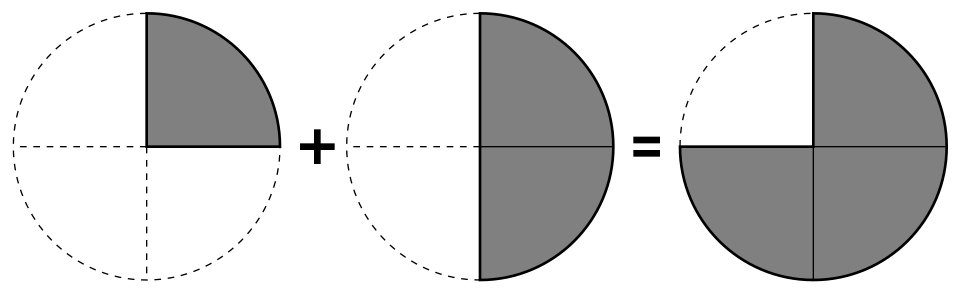
Measurements you are required to make on the job seldom turn out to be convenient whole numbers. Instead, they are often fractional amounts. Fractions are used extensively in all trades. In the construction trades many of the materials are still most commonly referred to by their imperial fractional widths. Mechanics encounter fractions in connection with the revolutions of rear axles, crankshafts, ring gears and wheels, in the measurement of parts, and in the adjustment of components of all kinds.
Calculating with Fractions
Fractions are simply one or more equal parts of a whole, divided by the total number of equal parts of that whole.
To be able to work with fractions as readily as with whole numbers, we must be familiar with the terms associated with fractions as well as with the addition, subtraction, multiplication and division of fractions.
Numerators and Denominators
Every fraction consists of two numbers. The number on the bottom is called the denominator. The denominator indicates into how many equal parts the object is divided. The top number is called the numerator and states the number of equal parts the fraction represents.
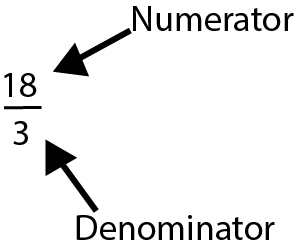
If we have a group of fractions in which the numerators are all the same, the fractions that have larger denominators will represent smaller values than those with smaller denominators. For example, when you read a tape measure, [latex]\frac{1}{8}[/latex] inch is less than [latex]\frac{1}{4}[/latex] inch; and [latex]\frac{1}{16}[/latex] is less than [latex]\frac{1}{8}[/latex], [latex]\frac{1}{4}[/latex] or [latex]\frac{1}{2}[/latex].
Conversely, when the denominators are the same, the fraction with the largest numerator is the largest: [latex]\frac{13}{16}[/latex] is greater than [latex]\frac{7}{16}[/latex]; [latex]\frac{5}{8}[/latex] is greater than [latex]\frac{3}{8}[/latex].
Proper Fractions
A fraction that is equal to less than one (e.g., [latex]\frac{1}{2}[/latex], [latex]\frac{1}{4}[/latex], [latex]\frac{1}{8}[/latex], [latex]\frac{1}{16}[/latex]) is called a proper fraction. The numerator is smaller than the denominator.
Improper Fractions
A fraction that is equal to one or more than one (e.g., [latex]\frac{5}{4}[/latex], [latex]\frac{18}{16}[/latex]) is called an improper fraction. The numerator is equal to or larger than the denominator.
Mixed Numbers
When a number is made up of a whole number and a fraction (e.g., [latex]2\frac{1}{4}[/latex] and [latex]4\frac{7}{8}[/latex]), it is called a mixed number. It represents a whole quantity of an object plus a part (fraction) of another.
Lowest Terms
A fraction is properly expressed in its lowest terms. It is in its lowest terms when the numerator and the denominator are such that no other number can be divided into both of them evenly, and without some amount left over, called a remainder. For example, the fraction [latex]\frac{12}{16}[/latex] is not in its lowest terms, since 4 can be divided into both top and bottom:
[latex]\quad\frac{12}{16} \div \frac{4}{4} = \frac{3}{4}[/latex]
Therefore, [latex]\frac{12}{16}[/latex] reduced to its lowest terms is [latex]\frac{3}{4}[/latex].
Fractions may be reduced to their lowest terms by dividing the numerators and denominators by the same number. For example, to reduce [latex]\frac{2}{8}[/latex] to its lowest terms, divide the numerator and denominator by 2:
[latex]\quad\frac{2}{8} \div \frac{2}{2}=\frac{1}{4}[/latex]
Fractions are often written in their lowest terms for clarity; however, only reduce them if the question asks you to do so (confirm with your instructor if necessary), or if your mathematical problem on the job requires it.
Changing Mixed Numbers to Improper Fractions
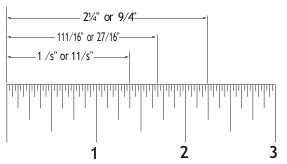
Multiplication and division require the changing of mixed numbers to improper fractions. The tape measure in Figure 4 shows the following:
- A mixed number, [latex]1\frac{3}{8}[/latex] in., and the equivalent improper fraction, [latex]\frac{11}{8}[/latex] in.
- A mixed number, [latex]1\frac{11}{16}[/latex] in., and the equivalent improper fraction, [latex]\frac{27}{16}[/latex] in.
- A mixed number, [latex]2\frac{1}{4}[/latex] in., and the equivalent improper fraction, [latex]\frac{9}{4}[/latex] in.
To change a mixed number to an improper fraction, follow the steps in the examples below.
Example 1:
Change [latex]3\frac{5}{8}[/latex] to an improper fraction.
Solution:
Multiply the denominator of the fraction by the whole number:
[latex]\quad8 \times 3 = 24[/latex]
Add the numerator to the result:
[latex]\quad5 + 24 = 29[/latex]
Place this result over the denominator:
[latex]\quad\frac{29}{8}[/latex]
Example 2:
Change [latex]3\frac{11}{16}[/latex] to an improper fraction.
Solution:
[latex]\quad16 \times 3 = 48\\ \quad11 + 48 = 59[/latex]
Place this result over the denominator:
[latex]\quad\frac{59}{16}[/latex]
Changing Improper Fractions to Mixed Numbers
Improper fractions usually result from the addition, subtraction, multiplication or division of proper fractions. For example, [latex]6\frac{7}{8}\text{"}[/latex] plus [latex]4\frac{3}{8}\text{"}[/latex] equals [latex]10\frac{10}{8}\text{"}[/latex]. The improper fractions must be changed to mixed numbers. This change is made by dividing the numerator by the denominator.

The answer to the division example above is 1 with 2 eighths remaining. Add the whole number to your previous whole number [latex](10 + 1 = 11)[/latex] and change the 2 eighths to a proper fraction, or [latex]\frac{1}{4}[/latex]. In summary, [latex]10\frac{10}{8}\text{"} = 11\frac{1}{4}\text{"}[/latex].
Self-Test C-1.1.2: Add, Subtract, Multiply and Divide Whole Numbers, Fractions, Decimals and Percentages
Complete Self-Test C-1.1.2 and check your answers.
If you are using a printed copy, please find Self-Test C-1.1.2 and Answer Key at the end of this section. If you prefer, you can scan the QR code with your digital device to go directly to the interactive Self-Test.
Common Denominators
When each fraction in a group has the same or common denominator, they are called like fractions. For example, in the series of like fractions [latex]\frac{1}{16}[/latex], [latex]\frac{3}{16}[/latex], [latex]\frac{5}{16}[/latex] and [latex]\frac{15}{16}[/latex], the number 16 is the common denominator.
Before a group of fractions can be added or subtracted, all the fractions must be like fractions and have the same denominator.
Addition and Subtraction of Like Fractions
It’s easy to add and subtract like fractions, or fractions with the same denominator. You just add or subtract the numerators, keep the same denominator, and then reduce to the lowest terms.
Examples with like fractions:
Addition:
[latex]\quad\frac{1}{8}+\frac{5}{8}=\frac{6}{8}=\frac{3}{4}[/latex]
[latex]\quad\frac{5}{16}+\frac{9}{16}=\frac{14}{16}=\frac{7}{8}[/latex]
[latex]\quad\frac{5}{32}+\frac{21}{32}=\frac{26}{32}=\frac{13}{16}[/latex]
Subtraction:
[latex]\quad\frac{11}{16}-\frac{3}{16}=\frac{8}{16}=\frac{1}{2}[/latex]
[latex]\quad\frac{7}{8}-\frac{5}{8}=\frac{2}{8}=\frac{1}{4}[/latex]
[latex]\quad\frac{4}{5}-\frac{2}{5}=\frac{2}{5}[/latex]
Addition and Subtraction with Uncommon Denominators
You will often need to add or subtract fractions that have different denominators. To do this, you need to know how to find the lowest or least common denominator (LCD). Since only like fractions can be added or subtracted, we first have to convert unlike fractions to equivalent like fractions. We want to find the smallest, or least, common denominator, because working with smaller numbers makes our calculations easier. The LCD, of two fractions is the smallest number that can be divided by both denominators. To find the LCD, start by writing all the multiples of both denominators, beginning with the numbers themselves.
Here’s an example of this method:
Add:
[latex]\quad\frac{1}{6}+\frac{3}{4}[/latex]
Multiples of 4 are 4, 8, 12, 16 and so forth (because 1 × 4 = 4, 2 × 4 = 8, 3 × 4 = 12, 4 × 4 = 16, etc.). The multiples of 6 are 6, 12, … The number we’re looking for is 12, because it’s the first one that appears in both lists of multiples. It’s the smallest or least common multiple, so we’ll use it as our least common denominator:
[latex]\space\quad\frac{1}{6}+\frac{3}{4}\\[/latex]
[latex]\quad\frac{2}{12}+\frac{9}{12}=\frac{11}{12}[/latex]
When subtracting fractions, follow the same rules as for addition by making sure the denominators are common. Next, subtract the numerators of the fractions, place the answer over the common denominator, and reduce to the lowest terms:
[latex]\quad\frac{11}{12}-\frac{1}{8}[/latex]
Multiples of 12 are 12, 24, 36 and so on. The multiples of 8 are 16, 24.
The number 24 is the first one that appears in both lists of multiples, so it’s the least common denominator:
[latex]\quad\frac{11}{12}-\frac{1}{8}\\[/latex]
[latex]\quad\frac{22}{24}-\frac{3}{24}=\frac{19}{24}[/latex]
Addition and Subtraction of Mixed Numbers
A mixed number consists of a whole number and a fraction. Any mixed number can also be written as an improper fraction, in which the numerator is larger than the denominator. To add mixed numbers where the fractions have a common denominator, we add the whole numbers together and then the fractions. If the sum of the fractions is an improper fraction, then we change it to a mixed number.
Example 1:
[latex]\quad2\frac{5}{8}+3\frac{1}{8}=5\frac{6}{8}=5\frac{3}{4}[/latex]
In this example, the whole numbers, 2 and 3, add up to 5. The fractions, [latex]\frac{5}{8}[/latex] and [latex]\frac{1}{8}[/latex], add up to [latex]\frac{6}{8}[/latex], which when reduced to the lowest terms is [latex]\frac{3}{4}[/latex].
If the denominators of the fractions are different, then first find a common denominator before adding. Then proceed as before.
Example 2:
[latex]\quad3\frac{13}{32}+9\frac{1}{4}=\\[/latex]
[latex]\quad3\frac{13}{32}+9\frac{8}{32}=\\[/latex]
[latex]\quad12\frac{21}{32}[/latex]
Subtracting mixed numbers is similar to adding them. A problem arises when the fractional part of the number you are subtracting is larger than the fractional part of the number you are subtracting from.
Example:
Since you’re trying to subtract a larger fraction from a smaller one, you need to “borrow” a 1 from the whole number 9, change it to [latex]\frac{16}{16}[/latex], and add it to the fraction [latex]\frac{2}{16}[/latex], making it [latex]\frac{18}{16}[/latex].
[latex]\quad9\frac{1}{8}-4\frac{13}{16}=\\[/latex]
[latex]\quad9\frac{2}{16}-4\frac{13}{16}=\\[/latex]
[latex]\quad8\frac{18}{16}-4\frac{13}{16}=\\[/latex]
[latex]\quad4\frac{5}{16}[/latex]
Multiplication of Fractions and Mixed Numbers
Multiplying fractions is simpler than adding or subtracting them. It is not necessary to have a common denominator.
To multiply two fractions, simply multiply the numerators of the fractions to get the new numerator, and multiply the denominators of the fractions to get the new denominator. Simplify the resulting fraction, if possible.
Example:
Multiply [latex]\frac{1}{4} \times \frac{2}{3}[/latex].
[latex]\quad\frac{1}{4}\times\frac{2}{3}=\frac{2}{12}=\frac{1}{6}[/latex]
Multiplying mixed numbers is just like multiplying fractions. In fact, it is multiplying fractions, since you first change the mixed numbers into improper fractions:
[latex]\quad2 \frac{3}{4} \times 4 \frac{1}{2} = \frac{11}{4} \times \frac{9}{2} = \frac{99}{8} = 12 \frac{3}{8}[/latex]
To multiply a fraction and a whole number, treat the whole number as if it were over 1, and then proceed as follows:
[latex]\quad4 \times \frac{5}{8}=\frac{4 \times 5}{1 \times 8}=\frac{20}{8}=2\frac{4}{8}=2\frac{1}{2}[/latex]
When multiplying more than two fractions or mixed numbers, just add them to the string and proceed as normal:
[latex]\quad\frac{1}{4} \times \frac{2}{5} \times \frac{1}{3}=\frac{1 \times 2 \times 1}{4 \times 5 \times 3}=\frac{2}{60}=\frac{1}{30}[/latex]
Cancellation
Cancellation is a technique used to simplify our work. This is done by using smaller numbers rather than larger ones. By cancelling, we reduce to lowest terms, as far as possible, before multiplying, rather than afterwards.
Example:
[latex]\space\quad\frac{3}{8}\times\frac{5}{11}\times\frac{4}{9}=\frac{60}{792}\\ \quad\frac{\cancel{3}^1}{\cancel{8}^2}\times\frac{5}{11}\times\frac{\cancel{4}^1}{\cancel{9}^3}=[/latex]
Note that the numerator 3 divides into the denominator 9, and the numerator 4 divides into the denominator 8. The numerator 5 and the denominator 11 are prime numbers and are only divisible by 1 and themselves, so they do not assist in cancellation.
Resulting in:
[latex]\quad\frac{1}{2}\times\frac{5}{11}\times\frac{1}{3}=\frac{5}{66}[/latex]
Also note that cancellation does not apply in addition or subtraction.
Division of Fractions and Mixed Numbers
Dividing fractions is just like multiplying fractions, except for one additional step.
Find the reciprocal of one of the fractions and multiply the original by the reciprocal of the fraction you just found. Reduce the fraction to the lowest terms.
To find the reciprocal of a fraction simply turn it upside down. For example, the reciprocal of [latex]\frac{1}{4}[/latex] is [latex]\frac{4}{1}[/latex].
Example 1:
Divide [latex]\frac{3}{8}[/latex] by [latex]\frac{1}{4}[/latex]:
[latex]\quad\frac{3}{8}\div\frac{1}{4}=\frac{3}{8}\times\frac{4}{1}=\frac{12}{8}=1\frac{1}{2}[/latex]
Dividing mixed numbers is very similar to multiplying mixed numbers. You just add one step. After changing the mixed numbers into improper fractions, you then find the reciprocal of one of the fractions. Always use cancellation if the opportunity presents itself, and multiply the numerators together and the denominators together.
Example 2:
Divide [latex]4\frac{1}{4}[/latex] by [latex]3\frac{3}{8}[/latex]:
[latex]\space\quad4\frac{1}{4}\div3\frac{3}{8}\\ \quad=\frac{17}{4}\div\frac{27}{8}\\ \quad=\frac{17}{\cancel{4}^1}\times\frac{\cancel{8}^2}{27}\\ \quad=\frac{17}{1}\times\frac{2}{27}=\frac{34}{27}=1\frac{7}{27}[/latex]
Self-Test C-1.1.3: Add, Subtract, Multiply and Divide Whole Numbers, Fractions, Decimals and Percentages
Complete Self-Test C-1.1.3 and check your answers.
If you are using a printed copy, please find Self-Test C-1.1.3 and Answer Key at the end of this section. If you prefer, you can scan the QR code with your digital device to go directly to the interactive Self-Test.
Calculating with Decimals
Adding and Subtracting Decimals
If you know how to add and subtract whole numbers, then you can add and subtract decimals. The only requirement is to be sure to line up the terms so that all the decimal points are in a vertical line.
Add Decimal Numbers
Put the numbers in a vertical column, aligning the decimal points. Add each column of digits, starting on the right and working left. If the sum of a column is more than 10, carry digits to the next column on the left. Place the decimal point in the answer directly below the decimal points in the terms.
Example:
[latex]\quad\begin{array}{ccccccccc} &4&\overset{1}{5}&\overset{1}{6}&2&.&\overset{1}{2}&\overset{1}{3}&0\\ &&1&2&5&.&2&8&7\\ &&&2&4&.&1&2&8\\ +&&&&1&.&2&1&0\\\hline &4&7&1&2&.&8&5&5 \end{array}[/latex]
Subtract Decimal Numbers
Put the numbers in a vertical column, aligning the decimal points. Subtract each column, starting on the right and working left. If the digit being subtracted in a column is larger than the digit above it, borrow a digit from the next column to the left.
Place the decimal point in the answer directly below the decimal points in the terms.
[latex]\quad\begin{array}{cccccccc} &2&\overset{3}{\cancel{4}}&2&.&8&7&5\\ -&&1&7&.&4&3&3\\\hline &2&2&5&.&4&4&2 \end{array}[/latex]
Multiply Decimal Numbers
Multiply the numbers just as if they were whole numbers. Line up the numbers on the right, and this time don’t worry if the decimal points are not aligned. Starting on the right, multiply each digit in the top number by each digit in the bottom number, just as with whole numbers. Add the products and place the decimal point in the answer by starting at the right and moving the point the number of places equal to the sum of the decimal places in both of the numbers that you multiplied.
Example:
Multiply [latex]47.32 \times 56.1[/latex]:
[latex]\quad\begin{array}{ccccccccccc} &&&&&&4&7&.&3&2\\ &&&&&\times&&5&6&.&1\\\hline &&&&&&&4&7&3&2\\ &&&&&2&8&3&9&2&0\\ &&&&2&3&6&6&0&0&0\\\hline &&&2&6&5&4&.&6&5&2 \end{array}[/latex]
Divide Decimal Numbers
Dividing decimals is like dividing whole numbers, but there is one extra step.
If the number you are dividing by (the divisor) has a decimal, move the decimal point to the right until it becomes a whole number. Then move the decimal point in the other number (the dividend) the same number of places.
Now divide as you normally would. If the numbers do not divide evenly, you can add zeros to the end (to the right of the last digit in the dividend) and keep dividing until it comes out evenly or a repeating pattern shows up.
Place the decimal point in your answer directly above the decimal point in the dividend.
Example:
Divide [latex]55.318 \div 3.4[/latex]:

Quotient = 16.27
Self-Test C-1.1.4: Add, Subtract, Multiply and Divide Whole Numbers, Fractions, Decimals and Percentages
Complete Self-Test C-1.1.4 and check your answers. *This self-test is meant to be done without a calculator.
If you are using a printed copy, please find Self-Test C-1.1.4 and Answer Key at the end of this section. If you prefer, you can scan the QR code with your digital device to go directly to the interactive Self-Test.
Calculating Percentages
We use the percent symbol (%) to express percent. percentages are used extensively in the trades, so you‘ll need to understand them well. Here are three ways to write the same thing:
[latex]\quad 15\% = \frac{15}{100} = 0.15[/latex]
Fifteen percent is the same as the fraction [latex]\frac{15}{100}[/latex] and the decimal 0.15. They all simply mean “fifteen out of a hundred.” A percentage can always be written as a decimal, and a decimal can be written as a percentage, like this:
[latex]\quad0.85 = 85\%[/latex]
To find a percentage of a number, convert the percentage to a decimal and multiply. One hundred percent of a number is just the number itself. Two hundred percent of a number is twice that number:
[latex]\quad 100\% \text{ of } 50 = 50[/latex]
[latex]\quad 200\% \text{ of } 50 = 2 \times 50 = 100[/latex]
Example:
Find 30% of 400.
Solution:
First change 30% to a decimal by moving the decimal point 2 places to the left:
[latex]\quad 30\% = 0.30[/latex]
Then multiply:
[latex]\quad0.30 \times 400 = 120[/latex]
[latex]\quad30\% \text{ of } 400 \text{ is } 120.[/latex]
The simplest way to calculate what percentage one number is of another is to divide the given amount by the total amount and then multiply the answer by 100. This gives the percentage that the given amount forms with respect to the total amount. The equation can be set up as follows:
[latex]\quad\frac{\text{Given Amount}}{\text{Total Amount}}\times100\\[/latex]
For example, if you score 60 out of 75 in mathematics, we can find your mark as a percentage by dividing 60 by 75. This comes to be 0.8. Multiplying by 100 gives us the percentage, which is 80%:
[latex]\quad(\frac{60}{75}) \times 100 = 80\%[/latex]
Converting Percentages to Common Fractions or Decimal Numbers
To convert a percentage to a common fraction, divide by 100. Use the percentage as the numerator and 100 as the denominator, and reduce, if possible.
To convert a percentage to a decimal number, divide by 100; or simply move the decimal place in the percentage two places to the left.
Example:
Convert 35% to a common fraction and a decimal number:
[latex]\quad 35\% = 35 \div 100 = \frac{35}{100} = \frac{7}{20} \text{ or } 35 \div 100 = 0.35[/latex]
Converting Common Fractions or Decimal Numbers to Percentage
To convert either a common or decimal number to a percentage, simply multiply it by 100. Write the percent symbol (%) after the answer.
Example:
Convert [latex]\frac{5}{6}[/latex] to a percentage:
[latex]\quad(5 \times 100) \div 6 = 83.3\%[/latex]
Convert 0.28 to a percentage:
[latex]\quad0.28 \times 100 = 28\%[/latex]
Multiplying the decimal number by 100 gives the same result as moving the decimal point two places to the right.
Self-Test C-1.1.5: Add, Subtract, Multiply and Divide Whole Numbers, Fractions, Decimals and Percentages
Complete Self-Test C-1.1.5 and check your answers.
If you are using a printed copy, please find Self-Test C-1.1.5 and Answer Key at the end of this section. If you prefer, you can scan the QR code with your digital device to go directly to the interactive Self-Test.
References
BCcampus. (n.d.). Playlist: Tools and equipment videos. BCcampus MediaSpace. https://media.bccampus.ca/playlist/details/0_3g8xp22x/categoryId/175673 Playlist Details – Trades Access Common Core Line C: Tools and Equipment Videos – BCcampus
BC Industry Training Authority. (2019). Piping trades apprenticeship program: Use Tools and Equipment—Level 1 harmonized [Binder]. Crown Publications, Queen’s Printer for British Columbia. https://www.crownpub.bc.ca/Product/Details/7960000261_S
- Plumber: Competency C-1 Use Mathematics and Science
- Steamfitter: Competency C-1 Use Mathematics and Science
- Sprinkler Fitter: Competency C-1 Use Mathematics and Science
Camosun College. (2019). Line C: Tools and Equipment—Competency D-1: Solve Trades Mathematical Problems (Rev. ed.) [Learning guide]. BCcampus. https://collection.bccampus.ca/textbook/qFKGAJ78/
Camosun College. (2015). Trades Access Common Core Competency D-1: Solve Trades Mathematical Problems. Victoria, B.C.: Crown Publications. Download for free from the B.C. Open Textbook Collection (https://open.bccampus.ca/browse-ourcollection/find-open-textbooks/).
Camosun Innovates. (2022). Tools and Equipment Videos [Video playlist]. Camosun College/BCcampus. https://camosuninnovates.opened.ca/
Flinn, C. (n.d.). OER for Trades: Math for Trades [Video collection]. BCcampus MediaSpace. https://media.bccampus.ca/channel/OER%2Bfor%2BTrades%3A%2BMath%2Bfor%2BTrades/175670
Note: these videos align with the open textbooks Math for Trades: Volume 1 and Math for Trades: Volume 2. All videos are by Chad Flinn and available under a Creative Commons Attribution 4.0 Licence.:
Media Attributions
All figures are sourced from Industry Training Authority (2019) and/or Camosun College (2019) and are used under the Creative Commons Attribution 4.0 (CC BY 4.0) licence unless otherwise noted. Images copyrighted by the BC Industry Training Authority are licensed under a Creative Commons Attribution-NonCommercial-ShareAlike 4.0 (CC BY-NC-SA 4.0) licence.
A number that shows equal parts of a whole. (Section C-1.1)
A number that shows parts of a whole using a decimal point (for example, 0.5). (Section C-1.1)
The value of a digit based on its position in a number. (C-1.1)
The place value of the digit farthest to the right in a whole number. (Section C-1.1)
A dot used to separate whole numbers from parts of a number. (Section C-1.1)
Finding the total when two or more numbers are put together. (Section C-1.1)
The answer to an addition question. (Section C-1.1)
Taking one number away from another. (Section C-1.1)
The answer to a subtraction question. (Section C-1.1)
A short way of adding the same number more than once. (Section C-1.1)
The answer to a multiplication question. (Section C-1.1)
Finding how many times one number fits into another number. (Section C-1.1)
The number you divide by. (Section C-1.1)
The number that is being divided. (Section C-1.1)
The answer to a division question. (Section C-1.1)
The number in a fraction below the line indicating how many parts the whole is
divided into. (Section C-1.1)
The number in a fraction above the line, indicating how many equal parts there are. (Section C-1.1)
A fraction where the numerator is smaller than the denominator; for example:
[latex]\frac{7}{9}[/latex],[latex]\frac{1}{4}[/latex],[latex]\frac{5}{8}[/latex], and [latex]\frac{13}{15}[/latex]
are proper fractions. (Section C-1.1)
A fraction where the numerator is the same size as or larger than the denominator; for example, 8/3, 4/4, and 9/5. (Section C-1.1)
A fraction written in its simplest form, where the top and bottom numbers cannot be divided further by the same number. (Section C-1.1)
The amount left over after division when a number does not divide evenly. (Section C-1.1)
A number consisting of a whole number and a fraction; for example, 2 [latex]\frac{2}{3}[/latex], 7¾, [latex]\frac{59}{16}[/latex]. (Section C-1.1)
A number that is the same on the bottom of two or more fractions so they can be added or subtracted. (Section C-1.1)
Fractions that have the same denominator (usually called a common denominator); for example, 7/8 and 3/8. (Section C-1.1)
The smallest whole number that contains the denominators of unlike fractions; for example, for the denominators 4 and 6, the lowest common denominator is 12. (Section C-1.1)
A reciprocal is two numbers that when multiplied together equal one; in a fraction, the reciprocal is calculated by multiplying the fraction by its inverse. The numerator and denominator of a fraction are interchanged. (Section C-1.1)
A way of showing a number out of 100 using the symbol %. (Section C-1.1)